

AI for PR: A Practical Guide for Communicators
AI for PR is a set of data-driven tools and models that speed research, personalize outreach, and surface narrative risk — but every output requires human review before it reaches a journalist, client, or public channel. The practical first step: run a four-week pilot using one AI monitoring tool and one generative assistant on a single active campaign, measure time saved and coverage quality, then decide whether to scale.
PR teams that adopt AI thoughtfully see gains in four areas right away:
- Faster research and monitoring: real-time alerts replace manual scanning
- Personalized pitching: AI drafts tailored to each journalist’s beat and recent coverage
- Predictive story angles: models surface themes likely to resonate before content is written
- Measurement at scale: automated sentiment and share-of-voice tracking replaces spreadsheet work
Key Takeaways
AI for PR delivers the most value when it accelerates research and drafting while humans retain final approval over every external communication.
| Point | Details |
|---|---|
| Run a four-week pilot first | Scope one tool, one campaign, and defined KPIs before committing to a broader rollout. |
| Human approval is non-negotiable | No AI-drafted pitch, release, or brief goes external without a named human reviewer signing off. |
| Measure baselines before you start | Pull four to eight weeks of pre-pilot data on time, coverage volume, and response rates so you can show real gains. |
| Ethics checklist covers five risks | Address hallucinations, bias, copyright, data privacy, and disclosure before any tool goes live on a client account. |
| Storylinepros delivers placements, not promises | Success-based campaigns with per-placement billing and attribution tracking give startups measurable visibility without a retainer. |
Table of Contents
- How AI is changing public relations right now
- What AI tool categories actually deliver for PR teams
- Your step-by-step checklist for piloting AI in a PR workflow
- Concrete PR use cases: before and after AI
- Ethics, legal, and risk checklist for US PR teams using AI
- Metrics and a simple dashboard for measuring AI-driven PR value
- What research and industry bodies recommend
- An editorial perspective on AI in PR workflows
- Storylinepros helps you turn AI strategy into measurable visibility
- Sources
How AI is changing public relations right now
Artificial intelligence in public relations has moved past the hype stage. Teams are using it daily for tasks that used to eat hours: scanning thousands of news sources for brand mentions, drafting the first version of a press release, and flagging a brewing crisis before it trends. The shift is less about replacing communicators and more about compressing the time between insight and action.
Three workflow changes stand out. First, automated media monitoring now surfaces relevant coverage within minutes of publication, letting teams respond to a developing story while it still has momentum. Second, generative AI writes first drafts of press releases, bylines, and pitch emails, with humans handling final framing and fact-checking. Third, predictive models analyze audience behavior data to identify story angles likely to resonate before a single word is written, a capability USC Annenberg describes as enabling more proactive narrative planning.
The PRSA frames AI as a creative collaborator that changes how narratives are developed and evaluated across campaigns. That framing is useful because it sets the right expectation: AI accelerates the craft, it does not own it. The primary impacts on PR teams are efficiency gains in research and drafting, deeper personalization in outreach, stronger measurement capabilities, and faster risk detection.
What AI tool categories actually deliver for PR teams
Understanding which category of tool solves which problem saves you from buying a platform that overlaps with what you already have.
LLMs and generative assistants (GPT-4o, Claude, Gemini) handle drafting, ideation, and summarization. They write press releases, pitch emails, executive briefing documents, and social copy at speed. The realistic limitation: they hallucinate facts, misattribute quotes, and sometimes produce confident-sounding errors. Every output needs a human fact-check before it leaves the building. Use case: draft five pitch variations for a product launch in ten minutes, then have a senior communicator select and refine the strongest one.
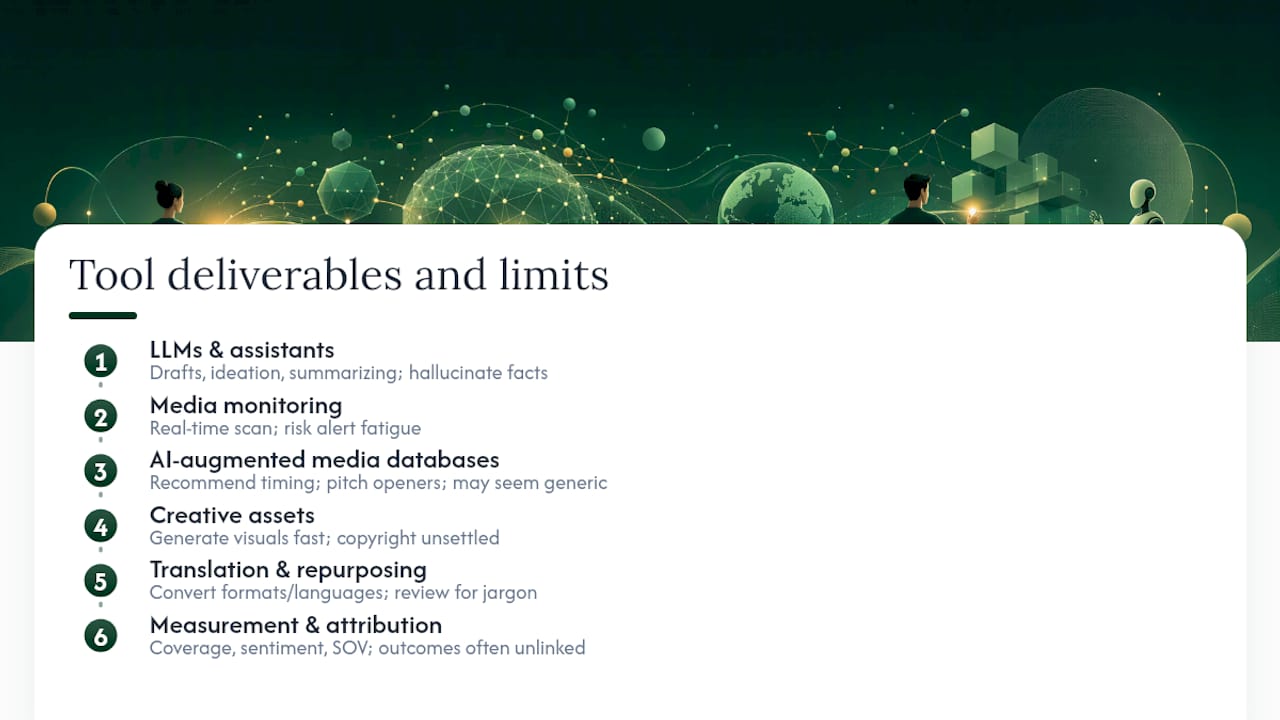
Media monitoring and social listening platforms scan news, blogs, broadcast transcripts, and social channels in real time. Vendor research from Meltwater, citing a Forrester Total Economic Impact study, claims teams using AI-enabled monitoring features saved a significant portion of their time on coverage analysis. Treat that figure as a directional benchmark from a vendor source, not a guaranteed outcome. The failure mode here is alert fatigue: poorly configured queries flood inboxes with irrelevant mentions. Use case: set a Boolean query around a client’s brand, key executives, and three competitors, then route alerts to a shared Slack channel with severity tags.
Media databases with AI augmentation (tools that layer AI onto journalist contact records) recommend outreach timing, flag which reporters recently covered adjacent topics, and generate personalized pitch openers. Platforms like CisionOne AI describe features that summarize coverage, recommend timing, and generate outreach drafts to increase pitch relevance. The limitation: AI-generated personalization still reads generic when the prompt is lazy. A human who actually reads the journalist’s last three pieces will always outperform a templated opener.
Creative asset generation tools (Midjourney, Adobe Firefly, DALL-E) produce visual concepts, social graphics, and presentation imagery quickly. Copyright ownership of AI-generated images remains legally unsettled in the US, so confirm your organization’s policy before publishing AI-created visuals externally.
Translation and content repurposing tools (DeepL, Notion AI, specialized repurposing workflows) convert a long-form press release into social snippets, a podcast summary into a byline, or English copy into Spanish for a bilingual campaign. Quality degrades on industry-specific terminology, so a native-language reviewer is non-negotiable for any external content.
Measurement and attribution platforms pull coverage data, sentiment scores, and share-of-voice metrics into dashboards automatically. The gap most teams hit: connecting earned media coverage to downstream business outcomes (pipeline, revenue) still requires a clean UTM structure and coordination with the marketing or analytics team.
Pro Tip: Before evaluating any AI tool, write down the specific workflow problem you want to solve and the metric you will use to judge success. Vendors will always show you the best-case demo; your written criteria keep the evaluation honest.
Your step-by-step checklist for piloting AI in a PR workflow
A structured pilot protects your team from committing budget and process changes to a tool that does not fit. Follow these steps in order.
-
Define scope. Choose one campaign, one tool category, and a four-week window. Do not pilot three tools simultaneously; you will not be able to isolate what worked.
-
Complete a data and privacy checklist. Identify what data the tool will process (journalist contact lists, client briefs, monitoring feeds). Confirm the vendor’s data retention and processing terms comply with your organization’s privacy policy and any applicable US state privacy laws (CCPA if California data is involved).
-
Set human-in-the-loop rules in writing. No AI output goes external without a named human approver. IPRA’s Gold Paper is explicit: practitioners must maintain decisive control over AI outputs and never allow AI to send pitches or direct outreach without human approval.
-
Assign roles. The table below shows a minimal governance structure for a pilot team.
| Role | Responsibility |
|---|---|
| PR Lead | Approves all AI-drafted external content before send |
| AI Tool Owner | Manages platform access, prompt library, and vendor relationship |
| Data/Privacy Contact | Reviews vendor terms; flags any confidential data exposure risk |
| Measurement Owner | Tracks pilot KPIs weekly and compiles the go/no-go report |
-
Build a prompt library. Start with three templates:
- Media list generation: “Generate a list of 10 US technology journalists who have covered [topic] in the last 90 days. Include their publication, recent article title, and a one-sentence note on their angle.”
- Pitch draft: “Write a 150-word pitch email for [journalist name] at [publication] about [story angle]. Reference their recent piece on [topic]. Tone: direct, no jargon.”
- Monitoring query: “Set up a Boolean query to track mentions of [brand], [CEO name], and [product name] across news and social, excluding job postings and stock tickers.”
-
Set go/no-go criteria. At week four, evaluate: Did the tool save measurable time? Did output quality meet the team’s standard after human review? Did any data privacy or hallucination issues arise? If two of three criteria pass, proceed to a broader rollout.
-
Budget and timeline. Most SaaS AI tools for PR run on monthly subscriptions. Pilot costs vary widely by platform tier; confirm pricing directly with vendors. Allocate two to four hours per week for a team member to manage prompts, review outputs, and log issues.
Pro Tip: Log every hallucination or factual error the AI produces during the pilot. That error log becomes your governance exhibit and your training document for the team.
Concrete PR use cases: before and after AI
Media relations and personalized pitching. Before AI: a publicist spends 45 minutes researching a journalist, drafting a pitch, and personalizing the opener. After AI: the research and first draft take eight minutes; the publicist spends the remaining time refining tone and adding a detail only a human would notice (a reference to the journalist’s recent panel appearance, for example. The human layer is what makes the pitch land.
Crisis detection and triage. A brand mention spikes overnight. Before AI: the team finds out at 9 AM when someone checks Google News. After AI: a monitoring alert fires at 2 AM with a severity tag, giving the communications director time to prepare a holding statement before the story gains traction. The AI flags; the human decides whether to act and what to say.

Content repurposing at scale. A 2,000-word white paper becomes five LinkedIn posts, a press release, and a podcast talking-points document in under an hour using a generative assistant. A human editor reviews each piece for accuracy and brand voice before publication.
Executive briefings. AI summarizes overnight coverage, competitor announcements, and analyst commentary into a two-page brief. The communications team reviews, adds context, and delivers it to the executive by 8 AM. Without AI, that brief took two hours to compile.
Measurement automation. Instead of manually pulling coverage reports from three platforms into a spreadsheet, an AI-enabled dashboard aggregates sentiment, reach, and share-of-voice data automatically. The measurement owner spends time interpreting trends rather than copying numbers.
- Always have a human read the final AI-generated brief before it reaches an executive or a journalist.
- Never let AI auto-send outreach. One factual error in a mass pitch can damage journalist relationships that took years to build.
- Use AI repurposing tools to extend the life of existing content, not to replace original reporting or expert commentary.
Ethics, legal, and risk checklist for US PR teams using AI
The ethical stance is straightforward: use AI to work faster and smarter, but keep human accountability at every external touchpoint and be transparent about AI’s role. That is not a soft principle; it is a practical risk-reduction strategy.
Work through this checklist before any AI tool goes live on a client account:
- Hallucination checks: Verify every factual claim, statistic, and attribution in AI-generated content against a primary source. AI models confidently produce false information.
- Bias review: AI models trained on historical data can reflect demographic and cultural biases. Review AI-generated media lists and messaging for unintentional skew.
- Copyright: Do not publish AI-generated text or images without reviewing your vendor’s terms on IP ownership. For images, US copyright law currently does not protect purely AI-generated works without meaningful human authorship.
- Data privacy: Never paste confidential client information, unpublished financial data, or personal data into a public AI tool. Use enterprise-tier tools with data isolation agreements.
- Disclosure: The FTC expects transparency when AI materially shapes consumer-facing content. For PR content that reaches consumers (sponsored content, influencer posts, branded articles), disclose AI involvement consistent with FTC guidance. For B2B pitches and press releases, industry norms are still forming, but transparency with clients about AI use is good practice.
- Confidential data exposure: Treat your AI tool’s input field the same way you treat email: assume it could be read by someone outside your organization unless you have a signed data processing agreement.
IPRA’s ethical standards recommend upskilling staff, building practical toolkits, and applying ethics-first standards in AI adoption. Practically, that means training every team member who touches an AI tool on these checklist items before they start using it.
Metrics and a simple dashboard for measuring AI-driven PR value
You cannot justify AI investment without a baseline. Before the pilot starts, record your current numbers for each metric below.
Core metrics to track:
- Time saved: Hours per week spent on drafting, research, and monitoring before vs. after AI
- Coverage volume: Number of earned placements per month
- Coverage quality: Tier-1 outlet percentage, message pull-through rate
- Journalist response rate: Replies per pitch sent (track by campaign)
- Share of voice: Brand mentions as a percentage of total category mentions
- Sentiment trend: Positive/neutral/negative ratio across monitored channels
- Conversion attribution: UTM-tagged traffic from earned media to website (requires coordination with marketing)
Setting baselines and running comparisons. Pull four to eight weeks of pre-pilot data for each metric. After the pilot, compare the same metrics over the same duration. For pitching, run an A/B comparison: send AI-drafted pitches (human-reviewed) to one half of a media list and manually written pitches to the other, then compare response rates.
Sample dashboard fields:
| Metric | Data Source | Cadence | Owner |
|---|---|---|---|
| Time saved (hours/week) | Team time log | Weekly | AI Tool Owner |
| Coverage volume | Monitoring platform | Monthly | Measurement Owner |
| Journalist response rate | Email platform | Per campaign | PR Lead |
| Share of voice | Monitoring platform | Monthly | Measurement Owner |
| Sentiment trend | Monitoring platform | Weekly | PR Lead |
| UTM-tagged earned traffic | Google Analytics | Monthly | Marketing/PR joint |
For teams connecting PR to broader AI-driven marketing ROI, aligning these metrics with the marketing team’s attribution model from the start saves significant reconciliation work later.
What research and industry bodies recommend
The consensus across USC Annenberg, IPRA, PRSA, and peer-reviewed scholarship is consistent: adopt AI early, keep human oversight at every external touchpoint, prioritize ethics and measurement, and treat AI as augmented intelligence rather than autonomous decision-making.
Three research-backed recommendations translate directly to practice:
Predictive content creation. USC Annenberg’s analysis finds that AI can identify story angles likely to resonate by analyzing audience preferences and real-time behavioral data. Gary Brotman at USC Annenberg argues the future of media relations is AI-driven predictive content creation. For practitioners, this means using AI monitoring data to inform editorial calendars, not just react to coverage.
Participatory PR over full delegation. A peer-reviewed analysis in Journalism Practice cautions that many guides focus narrowly on efficiency and argues for a participatory approach that preserves human engagement and professional judgment. The argument: if AI handles all the relationship-building signals (personalization, timing, tone), the human connection that makes PR work disappears.
High-tech, high-touch governance. IPRA’s position is a “high-tech, high-touch” posture: adopt AI early but keep decisive human control, disclose AI use, protect confidential data, and establish standards aligned with the industry.
An editorial perspective on AI in PR workflows
The most common mistake PR teams make with AI is treating it as a content machine rather than a research and drafting accelerator.
A well-structured pilot looks like this: one communicator, one tool, one campaign, four weeks. Track time saved on drafting and research. Log every error the AI produces. At week four, the error log and the time-savings number together tell you whether the tool earns a broader role. Teams that skip the error log often scale a tool that is quietly producing inaccurate content, which surfaces as a credibility problem months later.
The participatory PR argument from academic research resonates in practice. Journalists notice when a pitch was clearly generated by a model with no human fingerprint on it. The teams that use AI most effectively are the ones where the communicator’s voice still comes through in the final pitch, the final release, the final brief. AI gets you to a draft faster; the human is what makes it worth reading.
Storylinepros helps you turn AI strategy into measurable visibility
If the checklist in this article describes where you want to go but your team lacks the bandwidth or the technical infrastructure to get there, Storylinepros offers a direct alternative to building it from scratch. Rather than a traditional retainer with no guaranteed output, Storylinepros runs success-based visibility campaigns billed per delivered placement, podcast appearance, or syndicated piece, with attribution tracked through proprietary technology.

For startups that need to show up in AI-generated search results and earn citations in trusted media outlets, the Storylinepros model compresses the timeline significantly. You get earned media placements, Reddit community amplification, AI search optimization, and programmatic news syndication without hiring a full in-house PR team or committing to a long-term agency contract. Review the Storylinepros case studies to see how past clients translated media placements into investor conversations and customer conversions, then start a conversation about a pilot engagement.
Sources
- AI in PR: Reflection, reality and relevance
- ETHICAL STANDARDS AND GUIDELINES FOR THE USE OF ARTIFICIAL INTELLIGENCE IN PUBLIC RELATIONS
- Examining proposed generative AI integrations in public relations: Offering participatory (AI) public relations
- Creative Collaborators: How AI Is Driving PR Innovation