
Brand Mentions SEO: Turn Every Reference Into an AI Citation
A brand mention is any online reference to your company. Not just links. Google’s parser, and every large language model built after it, now reads unlinked mentions, implied references, and AI citations as trust signals too. Here’s what to do about it, in three moves:
- Set up monitoring across news, social, forums, and AI outputs (not just backlink trackers).
- Prioritize high-impact channels where corroborated, context-rich mentions actually shape entity signals.
- Reach out to convert loose mentions into links, schema, or structured citations before a competitor does.
Copy that checklist into your next sprint board. Everything below explains why it works and how to run it.
Key Takeaways
Brand mentions now function as both an SEO signal and an AI-citation input, and teams that monitor and convert them systematically outperform those that only track backlinks.
| Point | Details |
|---|---|
| Track all four mention types | Monitor linked, unlinked, implied, and AI-cited mentions, not just backlinks. |
| Layer your monitoring stack | Combine Google Alerts, a listening tool, an SEO suite, and an AI-visibility tool like Yoast AI Brand Insights. |
| Convert mentions within a week | Send link-reclamation outreach quickly, since response rates drop the longer you wait. |
| Anchor entity signals with schema | Add Organization and Person schema before mention volume accumulates, so models attribute mentions correctly. |
| Consider a done-for-you partner | Storylinepros builds earned placements and tracks AI-citation lift for brands that need this run externally. |
Table of Contents
- What Counts as a Brand Mention for SEO
- How Search Engines and AI Models Actually Read Your Mentions
- Where Brand Mentions Show Up Online
- Setting Up a Monitoring Stack You’ll Actually Use
- Tactics That Actually Earn Brand Mentions
- Turning Mentions Into Links, Citations, and Schema
- Measuring What Mentions Actually Do for You
- Running Mention Monitoring as a Monthly Operation
- Handling Risk: Negative Mentions and Ethical Gray Areas
- How Storylinepros Builds Mentions That Earn AI Citations
- Why Brand Mentions Stopped Being a PR Afterthought
- Become the Brand AI Recommends by Name
- Frequently Asked Questions
- Sources
What Counts as a Brand Mention for SEO
Search Engine Land defines four flavors of brand mention that matter for SEO and entity building, and most marketing teams only track one of them.
- Linked mention — your brand name with a hyperlink back to your site. The classic link-building target.
- Unlinked mention — your brand named in text with no link. Google’s algorithms have been able to parse these as ranking signals for years.
- Implied mention — a reference to your product or founder without stating the brand name directly (a screenshot, a described feature, a quoted stat attributed loosely).
- AI mention or citation — a large language model names your domain or content as its source inside a generated answer.
That last category is the one changing the game. AI citations behave less like a backlink and more like a direct discovery channel, according to HubSpot’s analysis of AI and answer engine optimization — a model recommends you by name inside a ChatGPT or Perplexity response, with no click required for the reader to trust the mention.
Think of it as three concentric layers: backlinks build authority slowly and directly measurably; brand mentions build entity recognition broadly; AI citations convert that recognition into direct visibility inside the answer itself. Brands sitting in the top quartile for online mentions show up in AI-generated reviews roughly 10 times more often than brands with sparse mention histories, per Brand24’s research.
Pro Tip: Start monitoring the channel where your competitors already dominate coverage. That’s the fastest place to spot mention gaps you can close in 30 days, not 12 months.
How Search Engines and AI Models Actually Read Your Mentions
Google’s knowledge graph and modern LLMs don’t just count how many times your brand appears online. They build an entity profile from where you’re mentioned, how consistently your name and description repeat across independent domains, and whether those domains carry their own credibility.
A single vague reference on a low-authority forum barely registers. A mention in an industry publication that describes what you actually do, paired with three similar mentions elsewhere using the same description, starts to corroborate an entity. That corroboration is what both traditional ranking systems and AI retrieval systems lean on.
The mechanics diverge in one important way. Backlinks still move the needle for classic ranking signals through link equity and anchor context. AI inclusion runs on a different logic: it favors corroborated mentions across trusted domains, clean structured data, and content a model can extract cleanly. Yoast’s guidance on AI citations makes this explicit. Clear author bylines, Organization and Article schema, and declarative opening answers all raise the odds a model cites you over a competitor with more raw mention volume but messier structure.
Picture two outcomes side by side. A backlink from a mid-tier blog sends measurable referral traffic and a small ranking bump. An AI citation inside a Perplexity answer sends zero clicks but puts your brand name directly in front of someone actively evaluating options; no click, but the trust transfer already happened. Both matter. They just get measured differently, and most teams still only have a dashboard for the first one.
- Entity signals compound across independent domains, not repeated mentions on one site.
- Structured data anchors ambiguous mentions to the correct entity before volume arrives.
- AI systems reward extractable content: short paragraphs, named sections, answers stated up front.
Pro Tip: If you have to choose between fixing your schema markup and chasing ten more low-quality mentions this month, fix the schema. Structural clarity outperforms volume for AI inclusion.
Where Brand Mentions Show Up Online
Mentions cluster in predictable places, and each one carries different weight for entity building versus straight referral traffic.
- News and trade press — high corroboration value; these domains already carry trust that transfers to your entity.
- Blogs and vertical publications — strong when topically relevant; a single mention in the right niche outlet can outweigh a dozen generic ones.
- Forums and communities (Reddit, niche Discords) — increasingly pulled into AI training and retrieval, even when the individual post carries little SEO authority on its own.
- Review sites — corroborating third-party evidence that LLMs treat as a credibility check, not just a conversion tool.
- Podcasts — transcript-based mentions are now indexable and citable, and they’re underused by most teams.
- Social platforms — LinkedIn long-form posts in particular are showing up as sources inside AI answers more often than a year ago.
Prioritize by impact versus effort: trade press and niche vertical outlets first, review platforms second, forums and podcasts third if you have the bandwidth.
Setting Up a Monitoring Stack You’ll Actually Use
Mention monitoring fails most often because teams pick one tool and expect it to cover every channel; a combined approach like AI Online Reputation Management for Local Businesses offers mention detection and automated response across platforms. It won’t. You need at least three types working together: a free baseline alert, a dedicated listening platform, and an SEO suite that tracks the authority side.
The stack, tool by tool:
- Google Alerts — free, catches basic web mentions of your exact brand name and product names. Weak on social and forums, but zero cost and worth running as a baseline.
- Mention or Brandwatch — dedicated social listening that catches conversations Google Alerts misses, with sentiment tagging built in.
- Semrush or Ahrefs — track the SEO side: which mentions sit on domains with real authority, and which unlinked mentions are worth a link-reclamation email.
- BuzzSumo — surfaces which content formats and topics are already earning shares and mentions in your space, useful for planning what to pitch next.
- Yoast AI Brand Insights — purpose-built for tracking how often and where your brand surfaces inside AI-generated answers, filling the gap none of the above cover.
Set up alerts for your exact brand name, common misspellings, product names, and founder names. Add branded phrase variations you expect in AI prompts (“best [category] tool,” “alternatives to [competitor]”) so you catch AI-surfaced mentions, not just direct-name references.
For each mention that lands, capture five fields: source type, a rough domain authority proxy, sentiment, whether it’s linked or link-worthy, and whether it shows AI-citation relevance. That fifth field is the one most spreadsheets are still missing.
- Google Alerts for baseline coverage, free and always running.
- A dedicated listening tool for social and forum conversations Alerts can’t reach.
- An SEO suite to score which mentions sit on domains worth chasing for links.
- An AI-visibility tool to close the gap traditional monitoring leaves open.
Pro Tip: Run your monitoring stack for two weeks before building any dashboard. You’ll spot noise (false-positive matches on common words in your brand name) that would otherwise pollute every metric downstream.
Tactics That Actually Earn Brand Mentions
Earning mentions is less about volume and more about picking the tactic that fits the channel you’re targeting. A single context-rich mention in a relevant vertical publication tends to do more entity-building work than a dozen low-quality directory listings.
Five tactics worth running, roughly in order of speed to first result:
- Digital PR pitches tied to news hooks — fastest turnaround, works best when tied to funding news, product launches, or industry data you can offer exclusively.
- Original research or data reports — slower to produce, but journalists cite them repeatedly over months, generating compounding mentions.
- Community seeding on Reddit and niche forums — genuine participation, not drive-by promotion, earns mentions that increasingly feed AI training data.
- Partnership and co-marketing mentions — cross-promote with adjacent (non-competing) brands for mutual entity reinforcement.
- Podcast guest appearances — a single well-placed interview generates a transcript that search engines and LLMs can both index and cite.
A usable pitch subject line: “Data on [trend] your readers haven’t seen yet.” A community prompt for user-generated mentions: ask happy customers to describe their specific results, not just leave a star rating. A podcast pitch hook: lead with a contrarian claim about your industry, not a company bio.
Combine tactics instead of running them in isolation. Digital PR earns the initial press mention; community seeding extends its life in forums; a product moment (a feature launch, a milestone) gives you a second news hook a month later. That layering is what produces compounding mentions instead of one spike that fades in a week.
Pro Tip: Micro-influencers with genuinely engaged, niche audiences often outperform larger accounts for entity building. A tightly relevant mention from someone with 8,000 followers can corroborate your entity better than a vague shoutout from someone with 800,000.
Turning Mentions Into Links, Citations, and Schema
An unlinked mention is unfinished business, not a lost cause. Semrush’s guidance on brand mention tracking recommends pairing monitoring with active outreach, since most unlinked mentions convert into links when someone simply asks.
The outreach template is simple: thank the author for the mention, note (briefly) that a link would help readers find you directly, and suggest the anchor text. Send it within a week of the mention appearing; response rates drop fast after that.
Not every mention needs a link, though. A mention on a highly authoritative but link-shy publication (some major news outlets won’t add outbound links) still corroborates your entity even unlinked. Save your outreach effort for mid-authority sites where a link is a realistic ask.
Beyond links, structured signals matter just as much:
- Organization and Person schema on your own site, anchoring your entity before mentions accumulate elsewhere.
- Wikipedia or Wikidata alignment where eligible, which many knowledge graphs treat as a primary reference point.
- Consistent NAP (name, address, phone) and “sameAs” links across every profile, directory, and local citation listing.
Pro Tip: When pitching a link, frame it as a reader benefit, not an SEO favor: “your readers might want a direct way to check pricing” lands better than “could you add a link back to us?”
Measuring What Mentions Actually Do for You
Track five core numbers: mention volume, share of voice against named competitors, sentiment split, referral traffic from linked mentions, and AI-citation counts. That last metric is the one most dashboards still lack entirely, and it’s the one growing fastest in importance.
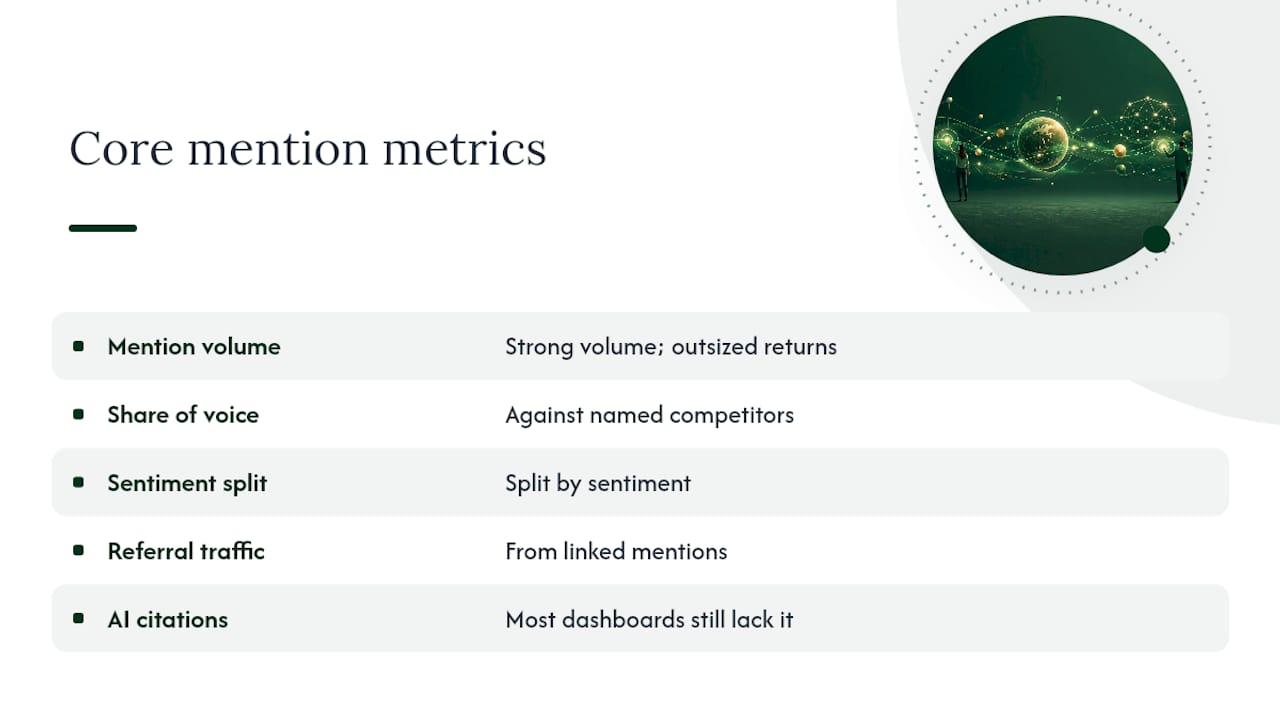
Attribution here isn’t single-touch. A mention rarely drives a direct conversion the same day; it works more like an assisted-visibility signal, showing up days or weeks before someone searches your brand name directly (a branded-search lift worth watching in its own right). Brands with strong mention volume see outsized returns here: that top-quartile cohort appearing 10 times more often in AI reviews isn’t a coincidence of luck. It’s a function of sustained, corroborated coverage.
Build your dashboard with these fields per mention: source, domain authority proxy, sentiment, link status, and a yes/no for AI citation presence. That last column is what separates a modern mention-tracking sheet from one built two years ago.
Running Mention Monitoring as a Monthly Operation
Assign clear ownership before you assign tools. A workable structure: one marketing lead owns the dashboard, PR handles outreach and pitch responses, SEO handles link reclamation and schema, and a community manager handles forum and social replies.
Cadence that holds up in practice:
- Daily — scan alerts for anything urgent (a viral mention, a negative spike) that needs same-day response.
- Weekly — triage the week’s mentions into buckets: link-worthy, schema-relevant, or no action needed.
- Monthly — run an outreach sprint on the accumulated link-worthy backlog.
- Quarterly — review which channels and tactics produced the highest-value mentions, and reallocate effort accordingly.
For high-impact mentions (a major outlet, a viral negative post), set a response SLA: PR reviews within four hours, legal gets looped in within 24 hours if the mention involves a factual dispute or claim.
Handling Risk: Negative Mentions and Ethical Gray Areas
Pay-for-mention arrangements without disclosure, astroturfed reviews, and scraping practices that ignore privacy law are the three traps that do the most damage. Each one can boomerang into a credibility problem that’s harder to fix than the mention gap you started with.
- Never buy mentions without disclosure; both search engines and readers penalize discovered pay-for-play patterns.
- Avoid astroturfing (fake grassroots mentions); misattributed enthusiasm reads as manufactured the moment someone checks.
- Loop in legal or PR before responding publicly to a negative mention that touches a factual or safety claim.
- For a genuinely damaging mention, request a correction first, and only escalate publicly if that fails.
How Storylinepros Builds Mentions That Earn AI Citations
The workflow runs in four stages: research the entity gaps a brand has in AI-generated answers, secure earned media placements that fill those gaps with credible third-party coverage, seed relevant communities to extend the mention’s life, and track which placements actually surface as AI citations afterward.
Storylinepros’s case studies illustrate the pattern: a cluster of earned placements across trusted outlets, followed by a measurable lift in how often the brand appears when AI tools are asked about that category.
If you’re evaluating an outside partner for this work, ask three questions: How do you measure AI-citation lift specifically, not just mention volume? What’s your placement-to-citation conversion rate on past clients? And do you track outcomes past the placement date, or stop once the piece runs?
Why Brand Mentions Stopped Being a PR Afterthought
Five years ago, a brand mention without a link was a PR vanity metric, tracked for ego, not for pipeline. That calculus broke the moment AI models started answering questions directly instead of handing back ten blue links. Now the operational playbook above, monitoring stack, outreach cadence, and structured signals, is table stakes for anyone trying to be the name a model says out loud.
Become the Brand AI Recommends by Name
Running the monitoring stack and outreach templates above takes real hours: research, pitching, tracking, repeat. Storylinepros exists for founders who need those earned placements and AI-citation results without building the operation in house. The firm handles the research-to-placement workflow directly, targeting the outlets and communities most likely to surface your brand inside AI-generated answers, not just traditional search results.

What you get: media placements in outlets your investors and customers already trust, ongoing AI-citation tracking so you know when your brand starts showing up in model responses, and clear KPIs tied to visibility lift rather than vague “brand awareness” reporting. Storylinepros bills for delivered results, not a monthly retainer with no guarantee attached.
Check the case studies page for examples of placement volume and citation lift, then reach out through the Storylinepros site to scope a pilot campaign.
Frequently Asked Questions
What’s the difference between a brand mention and a citation for SEO? A brand mention is any reference to your company, linked or not. A citation for SEO traditionally meant a local directory listing (name, address, phone), while an AI citation means a model like ChatGPT names your domain as its source inside a generated answer.
Do unlinked brand mentions actually help SEO? Yes. Google’s systems have parsed unlinked mentions as entity signals for years, and they also feed the corroboration that AI models use to decide who to cite.
How often should I check my brand mention monitoring? Daily for urgent alerts, weekly for triage, and monthly for outreach sprints, based on the cadence most teams can sustain without burning out on manual review.
Can Google Alerts replace a paid social listening tool? No. Google Alerts catches basic web mentions but misses most social and forum conversations, which is exactly where paid tools like Mention or Brandwatch add value.
How do I know if a mention is helping my AI visibility, not just traditional SEO? Track it with a dedicated AI-visibility tool such as Yoast AI Brand Insights, and log whether the source domain is one that AI models tend to cite, which you’ll start to notice once you review citation patterns over a few months.
Sources
- Brand mentions and SEO: What they are and why they matter — Search Engine Land
- Brand mentions and SEO & AI visibility — Brand24
- Brand mentions: complete guide to tracking, measuring & optimizing — Semrush
- AI citations explained — Yoast