

What a PR Case Study Actually Teaches You
A PR case study is a documented account of what an organization did, why it did it, and what measurable result followed. Use it as a template for three things: strategy design, crisis-response playbooks, and proof that a tactic actually moved a number. Not every write-up deserves your trust, though. Before you build a lesson plan around one, check for two signals:
- Clear metrics. Look for named KPIs (share of voice, earned media value, conversions) instead of vague claims like “significant buzz.”
- An explicit timeline. Strong case studies show the sequence of activations, not just the final outcome.
Key Takeaways
The most reliable PR case studies pair a named metric with an explicit timeline, and readers who skip that check end up copying tactics without knowing why they worked.
| Point | Details |
|---|---|
| Definition first | A PR case study documents what happened, why, and what measurable result followed, useful for strategy and crisis templates. |
| Trust the metrics, not the adjectives | Prioritize write-ups with named KPIs like share of voice or conversions over vague claims of buzz or attention. |
| Use the five-part framework | Read every case study for objective, insight, idea, activation, and measurement to judge quality of evidence. |
| Triangulate earned media value | EMV is an estimate, so cross-check it against share of voice or an actual business metric before trusting the headline figure. |
| Storylinepros tracks AI-era metrics | Storylinepros applies the same checklist to placements and podcast spots, adding AI citation tracking most legacy PR reporting skips. |
Table of Contents
- Why Case Study PR Analysis Matters for Strategy
- Where to Find Reliable Public Relations Case Studies
- How to Read and Analyze a PR Case Study
- Common Metrics in PR Case Studies and How to Read Them
- Three Case Studies and the Tactical Lessons They Teach
- How Storyline Pros Builds a Case Study: An AI-First Playbook
- Written Reports vs. Video vs. Interactive Case Studies
- What the Case Studies Actually Teach Us
- Get Measurable PR Outcomes Instead of a Retainer Bill
- Frequently Asked Questions
- Sources
Why Case Study PR Analysis Matters for Strategy
A well-documented case study pr professionals can study functions like a lab report: it shows the hypothesis, the intervention, and the result. That makes it useful for building strategy templates, stress-testing crisis playbooks before you need one, and learning how practitioners actually define success rather than how they describe it in a pitch deck.
The value has limits. Two mistakes show up constantly:
- Over-attribution. Crediting a sales spike entirely to PR when paid media, seasonality, or product changes ran alongside it.
- Mistaking attention for impact. A viral moment with no sales, signup, or policy change attached is a reach story, not a business story.
Replicate tactics when the context matches (same category pressure, similar audience behavior). Adapt them everywhere else.
Pro Tip: If a case study doesn’t mention what didn’t work, assume the write-up was built for an awards submission, not for your education.
Where to Find Reliable Public Relations Case Studies
Not all sources are equal. Some archives run promotional summaries; others require named metrics before publishing. Start with these:
- University research guides. Temple University’s public relations guide links library databases and academic collections that filter out marketing fluff.
- Award archives. PRSA’s Silver Anvil case studies are long-form and vetted by judges who ask for evidence, not adjectives.
- Trade coverage. PRWeek’s campaign case studies track current work with tactical detail you won’t find in a retrospective.
- Industry association archives. PR Council’s member case studies span industries and show how agencies frame measurable impact for clients.
Filter your search by award category, industry tag, and publication year, then add a measurement keyword (“share of voice,” “earned media value”) to skip the fluff pieces entirely.
How to Read and Analyze a PR Case Study
Most solid case studies follow a five-part shape: objective, insight, idea, activation, measurement. Read each part with a specific question in mind.
- Objective. What business or reputational problem was this solving, and for whom?
- Insight. What did the team know about the audience or moment that competitors missed?
- Idea. Is the creative concept the direct answer to that insight, or is it generic dressed up as clever?
- Activation. What actually happened, in what order, across how many days or markets?
- Measurement. What was counted, and does the metric match the original objective?
Then run three diagnostics on the claims themselves. Watch for causal language (“drove,” “caused”) without a control or comparison period. Check the sample and context, since a result from one market rarely holds everywhere. And note the time horizon: a one-week spike is a different story than a change sustained over a quarter.
Strong write-ups also show governance. Look for mentions of legal or executive sign-off, pre-agreed boundaries for risky creative moves, or a named crisis-response chain. Their absence usually means the team got lucky rather than planned well.
Pro Tip: If a case study skips the measurement section entirely, treat every other claim in it as marketing copy.
Common Metrics in PR Case Studies and How to Read Them
Case studies lean on a handful of recurring KPIs. Each one tells you something different, and each one can be misread if you take it at face value.
- Earned media value (EMV): an estimated dollar figure for coverage, based on ad-rate equivalents. Treat it as directional, never exact, since multiple studies show EMV calculations vary widely by vendor using different multipliers.
- Share of voice: the brand’s percentage of category conversation during a defined window. Useful for comparing to competitors, less useful for proving sales impact.
- Impressions: raw potential audience size. High impressions with flat sentiment usually means noise, not persuasion.
- Sentiment: the tone of coverage and social mentions. A sentiment shift that holds for months signals real reputation change; one that spikes and fades in a week signals a news cycle, not a shift.
- Conversions: signups, purchases, or policy actions tied directly to the campaign. This is the metric that separates attention from outcome.
EMV numbers deserve extra skepticism because they’re estimates built on assumptions the case study rarely discloses. Triangulate them against share of voice and, where possible, an actual business metric like revenue or signups before you accept the headline figure.
Three Case Studies and the Tactical Lessons They Teach
Three recent campaigns show the framework in action, each with a different lesson attached.
KitKat’s “heist” response turned what could have been a defensive crisis into a participation mechanic, reportedly generating a sizable share of voice across multiple markets and a very large amount of earned media within a short time, according to LBBOnline’s analysis of the campaign’s Cannes Lions Grand Prix win. Read the share-of-voice figure with some caution since it’s a single-source estimate, but the tactical lesson holds regardless of the exact number: speed and public participation beat a defensive statement.
Cross-functional teams that pre-agree risk boundaries can move fast on bold creative without losing control of the narrative. Teams without that alignment default to containment instead of opportunity.
PENNY’s “Sheep Happens” campaign shows the same principle applied to an unplanned local incident. Instead of managing the story defensively, the brand invited public participation, which LBBOnline reports turned a rural moment into global cultural coverage with measurable revenue uplift in localized markets.
- Lesson: giving an audience a simple, specific job to do concentrates conversation around your framing instead of the incident itself.
A search-focused digital PR campaign documented by Diggity Marketing reported a very large revenue increase alongside hundreds of press placements, built entirely on data-led content designed for editorial pickup and search visibility. The lesson here is different from the other two: PR built for search and AI citation, not just human editors, can compound its own reach long after the initial launch window.
How Storyline Pros Builds a Case Study: An AI-First Playbook
Storylinepros applies the same objective-to-measurement checklist covered above, but built around a proprietary technical layer designed for AI search visibility rather than traditional print pickup alone. The focus sits on earned media placements, podcast guest spots, and community amplification that a language model can actually cite back to a founder or company.
Deliverables get tracked the way this article recommends you evaluate any case study:
- Named placements across trusted outlets, not just “coverage secured.”
- AI citation tracking, showing where a brand shows up in generated search answers.
- Visibility signals mapped over time, not a single point-in-time snapshot.
Full examples of this measurement approach sit in Storylinepros’s own case study archive, built to survive the same causal-language and time-horizon scrutiny outlined earlier in this piece.
Pro Tip: When you evaluate any agency’s case study, ask specifically whether they track AI citations. Most legacy PR reporting still stops at impressions and clip counts, which tells you little about how a startup shows up in an investor’s ChatGPT query.
Written Reports vs. Video vs. Interactive Case Studies
Format changes what a case study can prove and how fast you can extract the lesson. A written report, still the dominant format across trade sites and award archives, gives you the most detail per minute of reading: full timelines, named metrics, and quoted strategy rationale. It’s the best format for the checklist approach covered earlier, since you can scan for causal language and measurement gaps at your own pace.
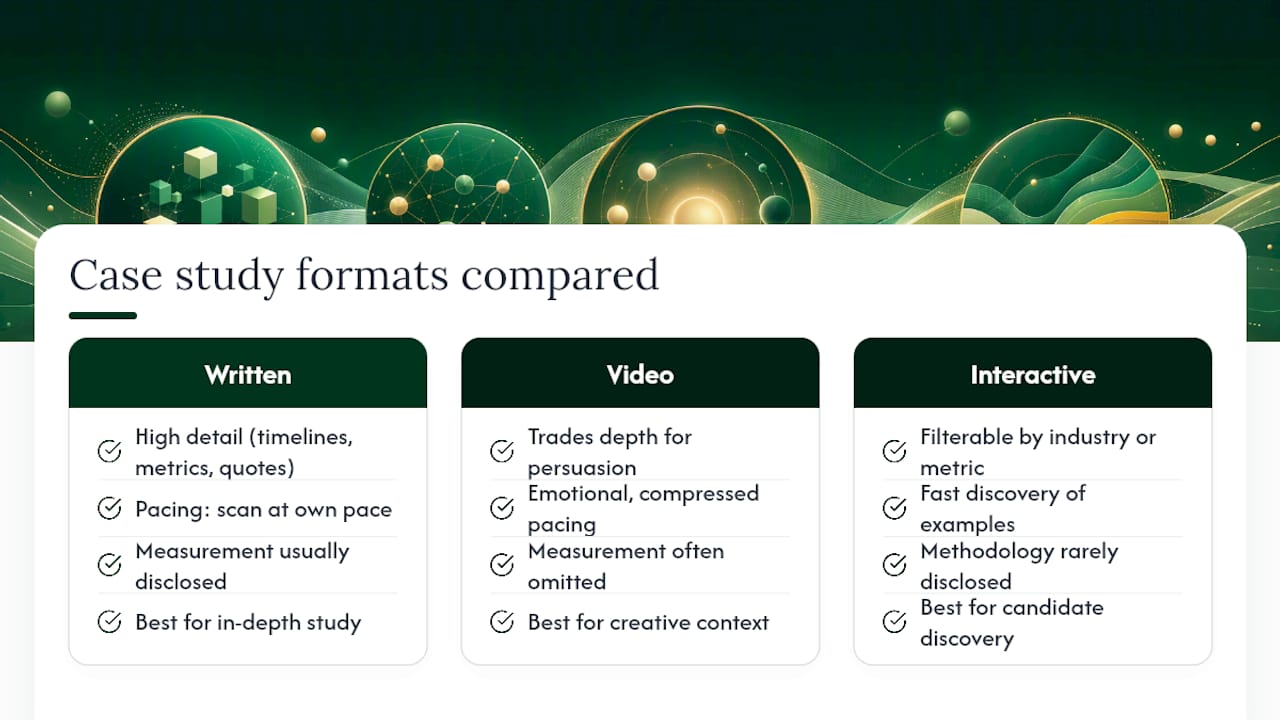
Video presentations, common at award shows like Cannes Lions, trade depth for persuasion. They’re built to sell a creative idea to a room of judges or clients, so they lean on emotional pacing and often compress or skip the measurement section entirely. Treat a video case study as a trailer for the real write-up, not the write-up itself, and look for a companion PDF or trade article with the actual numbers.
Interactive case studies, usually hosted on an agency’s own site, let you filter by industry or metric type but rarely disclose methodology behind their dashboards. They’re useful for finding examples fast, weaker for verifying claims, since the same page that shows you the result usually built the chart that supports it.
If you’re studying a campaign seriously, pull the written version first, watch the video for context on the creative idea, and use interactive tools only to discover candidates worth deeper research.
What the Case Studies Actually Teach Us
Most advice about studying PR case studies stops at “read a bunch and take notes.” That’s weak advice. The industry’s best-known examples, KitKat’s heist response and PENNY’s sheep incident among them, get cited constantly for their creative bravery, but the detail that actually matters is duller: pre-agreed governance. Teams that could move fast without losing control had already decided, before the crisis hit, who could approve what and how far the creative could stretch.

That’s the part most students and even some practitioners skip when they study a campaign. They admire the stunt and skip the org chart behind it.
The other gap in conventional case-study reading is treating earned media value and share of voice as settled facts instead of estimates built on assumptions. A number reported in one trade article isn’t audited the way a quarterly earnings statement is. Read it, use it as a directional signal, and stop there.
If you take one thing from this toolkit, prioritize the measurement section over the creative concept. The idea is memorable. The number, and whether it holds up under a causal-language check, is what actually transfers to your next campaign.
Get Measurable PR Outcomes Instead of a Retainer Bill
Most of the case studies above came from agencies working on fixed monthly fees with no guarantee attached to the outcome. Storylinepros works differently: campaigns are built around delivered placements, podcast spots, and tracked AI citations, so you’re paying for outcomes you can actually verify against the checklist covered in this article.

That model fits founders and executives at high-growth startups who need visibility with investors and customers now, not a quarterly report explaining why the retainer didn’t move the needle. Storylinepros’s proprietary technical layer targets the exact gap most legacy PR reporting misses: whether your company shows up when an investor or customer asks an AI search engine who to trust in your category. If you want to see how that plays out in practice, review Storylinepros’s own case studies or start a conversation about what a measurable campaign looks like for your company.
Frequently Asked Questions
What is a PR case study used for? A PR case study documents a completed campaign’s objective, tactics, and measurable results, and practitioners use it as a template for strategy, crisis planning, and proving which tactics actually move a business metric.
Where can I find real public relations case studies? Start with Temple University’s research guide, PRSA’s Silver Anvil archive, PRWeek’s campaign coverage, and PR Council’s member case studies for vetted, metric-backed write-ups.
How do I know if a case study’s results are credible? Check for named metrics instead of vague claims, look for an explicit timeline of activations, and watch for causal language used without a comparison period or control group.
What’s the difference between earned media value and share of voice? Earned media value estimates a dollar figure for coverage using ad-rate equivalents, while share of voice measures a brand’s percentage of category conversation during a set window. Both are estimates, so treat neither as an exact business result.
Should I copy the tactics from a successful PR case study? Only when the context matches, meaning similar audience behavior and category pressure. Adapt the underlying insight rather than copying the exact activation when your situation differs.
Sources
- Find Case Studies - Public Relations - Research Guides
- How KitKat ‘Heist’s Grand Prix Found PR Greatness in the Real World and in Real Time | LBBOnline
- How Search-Focused Digital PR Drove a 750% Revenue Increase and 300+ Press Placements Case Study