

E-E-A-T for Startups: Why Experience Beats Domain Age
E-E-A-T stands for Experience, Expertise, Authoritativeness, and Trustworthiness, and for a startup with no history, the fastest lever is Experience: publish real first-party proof (a screenshot, a case note, a decision log) under a named, credible author. Improvement isn’t instant. It builds through consistent, weekly publishing over months, not a single overhaul.
TL;DR:
- Prioritize publishing first-party proof, such as screenshots or case notes, to demonstrate real experience that search engines and AI systems can verify.
- Fix basic trust issues immediately, including activating HTTPS, adding a real contact method, and naming authors on every piece of content.
- Focus on building authority through small, consistent outreach efforts like original datasets, guest posting, and industry-specific research reports over several months.
- Use structured schema markups and detailed author bios to make content more understandable and trustworthy for both humans and AI citation systems.
- Avoid overinvesting in volume; instead, concentrate on evidence-based assets that directly prove your experience and expertise to improve rankings and AI recognition.
Table of Contents
- What E-E-A-T Actually Means for Startups
- The Priority Matrix: What to Fix in Week 1, Month 1, and Quarter 1
- Proving Experience Without Overexposing Your Business
- Making Author Signals Machine-Readable
- Earning Authority Through Digital PR and Citable Assets
- Trustworthiness: The Hygiene That Costs You Rankings by Omission
- How E-E-A-T Shapes AI Citations
- Your 30/90/180-Day E-E-A-T Action Plan
- What Actually Moves the Needle (And What Doesn’t)
- Sources
What E-E-A-T Actually Means for Startups
Google’s own guidance treats E-E-A-T less like a scoring formula and more like a trust filter that human raters and AI systems both apply when deciding whether content deserves visibility. The framework never assigns a single ranking number. It shapes how quality raters judge pages, and increasingly, how large language models decide what to cite. That distinction matters for how you spend your time this quarter.
Here’s what each pillar actually looks like when you’re three people in a shared office, not a legacy brand with a Wikipedia page.
Experience means firsthand contact with the problem you’re solving. For a startup, that’s a founder who ran the first 50 customer calls personally, a support log full of real tickets, or a product screenshot showing an actual dashboard instead of a stock mockup. Google added Experience to the E-A-T framework in December 2022 specifically because raters kept struggling to judge whether content came from someone who had actually done the thing they were writing about, versus someone who had simply researched it.
Expertise is domain knowledge, demonstrated through specificity. A generic “5 tips for better onboarding” post shows none. A post that walks through the exact drop-off point in your own onboarding funnel, with the fix you shipped and the retention delta that followed, shows plenty.
Authoritativeness is what other people and other sites say about you. This is the pillar startups struggle with most, because it can’t be self-declared. It has to be earned through citations, mentions, and links from sources that already carry weight.
Trustworthiness covers the boring stuff that quietly disqualifies otherwise good content: no HTTPS, no visible contact page, no author name, unclear sourcing. It’s the pillar most likely to tank an otherwise strong page, and the cheapest to fix.
A few things worth remembering about how this plays out in practice:
- Experience is the one pillar a two-week-old company can demonstrate as convincingly as a ten-year-old one.
- Authoritativeness is the slowest to build and the hardest to fake.
- Trustworthiness failures are binary. Either your contact page exists or it doesn’t.
- All four pillars get evaluated together. A brilliant proof page on a site with no HTTPS still reads as suspicious.
None of this is a checkbox Google runs against your homepage. It’s a lens. The question raters and AI systems are implicitly asking is: would a real person with real experience have written this, and can I verify that?
The Priority Matrix: What to Fix in Week 1, Month 1, and Quarter 1
Startups don’t have six months and a content team. They have a founder, maybe a part-time marketer, and a backlog. Here’s how to sequence the work so early effort compounds instead of scattering.
-
Week 1: fix the trust failures that cost you credibility for free. Confirm HTTPS is active site-wide, add a real phone number or support email to your contact page, and put a named author (not “Team” or “Admin”) on every existing blog post. These take a single afternoon and remove the most obvious reasons a rater or a reader distrusts you.
-
Week 1: publish one proof page. Pick your single strongest piece of evidence, a before/after metric, a customer result, an experiment outcome, and turn it into a standalone page with a screenshot, a date, and a plain-language explanation of what happened.
-
Month 1: write one detailed case note. Not a testimonial quote. A structured account of a specific problem, what you tried, what failed, and what worked, with numbers attached wherever you have them.
-
Month 1: get the founder publishing under their own name. One LinkedIn post or blog entry a week, written from direct experience, does more for Experience signals than five ghostwritten “thought leadership” pieces.
-
Quarter 1: start guest post and digital PR outreach. Identify five publications your customers actually read, and pitch a specific, data-backed angle rather than a generic company introduction.
-
Quarter 1: run one small original research project. Even a survey of 20 to 30 customers produces a statistic nobody else has, which is exactly the kind of citable asset that earns links.
The sequencing matters more than the individual tasks. Trust fixes and proof pages take days and remove immediate red flags. Guest posts and original research take months and build the authority layer that trust alone can’t provide. Skip the first tier to chase the second, and you’re building citations on top of a site that still fails basic credibility checks.
Proving Experience Without Overexposing Your Business
Your best E-E-A-T asset probably already exists in your Slack history, your support tickets, or your analytics dashboard. It just isn’t public yet. Turning internal evidence into citable content is where most startups leave the easiest wins on the table.
Safe first-party evidence generally falls into a few buckets:
- Anonymized customer interview notes (strip names, keep the insight)
- Before/after product screenshots with dates visible
- Aggregate usage statistics (“62% of trial users completed setup within 10 minutes”)
- Decision logs explaining why you built or killed a feature
- Support ticket themes, summarized without exposing customer identities
Redaction is simple in practice: replace company names with role descriptions (“a 40-person logistics company” instead of the actual name), blur account IDs in screenshots, and round sensitive numbers instead of stating exact revenue figures unless a customer has explicitly agreed to be named. Publishing this kind of first-party data materially increases the difficulty for generic AI-written pages to compete with you, because a generic content mill has no equivalent evidence to draw on. It can describe onboarding best practices in the abstract. It cannot show your actual drop-off curve.
A proof page works best with a simple structure: a one-sentence claim at the top, the evidence (chart, screenshot, or quote) directly beneath it, and two or three sentences of plain-language context explaining what the reader is looking at. Embed smaller versions of this same pattern, a claim plus a proof block, inside regular blog posts, not just on a dedicated page. That’s what turns an ordinary how-to post into something citable.
The formats that compound over time are the ones built on a recurring cadence: weekly build notes, a public changelog with reasoning attached, or a reproducible experiment you rerun quarterly and compare against past results. Each new entry adds to a growing body of evidence rather than starting from zero.
Pro Tip: Don’t wait for a large sample size to publish. A pattern from 12 customer conversations, clearly labeled as a small sample, is more credible than a vague claim implying broader research you haven’t actually done. Transparency about scope is itself a trust signal.
Making Author Signals Machine-Readable
A byline that just says a first name does almost nothing for expertise signals. Both human raters and AI crawlers need enough context to judge whether the person behind the content actually knows the subject, and enough structured markup to parse that context reliably.
A useful author bio, placed at the top or bottom of every article, should include the author’s full name, their specific role or credential relevant to the topic, one concrete marker of relevant experience (years in the field, a past company, a specific project), and a link to a fuller author page. Two sentences is usually enough. What matters is specificity over length: “Head of Growth, previously ran acquisition for two Series A startups” tells a reader far more than “Marketing expert with a passion for growth.”
The author page itself should function as a mini credibility hub: a short professional history, links to every article that person has written on the site, and, where relevant, external profiles like LinkedIn or a personal site that corroborate the bio. Cross-link every article back to its author page, and link the author page back out to the articles. That loop is exactly what Schema is designed to expose to machines, not just readers.
On the technical side, three schema types do most of the work:
- Article schema on every post, with author, datePublished, and dateModified fields filled in accurately
- Person schema on author pages, linking name, jobTitle, and sameAs profiles
- Organization schema on the homepage, tying the company entity to its logo, founding date, and social profiles
Startups that treat structured data as a one-time technical task quietly outperform competitors who never touch it, according to experts at Chrome Cactus Studio | Boutique SEO in Scottsdale, AZ. One industry analysis of SEO trust signals points to consistent author identity markup as one of the more measurable levers available to smaller sites trying to compete for AI citation.
Run a quick audit: open your last ten published articles. Do they all show a real named author? Does each author link to a page with more than a one-line bio? Is Article schema present and validated? If any answer is no, that’s your next sprint.
Earning Authority Through Digital PR and Citable Assets
Authoritativeness is the pillar you can’t fake with better copywriting, and it’s also the one that scares most founders away because it sounds like it requires a PR budget you don’t have. It doesn’t. It requires assets worth citing and a consistent outreach habit.
Journalists, newsletter writers, and other sites tend to reference a narrow set of formats: original survey data, a clearly labeled benchmark or industry report, a well-documented case study with numbers, or a strong contrarian opinion piece backed by evidence. Generic “ultimate guides” rarely get cited by anyone, because there’s nothing new in them to point to.
A repeatable pitch cadence looks something like this: identify one small original dataset or insight per month (a survey, a usage stat, a before/after result), build it into a short, scannable page, then pitch it to five relevant publications with a one-paragraph summary of the finding and why it matters to their audience right now. Guest posts follow a similar rhythm, but the pitch should lead with a specific angle the outlet hasn’t covered, not a request to “contribute content.”
A few tactics worth building into that cadence:
- Respond to journalist queries through HARO-style platforms (Help a Reporter Out) with specific, data-backed answers rather than generic company pitches
- Share your original research in relevant online communities where your actual customers spend time, not just startup forums
- Reuse the same dataset across multiple angles: one pitch to a trade publication, one LinkedIn post, one blog page
- Track which outlets actually respond, and double down on that channel rather than spreading thin across dozens of cold pitches
Progress here is measurable, even without a PR agency’s dashboard. Watch two numbers: the count of unique referring domains linking to your site, and unprompted brand mentions showing up in search or social listening tools. A jump in either after a pitch cycle tells you the asset worked. A broader guide on building authority signals from zero frames this consistency, not any single big placement, as the thing that actually compounds authority over time.
Trustworthiness: The Hygiene That Costs You Rankings by Omission
Trustworthiness rarely gets you extra credit. It just prevents you from losing credit you’d otherwise earn. Most startups fail here not from a single dramatic mistake, but from small omissions nobody prioritized.
At the site level, the checklist is short but non-negotiable:
- HTTPS active across every page, not just the homepage
- A real, findable contact method (email, phone, or physical address, not just a contact form that vanishes into a void)
- Visible, current privacy policy and terms of service pages
- Reasonable load speed, since a page that times out never gets evaluated on content at all
At the content level, trust shows up in smaller details that readers notice even when they can’t name why: sources linked inline rather than vaguely referenced, a visible “last updated” date on anything time-sensitive, honest corrections when something in an older post turns out wrong, and disclosed conflicts of interest when you’re reviewing your own category.
If you’re triaging with limited time, fix in this order: anything blocking HTTPS or making the contact page nonfunctional first, since those are binary failures; missing author names second, since they’re a five-minute fix per page; then move to the slower content-hygiene items like update dates and correction logs. A Forbes Coaches Council piece on founder credibility makes a version of this same point directly: transparency about limitations, documented honestly rather than glossed over, builds more trust in the first year than polished messaging ever does.
How E-E-A-T Shapes AI Citations
AI answer engines favor content with clear entities, structured markup, and evidence they can verify quickly, which is functionally the same list Google’s raters use, just processed by a model instead of a person. A page with a named author, Article and Person schema, and a labeled statistic is easier for an AI system to parse and safer for it to cite than a page with none of that.
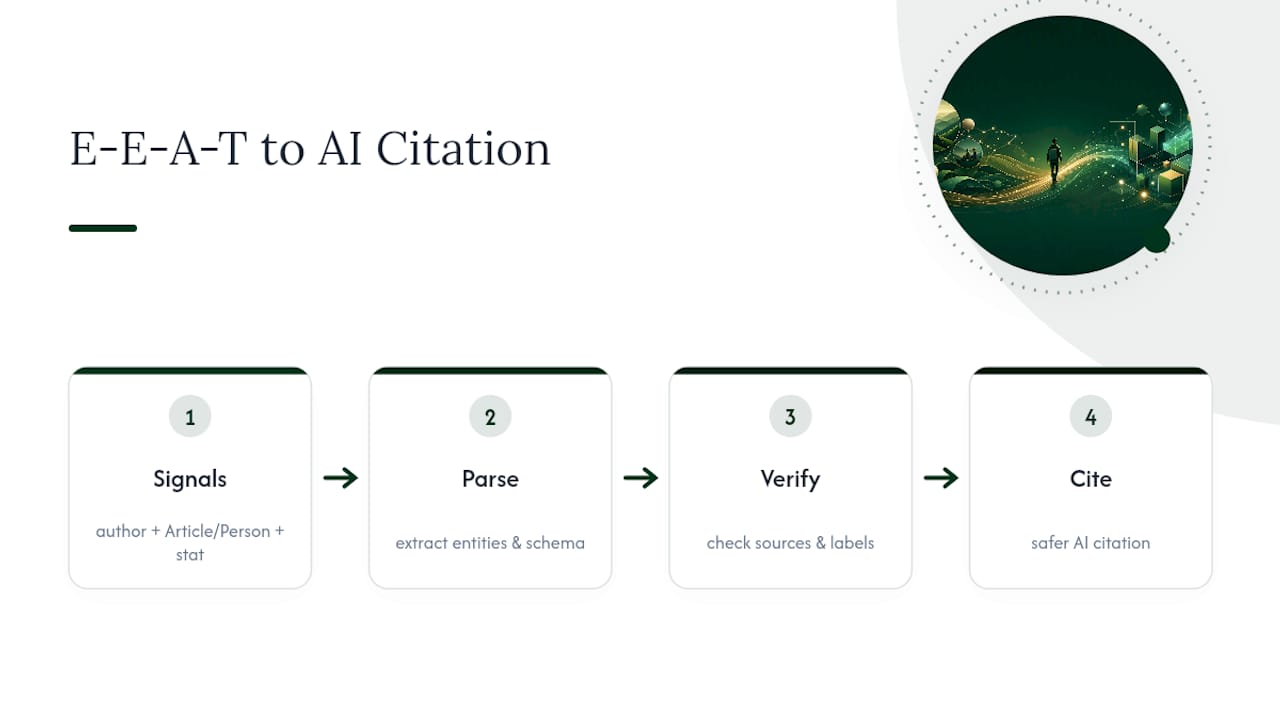
Tactically, this means writing in formats AI systems can lift cleanly: a tight two or three sentence answer block near the top of a section, data presented in a labeled table rather than buried in a paragraph, and FAQ schema where you’re genuinely answering discrete questions. Vague, unstructured prose forces a model to guess at what you’re claiming. A clearly labeled statistic with a source doesn’t.
You can test this yourself. Ask ChatGPT, Perplexity, or Claude a question your content answers, and see whether your page shows up as a cited source. If it doesn’t, check whether a competitor with weaker content but cleaner schema and clearer authorship is getting cited instead, then close that gap. Academic work on credibility modeling in information retrieval systems suggests these systems weigh verifiable, well-structured evidence more heavily than surface-level keyword relevance, which tracks with what founders report seeing in practice.
This is the exact mechanism Storyline Pros builds around: turning a startup’s raw first-party evidence into citable, structured assets placed where AI systems and journalists both look.
Your 30/90/180-Day E-E-A-T Action Plan
Spreading this work evenly across a quarter beats a single frantic overhaul. Here’s a sequence that assumes a small team with limited bandwidth.
- Days 1 to 30 (owner: founder or marketing lead): Fix trust hygiene (HTTPS, contact page, privacy policy), name every author, publish one proof page, and add Article schema to your ten most-visited pages.
- Days 31 to 90 (owner: marketing lead, founder contributes content): Build a full author page, add Person and Organization schema, publish one detailed case note, and pitch three guest posts or journalist queries.
- Days 91 to 180 (owner: marketing lead, founder reviews): Run one small original research project, publish the results as a citable asset, pitch that asset to five relevant outlets, and rerun the AI citation test from month one to measure change.
| Timeframe | Primary focus | KPI to watch |
|---|---|---|
| Days 1 to 30 | Trust hygiene and author identity | Pages with named authors and valid schema |
| Days 31 to 90 | Expertise and early authority outreach | Referral domains, guest post replies |
| Days 91 to 180 | Original research and AI citation testing | Brand mentions, AI citation test results, conversion lift |
Weight your team’s time roughly toward hygiene first, content production second, and PR outreach third in the early phase, then invert that as the technical foundation stabilizes and outreach becomes the bottleneck. A two-person team should not be pitching journalists before the contact page even works.
What Actually Moves the Needle (And What Doesn’t)
Most founders overinvest in publishing volume and underinvest in publishing proof. I’ve seen the pattern play out the same way across different companies: a team ships fifteen generic blog posts in a quarter, sees no movement in rankings or AI citations, and concludes content marketing doesn’t work for them. It usually isn’t the volume that’s wrong. It’s that none of those fifteen posts contained anything a competitor’s ghostwriter couldn’t have produced with the same prompt.
The engagements that actually shift a startup’s visibility tend to start smaller and more specific than founders expect. One case study worth pointing to involved a startup that had almost no organic footprint outside its own homepage. The fix wasn’t a content calendar overhaul. It was surfacing evidence the company already had, internal usage data, a founder’s direct account of a product decision, and packaging it into assets journalists and AI systems could actually verify and cite. Within a few months, branded mentions and referral domains both moved in a way volume alone never had.
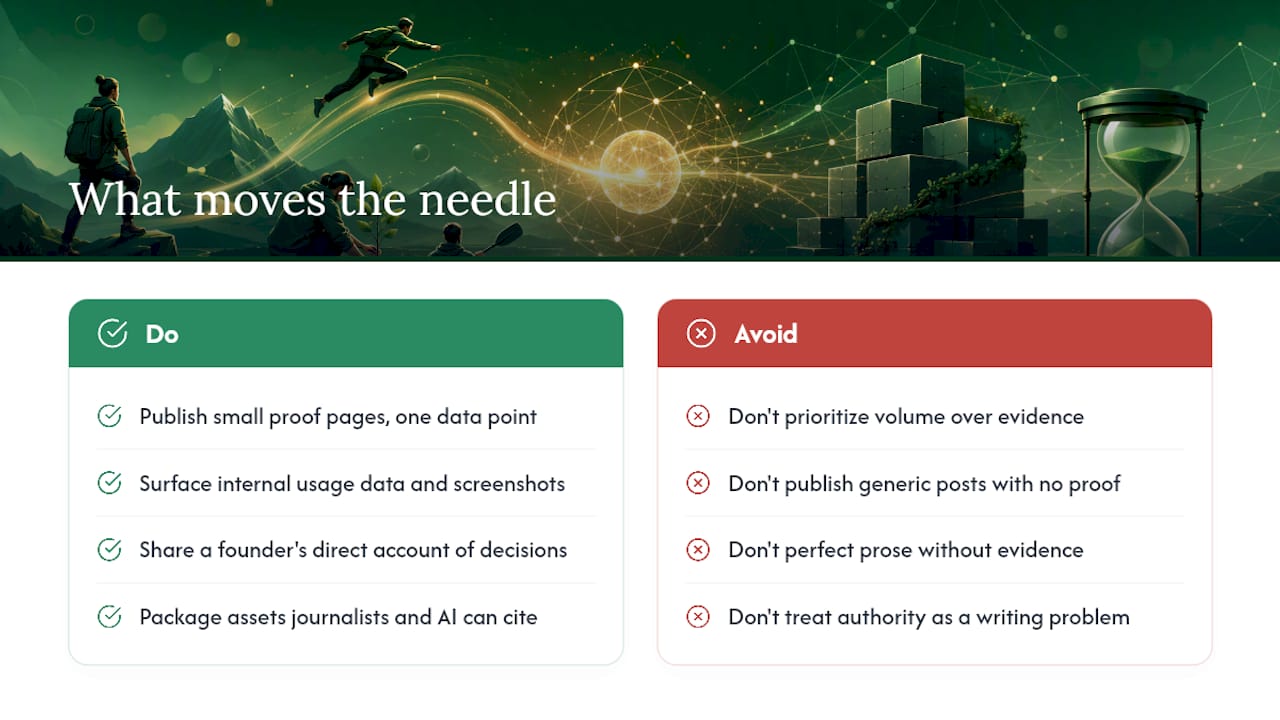
The honest confession: founders waste more time perfecting a single “flagship” piece of content than they’d spend publishing four smaller, rougher proof pages that each contain one real data point. Perfect prose with no evidence behind it convinces no one, human or machine. A slightly clumsy paragraph next to a real screenshot convinces almost everyone.
If there’s one misstep I’d flag above the rest, it’s treating authority-building as a writing problem instead of an evidence problem. Storyline Pros exists because most startups have the evidence already. They just haven’t figured out how to make it visible, structured, and citable to the systems now deciding who gets recommended. If that gap sounds familiar, Storyline Pros’s approach is built specifically to close it.
— Nik
Sources
For implementation, start with Google’s own rater guidelines update, which remains the baseline definition of Experience as a credibility signal. Pair it with Schema.org’s Article documentation for the actual markup syntax. For the first-party data argument specifically, Mean CEO’s analysis lays out why generic AI content can’t compete with real evidence, and the Forbes Coaches Council piece grounds the transparency argument in practical founder advice.
- Our latest update to the quality rater guidelines: E-A-T gets an extra E for Experience | Google Search Central Blog
- Schema
- E-E-A-T will not save generic AI content: first-party data will - Mean CEO’s BLOG