

90 Day Entity SEO for Startups: Schema, One Hub, and 3 Corroborations
Entity SEO turns your startup into a citable, machine-readable brand that AI systems and search engines can confidently recommend, not just rank. The first move is building an entity home page, typically your homepage or about page, with Organization schema, a stable @id, and sameAs links to profiles like Crunchbase or LinkedIn. Within weeks, watch for branded search upticks, early third-party citations, and eventually a Knowledge Panel.
TL;DR:
- Building a consistent entity profile with a hub page, stable @id, and authoritative third-party citations is crucial for AI recognition and long-term trust.
- Core tactics include deploying schema correctly across all essential pages, creating a hub-and-spoke structure, and linking internally with descriptive anchor text.
- Securing off-site validation through profiles like Crunchbase, Wikipedia, and media mentions significantly accelerates entity trust signals and Knowledge Panel appearance.
- Startups should focus on foundational schema and profile consistency within the first 90 days, then expand to outreach and media efforts over the next year.
- Tracking recognition signals such as branded search impressions, citation growth, and Knowledge Panel status provides a clearer picture of entity visibility than rankings alone.
Table of Contents
- What Is Entity SEO and Why Startups Need It
- Core Tactics: Schema, Entity Maps, and Corroboration
- A 90-Day to 12-Month Rollout for Small Teams
- How to Measure Entity Visibility
- Common Mistakes That Undercut Entity SEO
- E-E-A-T in Practice: What a Real Engagement Looks Like
- Entity SEO and the Rise of AI and Voice Search
- Tools and Platforms Worth Using
- Adapting Your Entity Strategy as You Grow
- The Startup Playbook That Actually Moves the Needle
- How Storyline Pros Fits Into Your Entity Strategy
- Where to Go Deeper on Entity SEO
- Sources
- FAQ
What Is Entity SEO and Why Startups Need It
An entity, in search terms, is any distinct thing a system can recognize and reason about: a person, a company, a product, a place. Google’s Knowledge Graph and similar systems built by Bing and AI platforms store entities as nodes with attributes (founder, industry, headquarters, funding stage) rather than as strings of keywords. When someone asks an AI assistant “who makes the best project management tool for remote teams,” the system isn’t matching text. It’s pulling from a web of entities it already trusts and cross-referencing which ones its sources associate with that query.
That’s the mechanic large language models rely on. They construct answers from a knowledge supply chain built out of corroborating sources, not from a single well-optimized page. A model favors brands that show up consistently across multiple trusted references over ones that merely rank well for a keyword.
This is exactly where startups get stuck. A ten-year-old company has a decade of press mentions, Wikipedia edits, and directory listings reinforcing its identity. A startup founded eighteen months ago often has:
- No historical citations for AI systems to draw from
- Naming ambiguity (a generic product name that collides with other companies or common phrases)
- Fragmented profiles across LinkedIn, Crunchbase, and its own site that don’t agree on basic facts like founding year or headquarters
Without deliberate entity work, a startup is invisible to the exact systems increasingly used by investors doing due diligence and customers doing research. Fixing that isn’t about ranking higher for a keyword. It’s about becoming a fact the internet agrees on.
Core Tactics: Schema, Entity Maps, and Corroboration
This is the actual toolkit. Five moves, done in sequence, build the machine-readable foundation an AI system needs to trust your brand as an entity.
- Deploy Organization and Product schema correctly. Your homepage needs Organization schema with a consistent
@id, your key pages needmainEntityOfPagemarkup, and any product or service pages benefit from Product or CreativeWork schema. The@idshould be identical across every page and, ideally, match the URL of your canonical entity page. Fragmenting your@idacross pages confuses the exact disambiguation process schema exists to help. - Build an entity map with a hub-and-spoke structure. Your homepage or a dedicated “about” page is the hub. Spokes are pages targeting related entities: your product category, your key differentiators, your founders as individuals. Entity-based SEO strategy built around hub-and-spoke architecture helps search systems map relationships between entities and expands the range of queries your site can plausibly answer.
- Link internally with descriptive anchor text. Instead of “click here,” link “our project management software for remote teams” back to the product hub. Internal linking functions as connective tissue that reinforces which entity a page is actually about, and it’s one of the few levers a two-person marketing team can pull without external help.
- Build topic clusters that cover definitions, comparisons, and FAQs. A cluster around “async standups” might include a definitional page, a comparison against live standups, and an FAQ page. Each reinforces the others and signals topical depth to both traditional search and AI crawlers.
- Secure earned, corroborating mentions off-site. This is the step startups skip because it’s the hardest, and it’s also the one that matters most. Authority gets built through corroboratable external data, meaning your own site’s schema is only half the equation. Wikidata entries, a Wikipedia page (once you meet notability standards), a Crunchbase profile, and coverage in trade press all function as third-party votes that your entity is real and stable.
On the technical side, one detail trips up more startups than any other: schema has to live in the actual HTML your server returns, not get injected client-side by JavaScript after the page loads. Many AI crawlers don’t execute JavaScript, so schema that only appears after a React component renders is invisible to exactly the systems you’re trying to reach. Run every key page through Google’s Rich Results Test or Schema.org’s validator after every deploy, not just once at launch.
Pro Tip: Register a Wikidata entry before you chase a Wikipedia page. Wikidata has a lower bar for inclusion, and it functions as a public identifier that search engines and AI systems already use to disambiguate entities with a sameAs link pointing straight to it.
Crunchbase deserves a special mention here because it’s often the single fastest corroboration a startup can get. Claim your profile, keep your funding data current, and list your founders by name, matching exactly how they appear on your site and LinkedIn. Inconsistency between these three sources is one of the most common reasons AI systems hedge on recommending a brand at all.
A 90-Day to 12-Month Rollout for Small Teams
You don’t need a twelve-person marketing department to execute this. You need sequencing.
First 90 days, focus entirely on foundation:
- Publish one entity home page with complete Organization schema, a locked
@id, andsameAslinks to every profile you control - Map and build three priority pages tied to your top target entities (your core product category and your two most important use cases)
- Add internal links from every existing blog post back to those three pages using descriptive anchor text
- Claim and complete your Crunchbase profile and any core industry directory listing relevant to your category
Months 3 through 12, shift to expansion:
- Build out full topic clusters around each of your three priority entities
- Run a focused outreach push for earned media, targeting three to five publications that cover your category, since earned citations meaningfully accelerate entity recognition for new sites
- Automate schema propagation so new blog posts and product pages inherit the correct markup by default, rather than relying on someone remembering to add it
- Pursue a Wikipedia entry once you have sufficient independent press coverage to meet notability guidelines
Most startups can execute the 90 day phase entirely in-house. The outreach and press phase is where teams typically decide whether to hire an agency or a freelance PR specialist, mostly because earned media takes relationship capital that internal teams rarely have time to build alongside product work.
| Phase | Primary focus | Who typically owns it |
|---|---|---|
| Days 1 to 90 | Schema, hub page, internal linking, core profiles | Founder or in-house marketer |
| Months 3 to 12 | Topic clusters, directory expansion | In-house marketer, part-time contractor |
| Months 3 to 12 | Earned media, Wikipedia eligibility, automation | Agency or dedicated PR specialist |
Expect early signals like Search Console impressions on branded terms within four to six weeks of publishing your entity hub. Third-party citations and Knowledge Panel appearances take longer, often three to nine months, because they depend on external validators you don’t fully control.
How to Measure Entity Visibility
Tracking entity SEO means measuring something different from rank position. You’re watching for recognition, not ranking.
Track these signals monthly:
- Branded search volume in Google Search Console, specifically growth in impressions for your company name and product name as standalone queries
- Knowledge Panel appearances, checked by searching your brand name directly and noting whether a panel populates and how complete it is
- Corroborating third-party citations, a running count of directories, press mentions, and profiles that reference your company consistently
- AI and LLM citations, tracked qualitatively by periodically asking tools like ChatGPT or Perplexity questions in your category and noting whether your brand surfaces
- Topical coverage breadth, essentially how many distinct entity-relevant queries your site can plausibly answer based on your cluster structure
For tooling, Google Search Console remains the backbone for branded query tracking. Beyond that, Google’s NLP API, TextRazor, and Diffbot let you extract which entities search systems already associate with your existing pages, which is useful for spotting gaps before you write another word of content. Schema validators (Google’s Rich Results Test, Schema.org’s own validator) should run on every deploy, and a manual directory audit once a quarter catches profile drift before it becomes a corroboration problem.
A practical dashboard for a small team combines Search Console exports with a manual log of citation sources, reviewed monthly by whoever owns marketing and quarterly by leadership. Early-stage startups should expect slow, lagging signals for the first two quarters. Growth-stage companies with active press relationships tend to see Knowledge Panel and citation growth compound much faster, since each new mention makes the next one easier to earn.
Common Mistakes That Undercut Entity SEO
Most entity SEO failures aren’t strategic. They’re operational sloppiness that compounds over time.
- Inconsistent naming across profiles. Your Crunchbase listing says “Acme Software Inc.” while LinkedIn says “Acme Software” and your site says “Acme.” Each variant fragments the entity signal instead of reinforcing one.
- Treating schema as the whole strategy. Perfect markup with zero external corroboration is a house with no neighbors vouching for it. Search systems still weigh outside validation heavily.
- Client-side-only schema. As covered above, JavaScript-injected markup that never appears in server-rendered HTML is effectively invisible to a large share of crawlers.
- Overbroad entity targeting. Trying to claim authority over ten loosely related entities dilutes your topical signal far more than owning three tightly connected ones.
The fix for nearly all of these is the same: designate one source of truth (usually a shared document listing your official company name, founding date, and profile URLs) and audit every public profile against it quarterly.
Pro Tip: Set a recurring calendar reminder to Google your own company name every quarter. If your Knowledge Panel, Crunchbase snippet, and LinkedIn “About” section tell three slightly different stories, that’s the fragmentation an AI system sees too.
E-E-A-T in Practice: What a Real Engagement Looks Like
Startups often ask what “doing this right” actually looks like from the outside, since most of the work happens off their own site. Storyline Pros specializes in building digital visibility for high-growth startups by ranking in AI search engines to attract investors and customers using a proprietary technical layer paired with data-driven earned media strategies.
The core problem this solves is the one covered earlier: startups get overlooked in AI-generated answers because they lack the corroborating sources that make an entity trustworthy. Storyline Pros’ approach establishes companies as credible references across trusted media outlets, which is the earned-media half of entity SEO most founders don’t have the time or press relationships to execute alone.
The gap isn’t usually a startup’s willingness to do the work. It’s that schema and a hub page only solve the on-site half of the equation, while the corroborating citations that actually move AI systems live entirely off-site, in press, directories, and community mentions a small team rarely has bandwidth to chase down.
Case evidence from Storyline Pros’ client work points to measurable growth in media reach and investor engagement tied directly to this earned-citation approach, rather than to on-site optimization alone.
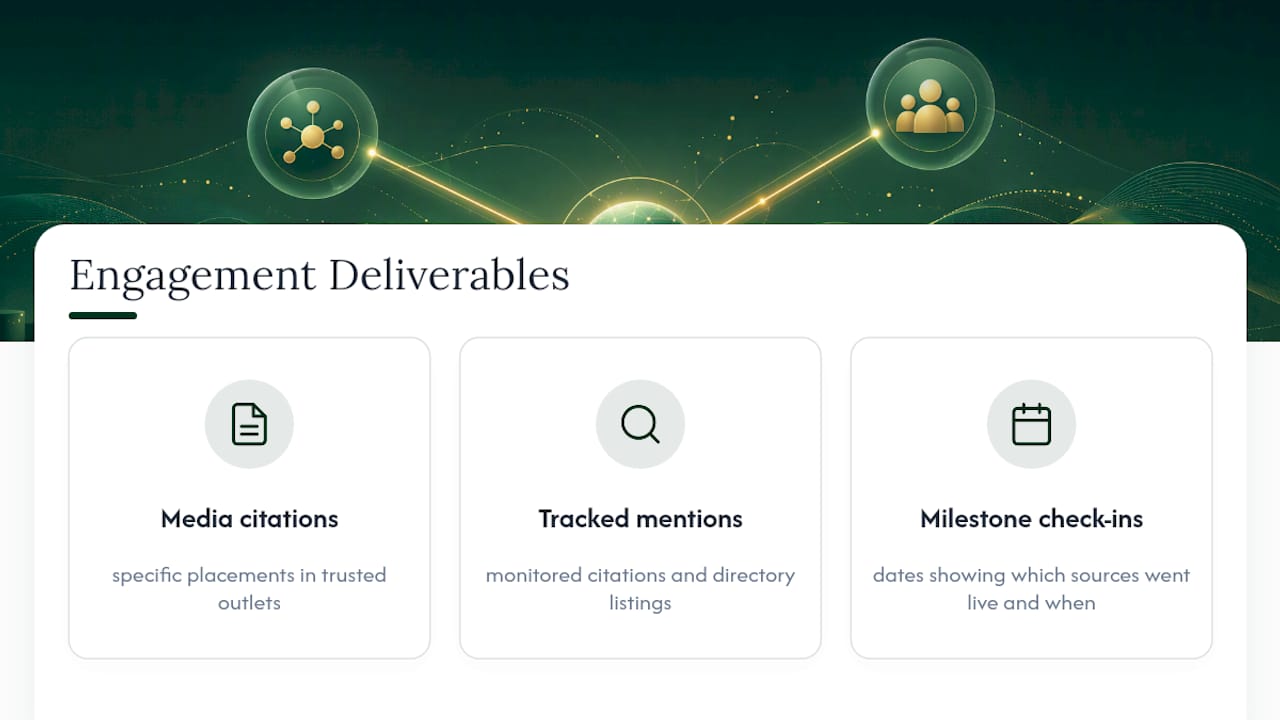
What should a founder expect walking into an engagement like this? Concrete deliverables tied to placements, not vague retainer promises: specific media citations, tracked mentions, and milestone check-ins that show which corroborating sources went live and when. That’s the standard worth holding any agency to, in-house team, or solo founder attempting this work.
Entity SEO and the Rise of AI and Voice Search
Voice assistants and AI chat interfaces don’t return ten blue links. They return one answer, sometimes with a citation, often without. That single-answer format raises the stakes on entity clarity dramatically, because there’s no second or third result for a searcher to scroll past to if your brand happens to get overlooked.
Voice queries also skew conversational and comparative: “what’s the best invoicing tool for freelancers” rather than “invoicing tool freelancers.” Answering that kind of query well requires the AI system to already have your brand mapped as an entity associated with “invoicing” and “freelancers” specifically, which is exactly what topic clusters and schema build toward.
The practical implication for startups is that optimizing for AI-driven search and optimizing for voice search are the same project, not two separate ones. Both depend on your entity being unambiguous, corroborated externally, and described in structured data an AI system can parse without guessing. A blog post stuffed with keywords does nothing here. A clearly marked-up product page with a sameAs link to a Crunchbase profile does real work, because it gives the AI system a verification path it can follow before including you in an answer.
Startups that get cited by AI assistants early tend to compound that advantage, since each citation makes the next model run more likely to surface them again, treating repeated corroboration as a trust signal in itself.
Tools and Platforms Worth Using
You don’t need an expensive stack to do this well, but a few tools genuinely earn their place.
Google Search Console is non-negotiable and free. It’s your primary window into branded query growth and which pages are actually earning impressions for entity-related searches.
For schema, Google’s Rich Results Test and the Schema.org validator catch markup errors before they cost you visibility. Run both after every site update, not just at launch.
For entity extraction and gap analysis, Google’s Cloud Natural Language API, TextRazor, and Diffbot all let you see which entities a page already reads as being about, which is often different from what you intended when you wrote it.
For content workflow and keeping topic clusters organized as a small team scales, a resource like Preferic’s playbook on aligning content and SEO is worth a read before you start assigning cluster pages to writers. And for understanding the broader signals AI systems weigh when deciding what to recommend, Catchouse’s breakdown of AI recommendation signals fills in context that pure SEO tools miss.
None of this requires enterprise software. It requires discipline in using free and low-cost tools consistently, which is usually the actual gap for a two-person marketing team.
Adapting Your Entity Strategy as You Grow
What works at ten employees stops being enough at fifty, mostly because your entity footprint gets more complicated as you launch new products, enter new markets, or bring on executives who become entities in their own right.
Revisit your entity map every time you ship a major product or hire a senior leader. A new VP of Sales quoted in press coverage becomes a person-entity linked to your company-entity, and that link needs to show up consistently across your site, LinkedIn, and any press mentions. Skipping this is how companies end up with outdated “About” pages that actively undermine the corroboration they’ve built elsewhere.
The AI search landscape itself keeps shifting too. What Google’s Knowledge Graph favored two years ago isn’t identical to what today’s large language models weigh when constructing an answer. Treat your quarterly profile audit as a permanent fixture, not a launch task you finish once and forget, and revisit your outreach targets as your category and competitive set evolve.
The Startup Playbook That Actually Moves the Needle
Most entity SEO advice treats every tactic as equally urgent, and that’s the wrong instinct for a team of three. The judgment worth acting on is narrower: schema, one hub page, and three corroborating citations beat a scattered attempt at everything at once. Conventional SEO advice still leans on keyword density and volume of content, but that’s advice built for an era before AI assistants started answering questions directly instead of linking to ten pages and letting the reader decide.
What’s overrated is chasing a Wikipedia page before you’ve earned the press coverage that makes you eligible for one. What’s underrated is Crunchbase, precisely because it’s boring, free, and fast to claim, yet it functions as one of the clearest corroborating signals available to a brand-new company. Prioritize the profile you can complete this week over the media placement that might take three months to land.
If there’s one discipline that separates startups who get cited from those who don’t, it’s consistency across the handful of sources that matter, rather than breadth across dozens that don’t.
— Nik
How Storyline Pros Fits Into Your Entity Strategy
Once your schema and hub pages are live, the bottleneck almost always shifts to earned media, the corroboration layer that’s hardest for a small team to build alone. One agency exists to close this gap by working on a success-based model tied to delivered media placements, podcast appearances, and syndicated coverage, using a proprietary technical layer to track and attribute each placement’s impact on your entity visibility.

If you’re still building your on-site foundation, DIY is the right call for now. Once your schema is solid and your hub page is live, that’s the moment to consider outside help for the corroboration side, since press relationships and community amplification take time most founding teams don’t have. A pilot project focused on a handful of measurable placements is a reasonable way to test the fit before committing further.
Start by reviewing Storyline Pros’ case studies to see how this has played out for other startups, then visit Storyline Pros to scope a pilot engagement around your specific entity gaps.
Where to Go Deeper on Entity SEO
A handful of references are worth bookmarking as you build this out. Search Engine Land’s guide to entity-first content optimization covers the Knowledge Graph mechanics in more technical depth than most SEO blogs attempt. Wikidata’s own documentation explains how to register and structure an entity entry correctly the first time. For content structure specifically, Semrush’s breakdown of entity-based SEO strategy and Neil Patel’s guide to entity-based SEO both offer practical frameworks for hub-and-spoke architecture. Schema.org’s validator remains the standard for checking markup before it ships.
Sources
- Entity-first SEO: How to align content with Google’s Knowledge Graph
- Entity-Based SEO: What Is Entity SEO & Why Does It Matter?
FAQ
What does entity SEO mean?
Entity SEO is the practice of optimizing your brand, products, and key concepts as recognizable, corroborated entities in systems like Google’s Knowledge Graph, rather than optimizing individual pages for keywords. It relies on structured data, consistent naming, and third-party corroboration so search engines and AI systems can identify and trust your brand.
Is SEO dead now that AI answers questions directly?
No, but the mechanics have shifted. AI systems still pull from an underlying knowledge supply chain built from indexed, structured, and corroborated content, so ranking and visibility work still matters. What’s changed is the emphasis: entity clarity and trust signals now carry more weight than raw keyword optimization.
What is the 80/20 rule in SEO for startups?
Applied to entity SEO, key visibility gains come from a small number of high-leverage actions. For a startup, that’s typically your entity hub page, schema markup, and a handful of priority corroborating citations rather than an even effort spread across dozens of pages and profiles.
Who handles entity SEO and earned media for startups?
Some founders manage the on-site schema and hub-page work internally, since that part is largely mechanical once you understand the requirements. For the earned-media and corroboration side, agencies like Storyline Pros specialize specifically in helping startups earn the third-party citations that make an entity trustworthy to AI search systems.