

Founders: Turn One Data Point Into TechCrunch Coverage
Getting featured in TechCrunch comes down to one thing: giving a specific reporter something newsworthy they can verify fast. That means a real hook (funding, a product milestone, a data trend), one clear number or exclusive detail, the right reporter for your beat, and proof that checks out within minutes, not days. Founders who treat this as a research task, not a spray campaign, get covered.
TL;DR:
- Pitches must include a verified, measurable milestone, such as user growth in a specific timeframe, paired with proof like retention data or competitor benchmarks.
- Target specific reporters who recently covered your category and craft personalized outreach referencing their recent work to increase the chance of response.
- Use a clear, concise subject line stating the news event and a one-page fact sheet with verifiable data for quick reporter verification.
- Offer exclusives only when you have genuinely scarce assets like proprietary data or a high-profile investor, and always confirm embargo details in writing.
- Focus on evidence-first pitching, building relationships beforehand through relevant data sharing, rather than relying on promotional language or mass emailing.
Table of Contents
- What Does TechCrunch Actually Cover?
- How Do You Find the Right TechCrunch Reporter?
- Writing the Pitch: Subject Line, Body, and Assets
- Timing, Embargoes, and When to Offer an Exclusive
- Building Relationship Capital Before You Need It
- Mistakes That Quietly Kill Your Chances
- Your Pre-Send Checklist
- How Storyline Pros Increases Placement Odds
- What I’d Tell a Founder Before Their First Pitch
- Get Editorial Placements Without the Guesswork of DIY Outreach
- Where to Verify TechCrunch’s Current Submission Guidance
- Sources
What Does TechCrunch Actually Cover?
TechCrunch runs on a narrow set of story types, and knowing them saves you from wasting a pitch. The site covers funding rounds with real context (not just “we raised money” but why investors bet on this market), founder and operator insight, product launches tied to measurable outcomes, original data or trend analysis, and investigative tips worth chasing. About TechCrunch shows this pattern across years of coverage: reporters lean toward stories with numbers, named investors, or a defensible claim about market movement.
What almost never works:
- Guest columns, since TechCrunch stopped accepting outside contributor posts entirely, according to its guest columns policy.
- Sponsored placements dressed up as editorial. TechCrunch treats sponsored posts as paid advertising, clearly separated from newsroom coverage.
- Minor hires, vague “strategic partnerships,” or a product update with no measurable before and after.
A milestone only becomes a pitch once you attach evidence to it. “We hit 50,000 users” is a status update. “We hit 50,000 users in eight weeks, three times faster than our nearest funded competitor, and here’s the retention data” is a story a reporter can build a headline around. The gap between those two sentences is the entire game.
How Do You Find the Right TechCrunch Reporter?
TechCrunch doesn’t have one inbox that matters. It has dozens of reporters, each covering a beat, and pitching the wrong one is the fastest way to get ignored.
- Scan the TechCrunch staff pages and recent bylines. Look for reporters who’ve covered companies in your category in the last 30 to 60 days. Recency beats seniority every time.
- Build a shortlist of three to five names, not one. Note a specific article each reporter wrote that’s adjacent to your story, so you can reference it in your opening line.
- Confirm beat and geography fit. A reporter covering fintech in Europe is not the right target for a US developer tools launch, even if their title says “startups.”
- Choose your contact route. Public reporter emails usually follow a predictable outlet pattern. For general news tips, TechCrunch’s tips page is the official channel, and it explicitly supports Signal or WhatsApp for sensitive submissions that need a secure line.
- Skip the general inbox for anything beat-specific. A direct, relevant pitch to the right reporter outperforms a broadcast email every time.
Writing the Pitch: Subject Line, Body, and Assets
Short pitches convert better than long ones, largely because reporters are triaging dozens of emails between deadlines and benefit from repeatable, concise creative hooks like those on TikTok Ad Fatigue. Your entire pitch should read in under 30 seconds.
Subject line: State the news, not your company name. “Series A: $12M to fix [specific problem]” beats “Exciting News from [Startup]” every time.
Body structure, roughly seven sentences:
- One line stating the news peg (what happened, when).
- One clear data point that anchors the story (revenue growth, user count, a benchmark against competitors).
- One sentence on why this matters to the reporter’s readers, not just to you.
- One sentence offering a verification path, meaning a named source, investor, or document the reporter can check.
- A closing line offering availability for a quick call.
Attach a one-page fact sheet, one or two screenshots or a demo link, and a short line establishing founder credibility (prior company, notable investor, relevant background). Reporters want to verify a claim in minutes, not hunt through a 20-slide deck.
Pro Tip: If you’re offering an exclusive, say so explicitly in the first two sentences: “I’d like to offer this as an exclusive if you’re interested.” Reporters decide fast, and burying the offer in paragraph four wastes the advantage.
Timing, Embargoes, and When to Offer an Exclusive
Lead time changes everything about how a pitch lands. A feature story or deep profile needs months of relationship groundwork. A timely news peg, like a funding announcement, works best with two to four weeks of notice to a reporter who already has some familiarity with your company.
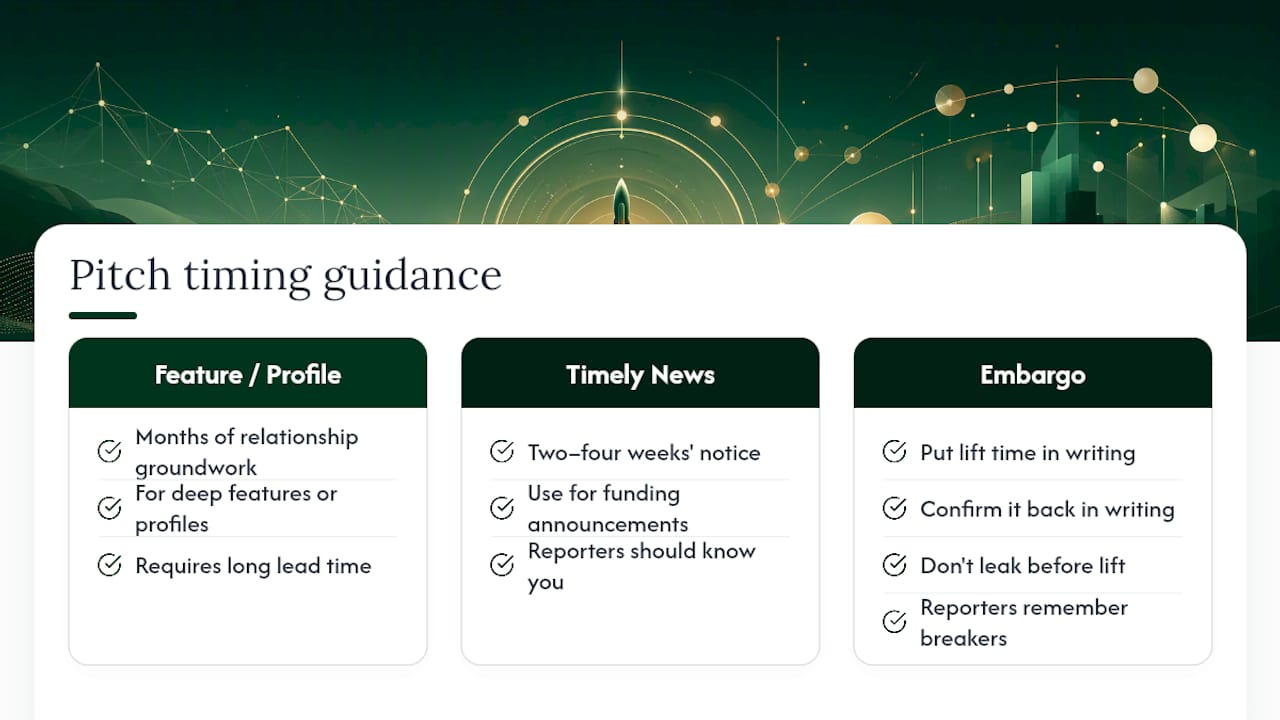
Exclusives make sense when you have something genuinely scarce: proprietary data, a high-profile investor, or a first-look product reveal. The trade-off is real. Offering an exclusive means one outlet gets it and everyone else waits or passes entirely, so don’t offer one to a reporter who isn’t a strong fit.
If you agree to an embargo, put the lift time in writing, confirm it back in your own words, and don’t leak the news anywhere, including your own social channels, before the clock runs out. Reporters remember who breaks embargoes, and they remember for years.
Building Relationship Capital Before You Need It
The founders who get covered repeatedly aren’t the ones with the best press release. They’re the ones a reporter already recognizes as useful.
- Follow the reporters on your shortlist and actually read their work, not just their headlines.
- Share relevant market signals or data with no ask attached, at least once before you ever pitch.
- If an investor or partner offers to introduce you, have them write one line explaining the hook and what the reporter gets from the conversation, not just “you should meet my founder.”
- Stay useful between pitches: a quick data point, a short customer anecdote, or a benchmark relevant to their beat keeps you on their radar without asking for anything.
A credential trail from smaller trade or vertical outlets makes this easier. Reporters check backgrounds, and prior coverage elsewhere signals you’re a legitimate source.
Mistakes That Quietly Kill Your Chances
- Leading with promotional language. Skip “revolutionary” and “game-changing.” Lead with a claim that matters to a reader who has zero interest in your product.
- Spraying the same pitch to twenty reporters. Personalize each one and reference something specific the reporter recently covered.
- Attaching a bloated deck instead of a fact sheet. One organized page with sources a reporter can verify beats 20 slides of vision statements.
- Skipping the verification path entirely. No named source, no data trail, no on-the-record spokesperson means no story, regardless of how good the news actually is.
Your Pre-Send Checklist
Run through this before a single pitch goes out:
- Confirm you have a genuine news peg, not just an update.
- Attach one specific, verifiable data point.
- List three to five best-fit reporters, each tied to a recent article you’ve read.
- Test your subject line against a plain, non-promotional alternative.
- Have a one-page fact sheet ready to link or attach.
- Confirm a spokesperson is available for a same-day or next-day call.
- Decide your release strategy upfront: exclusive, embargo, or open pitch to your full shortlist.
Pro Tip: Run a simple A/B test on your own list: send half your shortlist a subject line with a number in it, and half a subject line without one. Track which version gets a reply first, then use that pattern going forward.
How Storyline Pros Increases Placement Odds
Storyline Pros builds this playbook into a repeatable process instead of a one-off scramble. The approach centers on narrative engineering (shaping your milestone into a story reporters actually want), evidence-first pitching (fact sheets and data built before outreach starts), and programmatic syndication across trusted outlets, with measurement attached after placement lands.
- Prioritized reporter targeting reduces wasted outreach by matching your story to beats that already cover your category.
- Proprietary measurement tracks which pitches convert, so future outreach improves instead of repeating the same guesses.
- A packaged evidence dossier per reporter means founders aren’t rebuilding a fact sheet from scratch for every outlet.
Founders with the time and existing reporter relationships can run this process solo. Founders without that bandwidth, or without a warm reporter list already built, tend to see faster traction with a dedicated narrative engineering partner running the outreach.
What I’d Tell a Founder Before Their First Pitch
Evidence beats charisma every time. Get your data point right, find the reporter whose beat actually matches your story, and only then start building the relationship. Skip a step and you’ll wonder why a good pitch never gets a reply.
— Nik
Get Editorial Placements Without the Guesswork of DIY Outreach
Everything in this guide (finding the right reporter, building a fact sheet, timing your pitch) takes real hours founders don’t always have during a fundraise or launch sprint. An agency can run that entire process as a service: earned media placements, narrative engineering built around your actual data, and measurable campaigns tracked from pitch to publication instead of a flat retainer with no attribution.

The model ties work to delivered outcomes: placements, podcast spots, and syndicated coverage rather than hours billed regardless of results. Past campaigns are documented in Storyline Pros’s case studies, showing how evidence-first pitching translated into real coverage and follow-on investor interest.
If you’ve got a funding round closing, a product launch on the calendar, or a data set worth turning into a story, start a conversation with Storyline Pros about a placement pilot before your next milestone hits.
Where to Verify TechCrunch’s Current Submission Guidance
Confirm these details directly before you send anything, since editorial policies shift:
- TechCrunch’s contact page confirms the outlet does not accept unsolicited guest posts and directs news tips to a dedicated inbox.
- TechCrunch’s tips page explains how to submit a tip and outlines secure-contact options for sensitive information.
- The guest columns policy clarifies that guest contributions are closed and that sponsored content runs separately from editorial coverage.
Check the TechCrunch staff and about pages for current reporter beats before you finalize your shortlist. Beats shift as reporters move teams, and a pitch built on outdated beat information lands in the wrong inbox no matter how strong your data is.