

Founders: 60–90 Minutes That Decide Your Hacker News Launch
If you’re a YC company, apply for Launch HN; if not, plan a Show HN post. Either way, the one rule that separates a launch that gets traction from one that dies on page two is the same: make your product instantly usable, no signup wall, no waitlist, and show up in the comments the moment it posts.
TL;DR:
- The success of a launch post heavily depends on making the product instantly usable with no sign-up walls or waitlists, especially within the first 60 to 90 minutes.
- YC companies should reserve their single Launch HN for a fully ready product, while non-YC founders should focus on frequent Show HN posts for ongoing visibility.
- Posts that perform well feature straightforward titles, open demos or repositories, honest storytelling, and quick, technical replies from the founders.
- Poorly performing launches often include marketing language, gated demos, unanswered comments, and coordinated boosting that appear inauthentic.
- Post-launch, founders should actively engage in comments, address bugs, and follow up to retain credibility and encourage long-term growth.
Table of Contents
- Launch HN vs. Show HN: Which One Fits Your Startup?
- What the HN Admins Actually Want From Your Post
- Getting Your Product Ready Before You Post
- Running the Comment Thread Without Torching Your Launch
- What Successful Launch and Show HN Posts Have in Common
- Your Launch Day Checklist, Start to Finish
- How Outside Help Actually Fits Into an HN Launch
- When Should You Post on Hacker News?
- How the Hacker News Front Page Algorithm Actually Works
- Why Launch HN and Show HN Posts Fail
- Keeping the Momentum After Launch Day Ends
- Rules You Can’t Break When Posting on Hacker News
- What I’ve Learned Watching HN Launches Succeed and Fail
- Getting Launch-Ready Without Doing It Alone
- Primary Sources to Read Before You Submit
- Sources
- FAQ
Launch HN vs. Show HN: Which One Fits Your Startup?
Launch HN is reserved for YC-funded companies, and each one gets exactly one shot at it. The HN team curates the post with you directly, reviewing your draft and helping tighten the official submission logistics before it goes live. That editorial hand is the trade-off for exclusivity: you get a second set of experienced eyes, but only once per company, ever.
Show HN is open to anyone building something and posting it themselves, no gatekeeping, no waiting on YC status. Posts start in the /newest queue, and only enough early upvotes push them onto the front page where the bulk of traffic lives.
That mechanic changes your strategy:
- Non-YC founders should treat Show HN as their primary channel and can post as often as they have something genuinely new to show.
- YC founders should hold their single Launch HN for a moment when the product is fully ready, since there’s no redo.
- Show HN can also work as a warmup for YC founders testing messaging before spending their one Launch HN shot.
What the HN Admins Actually Want From Your Post
HN’s own guidance is blunt about tone: write like a person, not a press release. The Launch HN instructions explicitly warn against marketing language, superlatives, and hype. Modesty reads as credibility on this site; adjectives read as noise.
A structure that consistently works, pulled straight from admin guidance and reinforced across community discussion threads:
- Introduce yourselves briefly, first names are fine.
- State in one line what the product does.
- Describe the problem that made you build it.
- Give the backstory, how you landed on this idea.
- Explain the solution and the technical details that matter.
- Say plainly what’s different from existing options.
- Invite feedback directly and mean it.
For logistics, Launch HN titles typically follow the format “Launch HN: [Product] (YC S26) – [one-line description].” Submit through the same channel YC uses to coordinate with the HN team, and expect editorial back-and-forth in the days before your slot, not hours. Show HN posts skip that review; you write it, you submit it, you own it start to finish.
Pro Tip: Admit a real limitation in your post. A cheerfully self-critical line about what your product doesn’t do yet tends to invite people to help fix it rather than pile on.
Getting Your Product Ready Before You Post
HN readers test things. If your demo requires an email, a credit card or a “book a call” form, most visitors bounce before they see what you built. Reduce every barrier you can before launch day, or replace the barrier with a short video walkthrough that shows the real product.
What actually needs to be in place:
- A working demo that loads without an account, or a clear recorded walkthrough if a live demo isn’t possible.
- An honest explanation of your pricing or business model. HN commenters ask about revenue models constantly, and dodging the question reads worse than an awkward answer.
- For developer tools specifically, a public GitHub repository with a real README and a runnable example. Community sentiment backs this directly: linking a repo signals legitimacy and lets engineers verify your claims instead of taking your word for it.
Skepticism on Hacker News is default behavior, not hostility. A repo someone can clone and run in five minutes converts that skepticism into testers faster than any amount of copy ever will.
Running the Comment Thread Without Torching Your Launch
Your comments matter more than your post. Plan who from the team replies, how fast, and in what tone before you ever hit submit.
- Assign one or two founders to stay glued to the thread for the first four to six hours; that’s when most traffic and voting happens.
- Answer fact-first: lead with the technical or factual answer, then add context, not the reverse.
- Never seed booster comments from friends or teammates. HN’s own guidance flags this explicitly, and the community notices and punishes it fast.
- When someone pushes back hard, agree with the part that’s fair, then follow with specific technical detail. That combination tends to win over the much larger silent audience reading without commenting, a pattern borne out repeatedly in launch threads.
Pro Tip: Don’t argue to win the specific commenter. Argue to inform the hundred people scrolling past who never post a word but decide whether to sign up based on how you handled the criticism.
What Successful Launch and Show HN Posts Have in Common
A recurring pattern shows up across the launches index: a developer tool posts a plain-language title, links straight to a public repo, and the founder is visibly answering questions within the first hour. One well-regarded pattern involves a founder admitting upfront that the tool only solves part of a broader problem, then walking commenters through exactly how the code works when asked. That kind of candor consistently outperforms polish.
Signals that show up again and again in posts that do well:
- A title stating plainly what the thing does, no adjectives doing the selling.
- An open demo or repository instead of a gated signup.
- A founder-written blurb with a real story behind it, not marketing copy.
- Fast, specific replies in the first few hours of the thread.
The failure pattern is just as consistent, and practitioner breakdowns of dev-tool launches flag the same three anti-patterns every time: marketing-speak in the post itself, a beta gate that blocks anyone from actually trying it, and visible coordinated upvoting that reads as inauthentic the moment someone checks the commenter’s history.
Your Launch Day Checklist, Start to Finish
Treat launch day like a small operation, not a single button press.
Pre-launch (one to two weeks out):
- Finalize your blurb using the structure above and get a second founder to edit it for marketing language.
- Stress-test your demo under load, and confirm your server can handle a traffic spike without falling over.
- Draft answers to the five questions you expect most, especially around pricing and technical architecture.
Launch day:
- Confirm which founders are available and for how long, then post at your chosen time.
- Prioritize replies to questions that reveal genuine product fit issues over ones that are just curious.
- Watch your signup funnel in real time, not just your HN point count.
Post-launch (48 hours after):
- Collect every piece of feedback into one place before you forget the context behind it.
- Triage bugs that surfaced during the traffic spike, they’re often edge cases your normal testing missed.
- Publish a short follow-up noting what you fixed based on the thread.
| Phase | Primary focus | Common mistake to avoid |
|---|---|---|
| Pre-launch | Demo reliability and blurb tone | Marketing language slipping into the draft |
| Launch day | Fast, honest replies | Letting hours pass without a founder response |
| Post-launch | Feedback triage and public follow-up | Going silent once the thread cools down |
How Outside Help Actually Fits Into an HN Launch
An outside team’s real value isn’t writing your post for you, HN readers spot ghostwritten founder voice immediately. What an agency like Storylinepros typically contributes is narrower: stripping marketing language out of your draft while keeping it in your own voice, stress-testing your demo and pricing explanation before commenters find the gaps, and lining up earned-media coverage to run alongside the launch rather than competing with it for attention.
Worth hiring help for:
- Teams launching without a marketing background who need someone to catch tone issues before HN does.
- Founders juggling a product launch and fundraising simultaneously, where bandwidth is the real constraint.
- Companies wanting coordinated coverage beyond the thread itself, not a replacement for showing up in comments.
When Should You Post on Hacker News?
Timing matters less than founder availability, and HN’s own guidance says so directly: admins specifically advise against coordinating your post with a press embargo or event and instead recommend choosing a day when the founding team can actually be present in the thread for hours.
That said, traffic patterns still shape outcomes. Weekday mornings in US time zones, roughly 7 to 9 AM Eastern, tend to catch the front page before the day’s queue fills with competing submissions. Tuesday through Thursday generally outperforms Monday, when the queue is crowded with a weekend’s backlog, and Friday, when weekend attention drops off fast. Posting on a US federal holiday or over a weekend usually means less traffic overall, since a meaningful share of the audience is at work reading HN, not off duty.
None of that overrides the core constraint. A perfectly timed post with no founder replying for six hours will still stall, while a post at a mediocre hour with an engaged founder answering every comment can climb steadily through the day. Pick a slot where your team can commit to being present, then treat the specific hour as a secondary optimization, not the deciding factor.
If you’re coordinating a Launch HN with the admin team, they’ll often suggest a window based on their own editorial calendar. Show HN gives you full control, so use that flexibility to pick a day you know your team is free, not a day that merely looks statistically favorable on someone else’s blog post.
How the Hacker News Front Page Algorithm Actually Works
Hacker News ranks posts using a decaying score based on upvotes relative to how much time has passed since submission, not raw vote count. A post with 40 upvotes in its first hour will typically outrank a post with 40 upvotes spread across six hours, because the algorithm weights early velocity heavily.
That has a direct practical consequence for launches: the first 60 to 90 minutes after you post determine most of your visibility for the rest of the day. If your post doesn’t gain steady upvotes early, it drops out of contention before most of the site’s audience ever sees it, regardless of how good the product actually is.
Flags and “hellbanned” or downweighted accounts also affect placement. A cluster of new accounts upvoting or commenting in quick succession, the classic booster pattern, tends to trigger a ranking penalty rather than a boost, because it reads as manipulation to the ranking system as much as to human moderators. That’s a second, mechanical reason to avoid coordinating friends and colleagues to jump into your thread early: it can actively suppress your post rather than help it.
Comment activity feeds into visibility too, though less directly than votes. A thread with genuine back and forth signals to both the algorithm and human moderators that the post is generating real discussion, which tends to keep it visible longer even as newer submissions push it down the page. That’s the practical case for fast, substantive replies: they don’t just win over readers, they help keep the post alive long enough for those readers to find it.
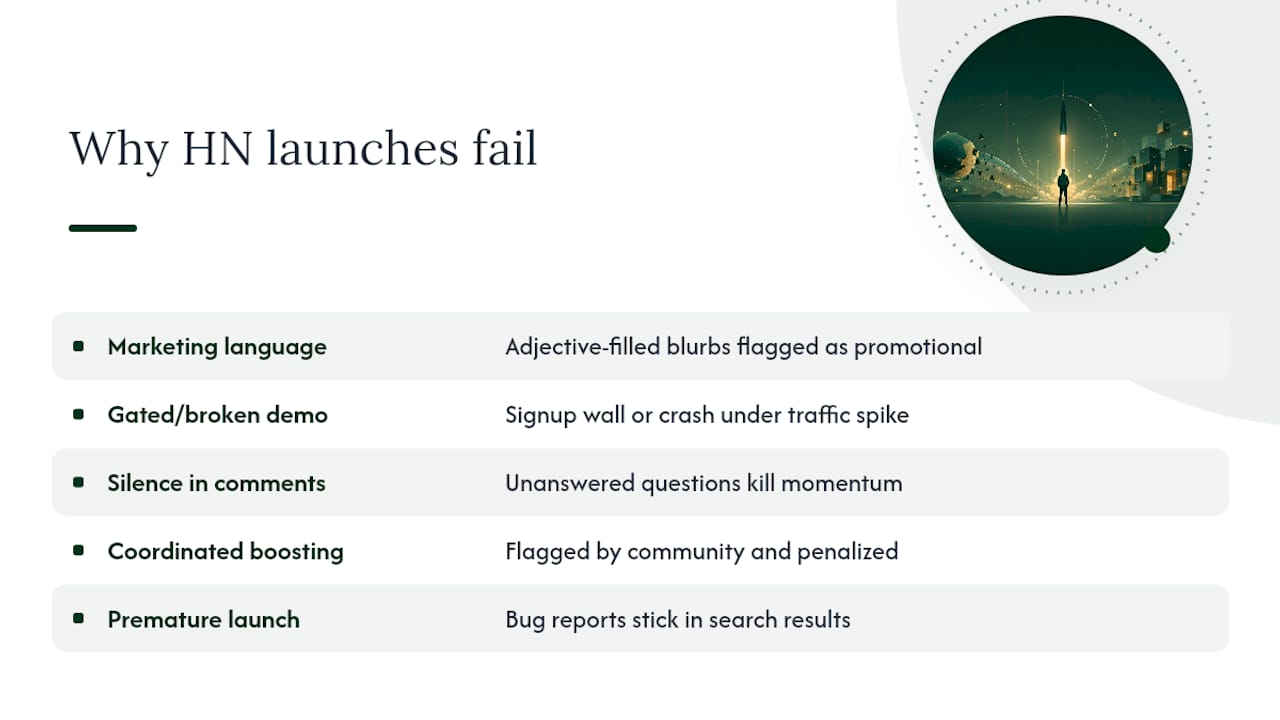
Why Launch HN and Show HN Posts Fail
Most failed launches share a small set of causes, and none of them are bad luck.
Marketing language is the most common one. A blurb full of adjectives like “seamless” or “revolutionary” gets flagged as promotional by an audience that actively resents being sold to, and the post gets buried in downvotes within the first hour.
A second frequent cause is a broken or gated demo. If a visitor hits a signup wall in the first ten seconds, they leave and often leave a comment about it, which then discourages the next reader from even trying. Slow load times under the traffic spike cause the same damage; a demo that worked fine in testing can buckle the moment a real launch-day crowd shows up.
Silence in the comments kills posts almost as reliably. A thread with unanswered questions two hours in signals to both readers and the ranking system that nobody’s home, and momentum that could have carried the post to the front page instead evaporates.
Coordinated boosting is the fastest way to actively damage a launch rather than merely fail to help it. HN’s community and admin guidance both flag it directly, and once flagged, a post can get penalized hard enough to disappear from view entirely, not just fail to climb.
Finally, posts that arrive too early, before the product can survive real scrutiny, tend to generate a wave of bug reports and unresolved complaints that stick to the thread permanently. Hacker News threads rank well in search results for years, so a rough launch thread can keep surfacing to future prospects long after the bugs are fixed.
Keeping the Momentum After Launch Day Ends
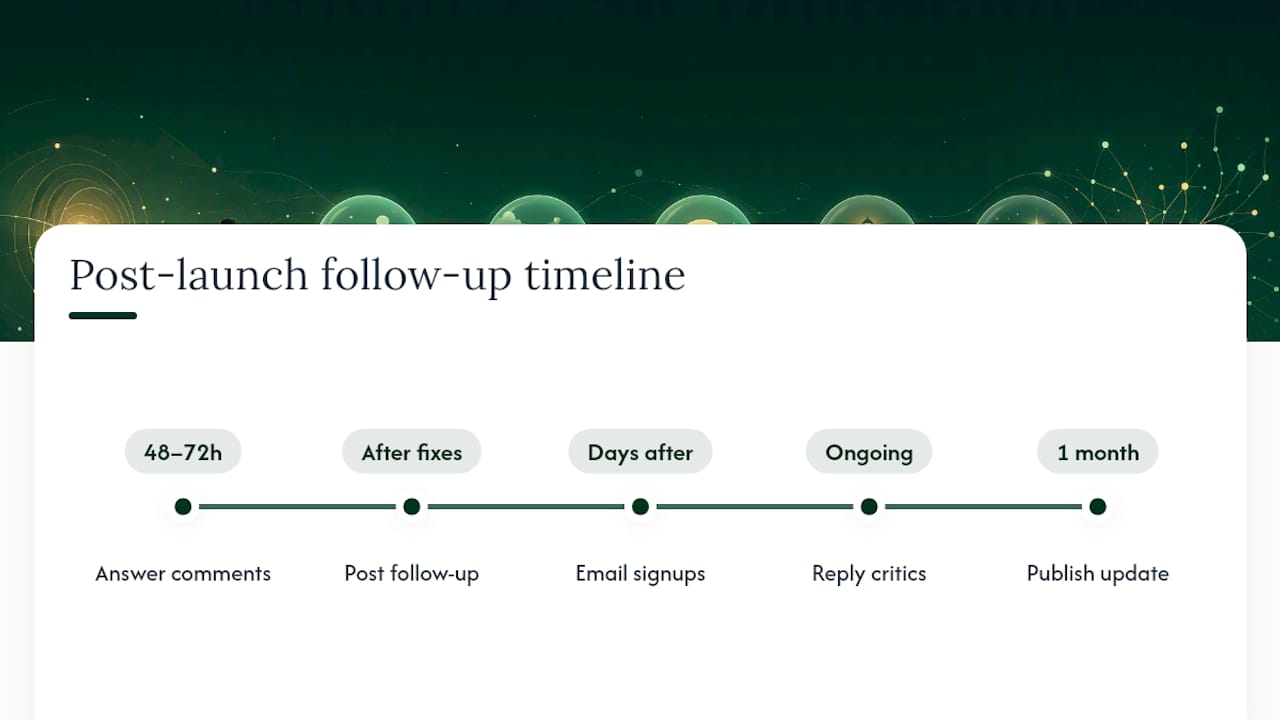
The thread doesn’t stop mattering once it drops off the front page. People find old Launch HN and Show HN posts through search for years, and a thread with unanswered questions or stale information keeps costing you credibility long after launch day.
Go back into your thread 48 to 72 hours later and answer anything left hanging. Then, once you’ve fixed the bugs your launch-day traffic surfaced, post a brief follow-up comment noting what changed. That single habit, quietly closing the loop, does more for long-term trust than almost anything you can plan in advance.
Beyond the thread itself, the signups and feedback from launch day are raw material, not a finish line. Email the people who signed up during the spike while your product is still fresh in their mind, ask specific questions about what confused them, and follow up individually with anyone who left detailed technical criticism in the comments. Those critics are often your most engaged potential users, and a direct, personal reply frequently turns a skeptical commenter into an advocate.
Sustained visibility also depends on treating your Launch HN or Show HN post as one data point in a longer-term visibility plan, not the whole plan. A single spike in traffic rarely converts into lasting growth on its own; it needs follow-on coverage, continued product updates, and a reason for people to come back and check what changed. Founders who publish a short “what we shipped since launch” update a month later, whether as a blog post or a fresh Show HN, tend to see a second, smaller wave of attention that compounds on the first.
Rules You Can’t Break When Posting on Hacker News
Hacker News runs on a small set of firm community norms, and violating them gets posts killed or accounts flagged, sometimes permanently.
Self-promotion is allowed within limits, that’s the entire premise of Show HN, but it has to read as sharing something you built, not advertising it. Repeated posting of the same product, excessive links back to your own site within unrelated threads, or submitting under multiple accounts to get extra visibility all violate community norms and typically get caught quickly by moderators or by the community itself flagging the post.
Content that’s illegal, deceptive, or designed to harvest personal data without disclosure has no place on the site regardless of how it’s framed. Misrepresenting who you are, claiming affiliation you don’t have, or hiding that a post is commercially motivated when it plainly is, all breach the basic trust the community runs on.
Vote manipulation, whether through coordinated boosting, sock puppet accounts, or paid upvote services, is treated as a serious violation, not a gray area. HN’s moderation team actively detects unusual voting patterns, and a caught manipulation attempt can get a post killed outright and the account associated with it banned.
None of this is exotic. The baseline expectation is straightforward: post as yourself, describe your product honestly, and let the community decide on its merits. Founders who try to shortcut that process almost always end up worse off than if they’d simply posted and waited.
What I’ve Learned Watching HN Launches Succeed and Fail
The founders who do well on Hacker News share one trait: they’re comfortable being wrong in public. The ones who treat every critical comment as an attack burn their own thread. The ones who say “good catch, here’s how that actually works” turn skeptics into contributors within an hour.
Three things separate the launches that land from the ones that don’t. Listen before you defend, most early comments are trying to help even when they sound blunt. Explain the mechanism, not the benefit, HN readers want to know how something works, not why it’s great. Follow up after the dust settles, because the thread outlives launch day by years in search results.
— Nik
Getting Launch-Ready Without Doing It Alone
Most of what makes a Hacker News launch land, tight messaging, a demo that holds up under real traffic, an honest pricing explanation, is work founders can absolutely do themselves, especially when using AI for Entrepreneurs to move fast on ideas. The gap shows up when a small team is trying to write the post, fix the last bugs, and handle fundraising in the same week. That’s the specific moment outside help exists to fill: a second set of eyes that catches the marketing language creeping into your draft, pressure-tests your demo before commenters do, and lines up earned-media coverage to run alongside the launch instead of competing with your HN thread for attention.

Storylinepros works from proprietary technical layer built specifically to get startups cited in AI-driven search, not just ranked in traditional results, which matters as much for investor visibility as for the launch-day traffic spike itself. If your team is heading into a launch window and stretched thin on bandwidth, see how Storylinepros approaches visibility campaigns and get a sense of whether outside help makes sense for your timeline.
Primary Sources to Read Before You Submit
Read these directly rather than relying on secondhand summaries, the wording matters more than it looks:
- Launch HN Instructions, the official rules on tone, structure, and logistics.
- Launches | Hacker News, a live index of recent posts and their community reception.
- Launch on Hacker News discussion, a candid community thread on what actually works.
- How to launch a dev tool on Hacker News, a practitioner breakdown with annotated examples.
Sources
- Launch HN Instructions
- Launch on Hacker News | Hacker News
- Launches | Hacker News
- How to launch a dev tool on Hacker News
FAQ
When Did Hacker News Launch?
Hacker News launched as an offshoot of Y Combinator, originally under the name “Startup News,” before being renamed to Hacker News shortly after.
Is Hacker News a Legitimate News Source?
Hacker News is a community-curated link aggregator and discussion forum, not a traditional newsroom; it surfaces and discusses stories from outside sources rather than producing original reporting itself.
Who Started Hacker News?
Hacker News was created by Paul Graham as part of Y Combinator, the startup accelerator he co-founded.
Who Is the CEO of The Hacker News?
The Hacker News (thehackernews.com) is a separate cybersecurity news publication unrelated to Y Combinator’s Hacker News forum; the two are frequently confused but have no organizational connection.
Do I Need to Be a YC Company to Post on Hacker News?
No. Launch HN is reserved for YC-funded startups, but Show HN is open to any founder or maker, and it’s the primary channel most companies use to share what they’ve built.