

LLM SEO: How to Get Your Brand Cited by AI Search
Getting cited by ChatGPT, Perplexity, or Google’s AI Overviews comes down to four things: crawlability, answer-first structure, third-party corroboration, and continuous measurement. Skip any one of them and your brand stays invisible no matter how good your content is. Here’s what to fix first.
Start with these five moves, in order:
- Verify crawler access. Confirm GPTBot, BingBot, and PerplexityBot can actually reach your site, and register with Bing Webmaster Tools.
- Rewrite your top pages answer-first. Put the direct answer in the opening 150 words, not buried after a history lesson.
- Add structured data. Article, FAQPage, and HowTo schema give AI systems a clean map of your claims.
- Earn three independent mentions. A listicle, a Reddit thread, and a review site citation do more for citation odds than another blog post.
- Run prompt tests monthly. Track whether you show up, and where.
The stakes are real: HBR reports that a large share of consumers used generative AI tools for product recommendations by 2024, increasing notably from the previous year, and that AI referrals to U.S. retail sites surged significantly during that year’s holiday season. Agencies like Storylinepros build their entire technical layer around this shift, treating AI citation as a measurable, engineerable outcome rather than a hope.
Key Takeaways
Winning AI citations requires crawlable infrastructure, answer-first content structure, independent corroboration, and monthly measurement working together, not in isolation.
| Point | Details |
|---|---|
| Crawlability is the gate | Verify GPTBot, BingBot, and PerplexityBot access before investing in content or outreach. |
| Bing matters more than expected | ChatGPT’s web-search mode draws primarily from Bing’s index, making Bing Webmaster Tools essential. |
| Structure drives citation | Chunked, schema-tagged, answer-first pages earn 3 to 5 times more AI citations than unstructured ones. |
| Corroboration compounds | Three independent mentions, paired with original data, multiply citation probability more than either alone. |
| Storylinepros operationalizes the playbook | Combines technical fixes, content capsules, and earned placements with trackable citation KPIs for startup clients. |
Table of Contents
- What LLM SEO Actually Means
- Why LLM SEO Matters Now
- Making Your Site Crawlable For AI Systems
- How to Write Content That AI Models Will Cite
- Do Third-Party Mentions Really Boost AI Citations?
- How Do You Measure LLM SEO Progress?
- Your Quarter-One LLM SEO Checklist
- How a Managed Approach Puts This Playbook Into Practice
- When Content Isn’t Enough: RAG and Fine-Tuning Trade-Offs
- Get Cited, Not Just Ranked
- Where to Go Deeper on LLM SEO
- Frequently Asked Questions
- Sources
What LLM SEO Actually Means
LLM SEO, also called generative engine optimization (GEO) or answer engine optimization (AEO), is the practice of structuring content and technical infrastructure so large language models can find, trust, and cite your brand in generated answers. It’s the same instinct behind classic SEO, applied to a different scoreboard.
Traditional SEO chases a ranked position on a results page. LLM SEO chases something different: does the model mention you, cite you, or recommend you when a user asks a relevant question? A page can rank #1 on Google and never surface in a ChatGPT answer, and a page buried on page three can get cited constantly if it’s structured for extraction.
Three retrieval modes matter here:
- Training-data signal: what the model absorbed during pretraining, which you can’t edit retroactively.
- Live retrieval: real-time web search, where ChatGPT’s web-search mode pulls primarily from Bing’s index.
- Grounding: the model checking a claim against retrieved sources before stating it as fact.
Most of your leverage sits in live retrieval and grounding, not in hoping you got baked into training data.
Why LLM SEO Matters Now
The adoption curve is steep enough that ignoring it is a business risk, not a theoretical one. It’s becoming the default first stop for people comparing products, vetting vendors, or researching a purchase.
The risk runs both directions:
- Invisible brand mentions: if your competitor’s product gets cited in an AI answer and yours doesn’t, you lose the sale before the buyer ever visits your site.
- Higher-qualified discovery: buyers who reach you through an AI citation typically arrive already convinced by a synthesized recommendation, not just a blue link.
- Compounding effect: one citation often triggers more, since models weight consistently-corroborated entities more heavily in future retrieval.
Picture two SaaS companies with nearly identical products. One has a Wikipedia entry, three trade-press mentions, and a Reddit thread recommending it. The other has none of that, despite better product-market fit on paper. When a buyer asks ChatGPT “what’s the best tool for X,” only the first company gets named. The second doesn’t lose because its product is worse. It loses because it’s not part of the answer.
Making Your Site Crawlable For AI Systems
If an AI crawler can’t reach your page, none of your content strategy matters. This is the gating layer, and most teams skip straight past it to worry about writing style instead.
- Open your robots.txt to AI crawlers. Explicitly allow GPTBot, BingBot, ClaudeBot, and PerplexityBot. Check for accidental blanket disallows left over from a staging environment or an overzealous security plugin.
- Register and verify in Bing Webmaster Tools. Since ChatGPT’s browsing mode leans on Bing’s index, skipping Bing while obsessing over Google Search Console leaves a real gap in your visibility.
- Submit a sitemap with accurate lastmod dates. Stale or missing lastmod timestamps understate how fresh your content actually is.
- Enable IndexNow. This pushes new and updated URLs to Bing and other participants near-instantly instead of waiting on a crawl cycle.
- Server-side render anything citable. If a key stat or claim only renders after client-side JavaScript executes, many crawlers never see it. Reduce Time to First Byte too. Slow servers cause crawler timeouts before your best content even loads.
- Consider publishing an llms.txt file. Yoast recommends this simple text file at your root domain, listing your most important pages and a plain-language description of what your site covers, as a direct signal to AI systems about what you want surfaced.
Pro Tip: Log GPTBot and BingBot crawl activity separately in your server logs. If BingBot visits daily but GPTBot never shows up, you have a targeted blocking issue, not a general crawlability problem, and it’s fixable in an afternoon.
Practitioners increasingly treat crawler access as a binary gate: if AI systems can’t index or reach your page, your citation probability is effectively zero, regardless of content quality.
How to Write Content That AI Models Will Cite
Once a page is reachable, the next question is whether it’s structured for extraction. Models don’t read the way humans skim. They chunk content into discrete passages and score each one for how cleanly it answers a specific query.
The highest-leverage move is the answer-first capsule: a tight 120 to 300-word block directly under your main H2 that answers the conversational version of that question, no preamble. Follow it with short, self-contained H3 sections, each building toward a related sub-answer.
- Use numbered or bulleted lists for anything genuinely quotable, like a checklist, a ranking, or a set of steps.
- Label definitions clearly (“X is defined as…”) so a model can lift them cleanly.
- Include original statistics and short, quotable takeaways, each with a proper source link, since fabricated grounding gets flagged fast.
- Add Article, FAQPage, and HowTo JSON-LD schema, including author, datePublished, dateModified, and sameAs fields, wherever the content type fits.
The structural gap between generic and extraction-ready content is stark:
| Content pattern | Citation outcome |
|---|---|
| Long intro before the answer | Model has to guess where the real content starts, often skips the page |
| Answer-first capsule under H2 | Model can lift the passage directly as a citable chunk |
| No schema markup | Model relies on parsing raw HTML, increasing error risk |
| Article/FAQ/HowTo schema present | Model gets explicit, machine-readable structure to trust |
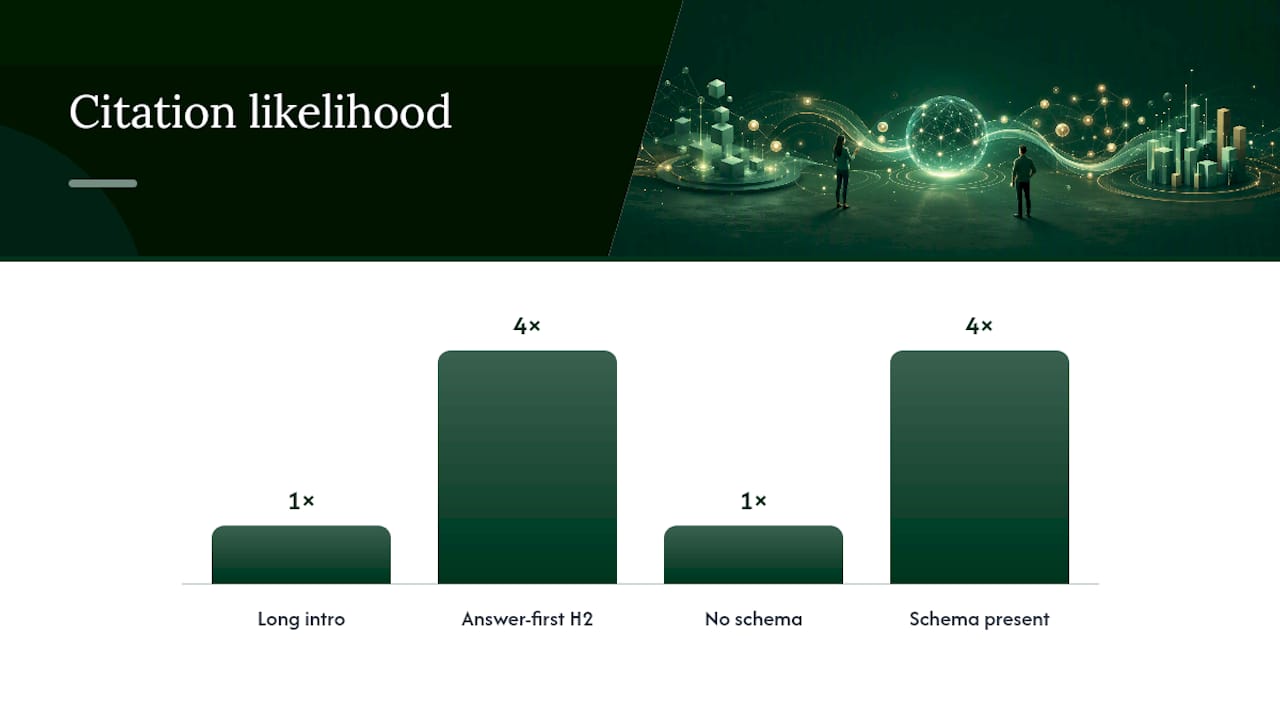
Chunked, schema-tagged pages received 3 to 5 times more citations than unstructured competitors in practitioner studies. That’s not a marginal formatting preference. It’s the difference between showing up and disappearing.
Do Third-Party Mentions Really Boost AI Citations?
Yes, and the effect compounds. A page you control talking about your own product carries less weight than an independent source saying the same thing, because models weight corroboration as a trust signal, not just relevance.
Listicles, trade press, Reddit threads, G2 reviews, and Wikipedia entries all function as votes of confidence that a model can cross-reference against your own site. When three unrelated sources describe your company the same way, that consistency itself becomes a signal worth citing.
Tactics that actually move the needle:
- Publish one data-led report or original study per quarter. Journalists and listicle writers need something to cite, and original data gives them a reason to link back.
- Pitch targeted PR to outlets your buyers already read, not broad-reach publications with no topical relevance.
- Encourage reviews on G2, Capterra, or category-specific directories where your buyers actually research vendors.
- Seed accurate mentions in relevant forums and community threads, answering real questions rather than dropping links.
- Keep your entity description consistent everywhere. If one outlet calls you a “visibility platform” and another calls you a “PR agency,” you dilute the exact match a model looks for.
Pro Tip: Write a single, tight one-sentence description of what your company does and paste it, unmodified, into every pitch, bio, and directory listing you control. Consistency across sources matters more than clever variation.
Stacking original data with earned mentions multiplies citation probability far more than either tactic alone, since one supplies the raw material and the other supplies the distribution.
How Do You Measure LLM SEO Progress?
You can’t optimize what you don’t track, and prompt-based testing is the closest thing this discipline has to a rank tracker.
- Build a list of 20 real buyer prompts, the actual conversational questions your customers would type into ChatGPT or Perplexity, not keyword-style queries.
- Run them monthly across at least two models, recording the model used, the full response, and every cited source.
- Calculate your citation rate: the percentage of prompts where your brand appears at all, and your branded share among competitors that also got mentioned.
- Set up a GA4 “AI referrals” channel to catch traffic from chat-supplied UTMs and referral domains like chat.openai.com or perplexity.ai.
- Treat single-digit sample sizes as noise. Twenty prompts run once tells you little. Twenty prompts run monthly for a quarter tells you a trend.
A handful of AI-citation tracking tools now automate this prompt-testing loop, reporting citation rate and share of voice the way rank trackers once reported position.
Your Quarter-One LLM SEO Checklist
Ten tasks, ranked by what actually moves the needle first:
- Verify Bing Webmaster Tools and bot access. Low effort, high impact. Do this in week one.
- Rewrite five flagship pages answer-first. Medium effort, high impact.
- Add Article and FAQ JSON-LD sitewide. Medium effort, high impact.
- Publish one original data report for outreach. High effort, high impact.
- Submit llms.txt and enable IndexNow. Low effort, medium impact.
- Server-side render key claims currently hidden behind JavaScript. High effort, high impact.
- Run prompt tests weekly on your priority queries. Low effort, medium impact, compounding over time.
- Earn three third-party mentions this quarter. High effort, high impact.
- Monitor GPTBot logs and fix any TTFB bottlenecks. Medium effort, medium impact.
- Enforce Last-Modified header discipline on every substantial content update. Low effort, medium impact.
A solo SEO should start at tasks 1, 5, and 7, since they need no design or dev resources. A cross-functional team can run 2, 3, 4, 6, and 8 in parallel within a single sprint cycle.
How a Managed Approach Puts This Playbook Into Practice
Storylinepros builds this exact playbook into a repeatable operating model rather than a one-time audit: technical crawl fixes, answer-first content capsules, earned media placements, and structured community seeding, all tied to trackable citation KPIs. Their case studies document measurable gains in AI search visibility and citation frequency for startup clients working from a similar starting point to what’s described above.
Three things worth replicating regardless of who executes them:
- Treat crawlability as a gate to clear before investing in content polish.
- Pair every content push with a corroboration push. Neither works as well alone.
- Track citation rate monthly, not quarterly. AI answer patterns shift faster than search rankings ever did.
When Content Isn’t Enough: RAG and Fine-Tuning Trade-Offs
Content and earned corroboration solve most discovery queries. That covers the vast majority of what marketers need. But if you’re building a branded assistant or need consistent, precise answers about proprietary data, OpenAI’s own guidance says start with retrieval, not fine-tuning. Fine-tuning costs more, in engineering time and ongoing maintenance, than most teams should spend before retrieval has even been tried and found wanting.
Get Cited, Not Just Ranked
Storylinepros exists for founders who need AI search visibility now, not after a twelve-month retainer with no guaranteed outcome. Instead of billing for effort, Storylinepros ties its work to delivered placements: earned media, podcast guest spots, programmatic syndication, and the technical fixes covered above, all tracked against measurable citation and visibility gains.

The evaluation checklist for any prospective client is simple: does the engagement include technical crawlability work, structured content builds, third-party placements, and a way to measure citation rate over time? If an agency can’t answer yes to all four, you’re buying activity, not outcomes. Storylinepros’ case studies walk through what that looked like for startups going from zero AI visibility to consistent citation across model answers. Visit Storylinepros to see how a pilot engagement could apply to your own visibility gaps this quarter.
Where to Go Deeper on LLM SEO
- HBR’s LLM adoption summary: consumer adoption data behind the urgency.
- AtomicAGI’s ChatGPT ranking guide: the Bing-index mechanics explained.
- OpenAI’s optimization guide: when RAG and fine-tuning actually apply.
- Yoast’s LLM SEO primer: practical llms.txt and FAQ tactics.
- CrawlRaven’s visibility loop: the crawlable-to-tracked framework.
- Vercel’s SEO adaptation post: platform-level framing for LLM SEO.
Frequently Asked Questions
What’s the difference between LLM SEO and traditional SEO? Traditional SEO optimizes for ranked position on a results page. LLM SEO optimizes for whether an AI model mentions, cites, or recommends your brand inside a generated answer, a different unit of success entirely.
Do I need to abandon traditional SEO to focus on LLM SEO? No. Strong technical SEO, backlinks, and site authority still feed AI visibility, since models often draw on the same indexed web data. Treat LLM SEO as an added layer, not a replacement.
How long does it take to see AI citation results? Crawlability fixes can shift bot access within days. Content restructuring and corroboration efforts typically take a full quarter to show measurable movement in prompt-based tracking.
Is llms.txt required for AI visibility? It’s not required, but it’s a low-effort signal some AI systems use to understand site structure and priority content, and it takes minutes to publish.
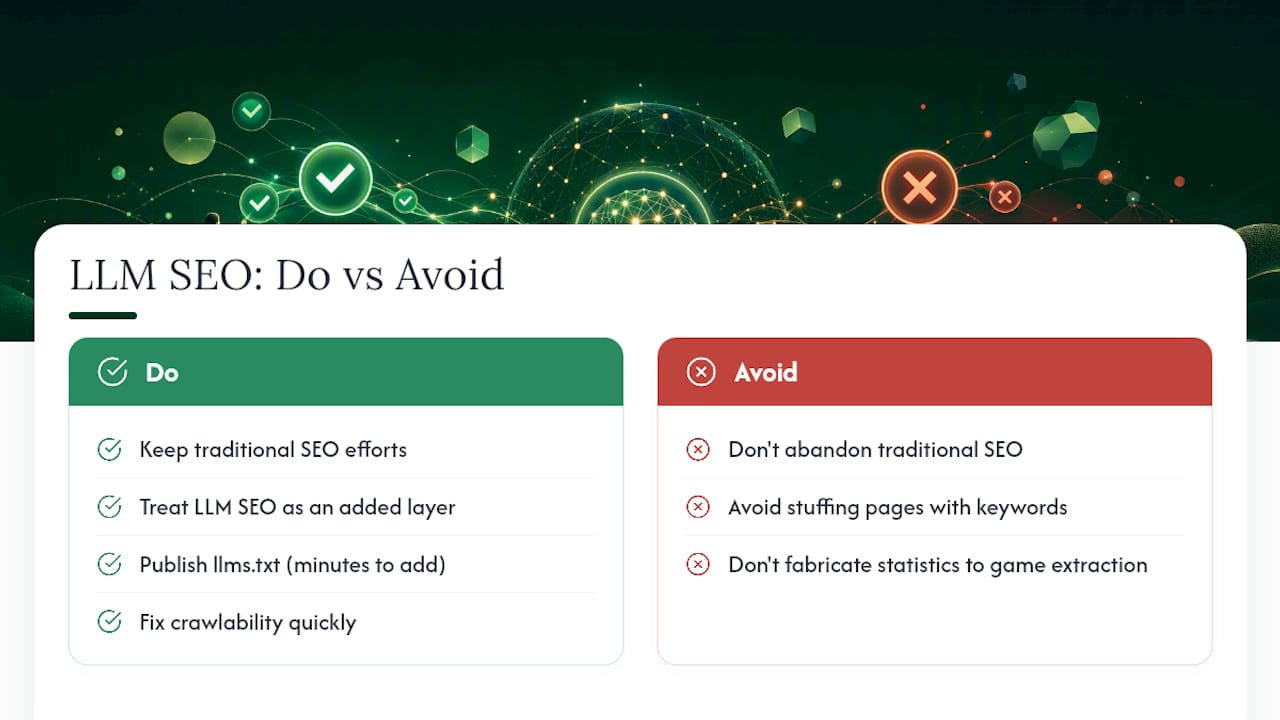
Can over-optimizing for AI citations backfire? Yes. Stuffing pages with keyword-heavy phrasing or fabricated statistics to game extraction can trigger trust penalties once models or their retrieval layers detect inconsistency between your claims and independent sources.
Sources
- Forget What You Know About Search. Optimize Your Brand for LLMs. (HBR)
- How to rank in ChatGPT: the complete guide to AI search visibility (AtomicAGI)
- Optimizing LLM accuracy | OpenAI API
- LLM SEO: The Complete Guide to Ranking in AI Answers (CrawlRaven)
- What is LLM SEO? Optimizing for AI search and Google • Yoast