

Podcast Backlinks: A 2026 Playbook for SEO Teams
Podcast backlinks are one of the few editorial link sources left where a single conversation reliably earns you a followed, contextual link on a real domain. Not every show delivers one, but the shows that publish real episode pages and show notes do, consistently. Here’s the fastest way to test the channel this week.
Run these three steps in the next 48 hours:
- Pull a list of 10 shows in your niche that already link out to past guests in their show notes.
- Open three of their recent episode pages and confirm the link format (dofollow text link, not a plain-text mention buried in a paragraph).
- Send one personalized pitch today, referencing a specific recent episode and proposing two or three talking points a listener would actually want.
A well-vetted appearance typically produces two to five external links from a single episode’s show notes, plus directory citations. That’s a reasonable return for one 30-minute recording, and it’s the fastest way to know whether this channel is worth building into your ongoing link strategy.
Key Takeaways
Podcast backlinks deliver repeatable editorial links when you vet shows for indexable episode pages, confirm link placement before recording, and back every appearance with a guest-owned recap post.
| Point | Details |
|---|---|
| Vet before pitching | Confirm the show has real, indexable episode pages with dofollow outbound links before you invest time. |
| Expect 2 to 5 links per episode | Set realistic yield expectations using show notes, directories, and your own recap post combined. |
| Lock in link details early | Confirm URL, anchor text, and link status during scheduling, not after the episode airs. |
| Track ROI over months, not weeks | Ranking impact typically compounds over three to six months of consistent appearances. |
| Consider a managed workflow | Storylinepros runs AI-assisted discovery, pitching, and link verification for teams that want tracked outcomes without building the system in house. |
Where to Go Deeper
- Rephonic for scaled show discovery and filtering.
- PodMatch style matching platforms for faster booking once your pitch templates are dialed in.
- SpeakerHub’s guide to AI-assisted booking for media kit and CRM workflow tips.
- SEO Sandwitch’s operational playbook for the technical vetting checklist covered above.
Table of Contents
- What Is Podcast Link Building and Where Do the Links Live?
- Why Podcast Backlinks Matter for SEO and Lead Generation
- How Do You Know a Podcast Backlink Is Worth Pursuing?
- Finding Podcast Backlink Opportunities at Scale
- How Do You Pitch Hosts to Earn a Show-Note Link?
- What to Do After Recording to Lock In the Backlink
- How Do You Measure Podcast Backlink ROI?
- What Are the Biggest Red Flags in Podcast Link Building?
- What Does a Repeatable Podcast Backlink Workflow Look Like?
- Should You Run This In House or Hire It Out?
- How Storylinepros Turns Podcast Guesting Into Tracked Backlinks
- Frequently Asked Questions
- Sources
What Is Podcast Link Building and Where Do the Links Live?
Podcast link building means earning editorial backlinks by appearing as a guest, then capturing the links that show up around that appearance. It’s not guest posting with a microphone. The link isn’t something you write. It’s something the host publishes because you gave their audience something worth referencing.
A single guest slot can generate links in several places, and each one carries different SEO weight:
- Host episode page — the primary page for the episode, often the strongest link if the show has real domain authority and a clean site structure.
- Show notes — the summary text under or alongside the embedded player, which is where most guest links actually live.
- Transcript pages — some shows publish full transcripts as separate indexed pages, doubling your link surface.
- Directory citations — aggregators and podcast directories that syndicate episode metadata and sometimes carry guest bio links.
- Guest recap posts — a page the host builds specifically to promote the episode, distinct from the show notes themselves.
Search Engine Journal’s reporting on podcast backlinks notes that these links are contextual and editorial by nature. They exist because a real host decided your expertise was worth referencing to a real audience, which is exactly the kind of signal link building has been chasing since Google started devaluing paid and low-context links.
Statistic callout: Show notes typically carry two to five external links per episode. That’s your baseline for judging whether a show’s linking habits are worth pursuing at all.
Why Podcast Backlinks Matter for SEO and Lead Generation
The SEO value comes from context around backlinks, not just the link itself. A backlink from a marketing podcast’s episode page, sitting next to a paragraph about your specific area of expertise, tells search engines something a directory listing never can: that a real publisher considers you relevant to that topic. That’s a stronger relevance signal than most guest posts, which are often written to satisfy an editorial calendar rather than to reflect genuine topical authority.
The SEO payoff is only part of the case, though. Three other benefits tend to compound over time:
- Referral traffic that arrives already warmed up, since listeners heard you talk for 30 to 45 minutes before clicking through.
- Brand trust, because being interviewed reads as third-party validation in a way that a self-published blog post never will.
- Lead generation, particularly in B2B, where podcast audiences skew toward decision-makers who listen during commutes and workouts rather than skimming search results.
Digistore24’s analysis of podcast-first link building makes a useful comparison: a single podcast conversation naturally produces a diverse link profile (host domain, directory, syndication, and any recap post you build) in a way that cold outreach for guest posts almost never replicates from one placement.
Pro Tip: Don’t chase domain rating alone. A niche show with 3,000 downloads an episode and a highly relevant audience will often outrank the SEO value of a generic 50,000-download show that’s off-topic for your industry. Relevance beats raw authority almost every time in podcast link building.
How Do You Know a Podcast Backlink Is Worth Pursuing?
Not every guest slot produces a usable link, and figuring that out before you pitch saves hours of wasted outreach. Some hosts mention guests only by first name in an audio intro with zero corresponding text online. Others maintain a full guest archive with bios, links, and transcripts going back years. The difference determines whether your appearance turns into an SEO asset or just a nice conversation nobody can find later.
Start with the link type itself. Episode pages and transcript pages usually pass link equity when built correctly. Show notes vary. Directory citations rarely carry much weight alone but add to a natural-looking link profile. Guest recap posts, when you control them, are the most reliable of the bunch because you decide the anchor text and destination page.
Before pitching, open a few recent episode pages and check the underlying HTML for whether outbound guest links are actually coded as followed links, since some hosts nofollow every external link as a blanket policy. Also check whether the page is canonicalized to itself and not blocked by a robots directive, because a page can look perfect and still be excluded from indexing behind the scenes, a nuance explained in Bing’s own documentation on how search results get delivered.
| Evaluation criteria | What to check |
|---|---|
| Audience relevance / topical fit | Recent episode topics match your niche, not just adjacent industries |
| Link presence and type | Show notes/episode page have visible outbound links, dofollow, not buried in text |
| Site authority / domain quality | Domain rating, indexed page count, and organic traffic trend |
| Ease of booking / responsiveness | Guest form exists, recent guest turnaround under two weeks |
| Expected link yield | Multiple link types (episode page, show notes, directory, recap) vs. just one |
| Tools & workflow fit | Discovery tool coverage, CRM/tracking support for outreach at scale |
Finding Podcast Backlink Opportunities at Scale
Manually searching “podcast + [your niche]” gets you maybe 15 shows before the results turn stale. A repeatable discovery workflow gets you hundreds of qualified prospects, filtered down to the ones actually worth pitching.
Three tools cover most of the workflow:
- Rephonic handles discovery at scale, letting you filter shows by audience size, category, and guest history so you’re not manually clicking through hundreds of RSS feeds.
- PodMatch works more like a matching platform, connecting guests to hosts actively looking for interviews, which speeds up booking for teams without an existing media list.
- SpeakerHUB functions as a media kit and lightweight CRM, useful once you’re managing dozens of active pitches and need to track where each one stands.
- Podchaser is worth adding for guest-credit research, letting you see who else has appeared on a show and cross-reference their backlink outcomes.
Here’s the workflow that scales without turning into spreadsheet chaos:
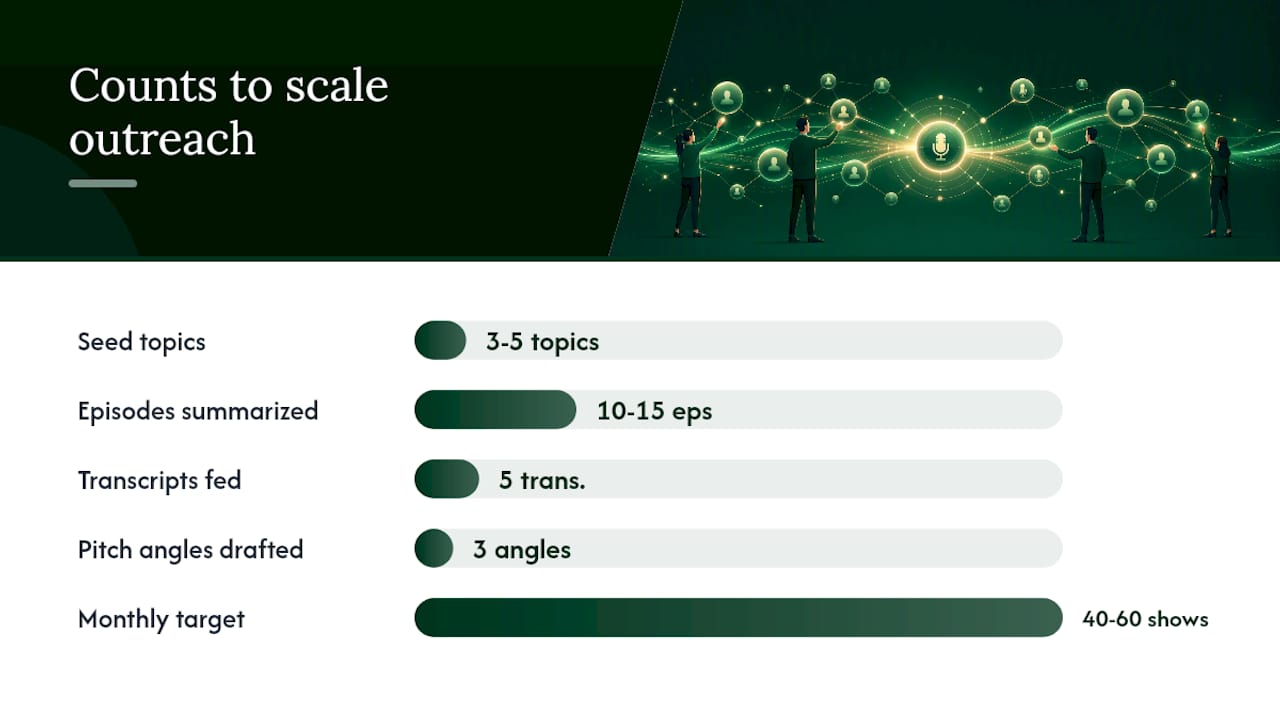
- Define three to five seed topics that map directly to the pages you want to rank.
- Use an LLM to summarize a show’s last 10 to 15 episodes and flag content gaps your expertise fills.
- Filter the resulting list for link signals: does the show have show notes at all, and do recent episodes link out to guests?
- Export the qualified list into a CRM or spreadsheet with contact info, last episode date, and link format noted per show.
- Prioritize outreach by vetting score, not just download numbers.
A campaign of 40 to 60 vetted shows is a realistic monthly target for one person running this part time. Filter aggressively for guest acceptance history and recent publishing activity. A show that hasn’t published in four months is a dead end regardless of its archive quality, a point echoed in vetting guidance from SEO Sandwitch’s breakdown of show-note link building.
Pro Tip: Feed your LLM the show’s last five episode transcripts and ask it to draft three pitch angles tied to gaps in their coverage. This single step usually doubles response rates because the pitch reads like it came from someone who actually listens.
How Do You Pitch Hosts to Earn a Show-Note Link?
The pitch is where most podcast link building campaigns fail, not because the idea is wrong but because the execution reads like a mass blast. Hosts get a dozen generic guest pitches a week. The ones that land reference something specific and make the host’s job easier, not harder.
A pitch template that consistently books shows:
Subject: Quick idea for [Show Name] listeners
Hi [Host name],
I caught your episode with [recent guest] on [topic] and appreciated the point about [specific detail]. It got me thinking about [related angle you’re positioned to speak on].
I work on [specific area of expertise] at [company], and I’d love to bring your listeners a practical angle on:
- [Talking point one]
- [Talking point two]
- [Talking point three]
Happy to work around your schedule, and I’ll send over a full bio and past clips whenever useful.
[Your name]
Buzzsprout’s guide to getting booked on podcasts confirms the pattern that works best: reference a specific episode, propose concrete listener-benefit topics, and include social proof rather than a generic credentials list.
Follow-up matters as much as the initial pitch. A workable cadence:
- Day 0: Send the initial pitch with the template above.
- Day 5: Follow up with one additional proof point, like a link to a past appearance or a relevant piece of coverage.
- Day 12: Send a brief, low-pressure bump asking if the timing works better later in the quarter.
Avoid the signals that tank booking rates: templated blasts with no personalization, pitches with zero proof of speaking ability, and asking about link placement before the host has even agreed to record you. A few things separate the pitches that convert:
- Do reference something specific from a recent episode.
- Do propose concrete topics, not vague “I’d love to chat about my journey” framing.
- Don’t ask for a guaranteed link before the host has agreed to book you.
- Don’t send the same template to 50 hosts without swapping a single detail.
Pro Tip: Raise the link expectation during scheduling, not after recording. A simple line like, “I’ll send over a short recap post you’re welcome to link to in the show notes,” sets the expectation early and avoids the awkward post-episode ask that a lot of guests get wrong.
What to Do After Recording to Lock In the Backlink
The recording is only half the job. What happens in the two weeks after determines whether you get one link or four.
Before the episode goes live, confirm three things directly with the host or their producer: the exact URL going into the show notes, whether the link will be dofollow, and where your name or brand appears as anchor text. This single confirmation step, outlined in SEO Sandwitch’s operational playbook, prevents the most common failure in podcast link building: the episode airs, and the promised link never materializes because nobody wrote it down.
Send the host a package that makes their job easier:
- A two-sentence bio with your preferred link and anchor text already written out.
- A short resource list relevant to what you discussed, in case they want to link to more than one page.
- A dedicated recap post on your own site or blog that summarizes the episode and links back to the host, giving them an easy reciprocal link target.
Once the episode is live, don’t let it sit. Syndicate the recap post to LinkedIn and any newsletter or Substack you run, tag the host, and push a short audiogram or quote graphic. Each syndicated post is a secondary link opportunity, and hosts often reshare content that already has traction, which extends your reach well past the original episode’s listener base.
How Do You Measure Podcast Backlink ROI?
Treat this like any other link-building channel: set the KPIs before you start pitching, not after the first few episodes air.
Track these metrics per campaign:
- Number of indexable, dofollow links actually secured (not promised).
- Domain rating mix across secured links, so you can see whether you’re building a lopsided profile.
- Referral sessions landing on a UTM-tagged page from each episode.
- Conversion events tied to that referral traffic, whether that’s a demo request or a newsletter signup.
- Time-to-index for each new link, tracked in your backlink monitoring tool.
The setup is straightforward: build a UTM-tagged landing page for podcast referrals, monitor new backlinks in a tool like Ahrefs or Semrush, and set up GA4 events to attribute conversions back to the specific episode that drove them.
Timing matters for expectations. New links typically get crawled and indexed within days to a few weeks, but the actual ranking and authority impact tends to compound over three to six months of consistent activity, not from one appearance in isolation.
Pro Tip: Judge a podcast link building program on a minimum of 15 to 20 completed appearances before drawing conclusions. Fewer than that, and normal variance in host behavior will skew your read on what’s actually working.
What Are the Biggest Red Flags in Podcast Link Building?
A few patterns waste time and produce nothing worth tracking.
- Shows with no real episode pages, just an embedded player and a two-line caption with no indexable text.
- Links formatted as plain text mentions rather than actual anchor tags.
- Hosts who nofollow every single outbound link as a blanket site policy.
- Publishing cadences that have gone quiet for months, no matter how good the back catalog looks.
- Any host clearly running a mass-guest mill with zero personalization in their booking process.
Operationally, the two most common mistakes are skipping the pre-recording link confirmation and never building a guest-owned recap post to fall back on. If a promised link goes missing after launch, a short, friendly follow-up referencing your original conversation about the link usually resolves it within a week. If it doesn’t, your recap post still captures most of the SEO and traffic value on its own.
Pro Tip: Keep a simple tracker with a “promised link” column filled in before the episode airs. It turns a vague memory into a concrete follow-up conversation two weeks later.
What Does a Repeatable Podcast Backlink Workflow Look Like?
A structured guesting program tends to follow a five-stage workflow, with clear ownership at each step: discovery, vetting, personalized pitching, pre-recording link confirmation, and post-appearance amplification.

In a typical monthly cycle, discovery and vetting happen in week one, using tools like Rephonic and Podchaser to build and score a prospect list. Pitching runs through weeks two and three, with follow-ups staggered on the cadence described earlier. Recording and link confirmation happen as bookings land, often weeks three through six depending on host availability. Amplification and monitoring run continuously after each episode airs.
The numeric outcome varies by industry and show quality, but a well-run monthly cycle of 40 to 60 pitches typically converts into a handful of booked appearances, each capable of producing multiple link types from a single conversation, consistent with the diverse link profile Digistore24 describes in its analysis of podcast-first link building. For specific client results, Storylinepros’s case studies walk through campaign-level outcomes rather than industry averages, which tend to vary too widely to be useful as a benchmark.
Statistic callout: Expect roughly two to five links per successfully vetted appearance once show notes, directories, and your own recap post are counted together.
Should You Run This In House or Hire It Out?
The honest answer depends less on budget and more on bandwidth. If your team can commit five to eight hours a week to discovery, pitching, and follow-up, a DIY program with AI-assisted research tools is genuinely workable and keeps the process close to your product knowledge.
Run through this checklist before deciding:
- Do you have someone who can own outreach consistently for at least three months?
- Do you need CRM-level tracking across dozens of simultaneous pitches?
- Is guaranteed placement volume important enough to justify paying for managed follow-through?
Most in-house SEO teams do fine piloting this manually for a month using the tools above before deciding whether to scale it internally or hand it to a specialist. If you do bring in an agency, ask specifically for sample placements, a reporting cadence, and proof of link verification, not just a list of shows they’ve pitched.
How Storylinepros Turns Podcast Guesting Into Tracked Backlinks
Most agencies charge a flat retainer whether or not you get booked anywhere, and you’re left guessing which appearances actually moved the needle. Storylinepros runs podcast guesting as a measurable pipeline, not a vague awareness play. That means AI-assisted show discovery filtered for real linking behavior, pitch execution built around the listener-benefit angles that actually get responses, and link verification after every episode airs, so you know exactly what landed and where.

If you’re evaluating a vendor for this, ask for the same things Storylinepros builds into every campaign: sample placements from a comparable industry, a defined reporting cadence, and an attribution method that ties episode appearances to actual traffic and pipeline, not just download counts. Review recent outcomes on the Storylinepros case studies page, then reach out through the Storylinepros site to scope a campaign built around your specific niche and target shows.
Frequently Asked Questions
Are podcast backlinks actually good for SEO? Yes, when the show publishes real episode pages with dofollow outbound links. The value comes from the editorial context and topical relevance, not just the link existing.
How many backlinks does one podcast appearance typically produce? Usually two to five external links from show notes alone, plus any directory citations or recap posts you add on top.
What’s the difference between dofollow and nofollow podcast backlinks? A dofollow link passes ranking signal to your site directly. A nofollow link still drives referral traffic and brand exposure but doesn’t pass that same equity, which is why checking link status before pitching matters.
How do I find podcasts that actually link to their guests? Use a discovery tool like Rephonic to filter by niche and audience size, then manually check three or four recent episode pages per show to confirm they publish real show notes with outbound links.
How long before podcast backlinks affect my rankings? New links usually get indexed within days to a few weeks. The actual ranking and authority impact tends to build over three to six months of consistent guest appearances rather than a single episode.
Sources
- How to Use Podcasts for Link Building 2026 Full Guide
- 7 Proven Steps to Earn Backlinks From Podcast Show Notes
- Getting booked on podcasts (Buzzsprout guide)
- Podcast-First Link Building Beats Cold Outreach | Digistore24 Blog