

Marketers: Turn PR and Content Into SEO Driving Assets
Neither wins on its own: use public relations when you need fast, third-party credibility, and content marketing when you need sustained, compounding demand. If you’re launching something or managing a crisis, lead with PR. If you’re building a pipeline that outlasts any single news cycle, lead with content, then integrate the two so earned coverage feeds your owned assets instead of evaporating after a week.
TL;DR:
- Public relations provides quick credibility boosts through media placements, typically within days, but these placements tend to have short lifespans.
- Content marketing builds long-term visibility by creating search-optimized assets that can generate traffic for years, though it requires three to nine months to show results.
- Combining PR and content marketing in a shared workflow maximizes both immediate coverage and sustained growth, especially when repurposing earned media into owned assets.
- Relying solely on vanity metrics or treating PR and content as separate silos leads to missed opportunities for long-term pipeline development.
- The rise of digital channels and AI-driven search amplifies the need for integrated, cross-channel strategies that connect earned media, owned content, and community discussions.
Table of Contents
- PR vs Content Marketing: How the Two Disciplines Actually Differ
- When Should You Choose PR, Content Marketing, or Both?
- How to Build an Integrated PR and Content Marketing Workflow
- How Do You Measure PR and Content Marketing Results?
- What Practitioner Evidence Shows About Repurposing Earned Media
- Where Did the Rivalry Between PR and Content Marketing Come From?
- What Goes Wrong When Teams Implement PR and Content Marketing?
- What Do Successful Integrated PR and Content Campaigns Look Like?
- How Do Digital and Social Media Change PR vs Content Marketing?
- My Take: Stop Treating This as a Budget Fight
- Need Help Turning Earned Coverage Into Lasting Visibility?
- Sources
PR vs Content Marketing: How the Two Disciplines Actually Differ
PR is a strategic communication process built to create mutually beneficial relationships between an organization and its publics, according to the PRSA’s own definition. Content marketing, by contrast, is an audience-focused, value-first practice that earns attention gradually and builds trust over time rather than borrowing it from a journalist’s byline.
That distinction shapes everything downstream:
- Audience posture: PR reaches passive audiences through third-party channels; content marketing reaches people actively searching for answers.
- Typical deliverables: PR produces press releases, media pitches, executive interviews, and crisis statements. Content marketing produces guides, case studies, webinars, and SEO-optimized articles.
- Speed of results: PR can generate coverage within days. Content marketing typically needs 3 to 9 months before it produces steady traffic.
- Longevity: A press hit fades from the news cycle fast. A ranking article keeps working for years.
- Cost pattern: PR often runs on retainers or per-placement fees tied to media relationships. Content marketing front-loads production cost, then pays back through compounding organic traffic.
Neither discipline replaces the other. PR delivers the credibility spike; content marketing turns that spike into a discoverable asset that keeps earning attention.
When Should You Choose PR, Content Marketing, or Both?
The right call depends on four variables: timeline, objective, audience, and budget. Map your situation against these before picking a channel.
- Product launch: Lead with PR to generate immediate coverage and third-party validation, then publish a supporting content asset (a landing page, a founder Q&A, a data-backed guide) the same week so the coverage has somewhere to point.
- Crisis or reputation event: PR first, always. Content marketing plays no role in the first 48 hours of a crisis; it matters afterward, when you’re rebuilding search visibility around the corrected narrative.
- Rapid demand generation: If you need leads next quarter and have budget, content marketing paired with paid promotion outperforms PR alone, since B2B companies with active content programs generate three times more leads at roughly 62% lower cost per lead than outbound tactics.
- Long-term brand building: Run both on parallel tracks. PR builds recognition among journalists, investors, and analysts; content builds the search and AI visibility that converts that recognition into pipeline.
If your budget only covers one discipline this quarter, ask which failure hurts more: no credibility right now, or no compounding pipeline in nine months. That answer picks your starting point.
How to Build an Integrated PR and Content Marketing Workflow
Most teams run PR and content in separate silos with separate calendars, separate KPIs, and no shared asset library. That’s the single biggest reason earned coverage disappears without ever feeding growth. Fixing it doesn’t require new headcount, just a shared workflow.
- Set one shared calendar. PR and content leads should plan launches, announcements, and campaigns from the same document, not two competing spreadsheets.
- Build pitch-ready assets before outreach. Give journalists original data, a quotable executive line, and a usable visual. Reporters move faster on stories that arrive half-written.
- Repurpose every earned mention. When a journalist covers your launch, turn that mention into a landing page, a blog post citing the coverage, or a “as seen in” section on your site. This is the step most teams skip, and it’s the one that compounds authority over time instead of letting the placement expire with the news cycle.
- Track everything in one place. A shared project tracker (a simple spreadsheet works, or a project management tool like Asana or Monday) should log every pitch, placement, and repurposed asset so nothing falls through.
- Assign ownership of the handoff. Someone specific owns turning “we got coverage” into “here’s the SEO asset,” or it never happens.
Pro Tip: Prioritize repurposing over new pitching in weeks when your team is stretched. One earned mention turned into three owned assets usually beats three new pitches that never land.
Journalist-friendly collateral matters more than most PR teams admit. A one-page fact sheet with real numbers, a headshot, and a pre-approved quote gets used. A generic press release gets ignored.
How Do You Measure PR and Content Marketing Results?
PR metrics answer a different question than content metrics, and conflating them is where most reporting goes wrong.
- PR KPIs: media placements, share of voice, sentiment, and referral traffic from coverage. These numbers prove reach but rarely map cleanly to revenue, since PR is inherently harder to quantify as direct revenue than a tracked content funnel.
- Content KPIs: organic sessions, keyword rankings, time on page, and conversion rate. Expect 3 to 9 months before these numbers stabilize, then expect them to keep climbing.
- Hybrid KPIs: referral-to-lead conversion from press mentions, organic lift on branded search after a placement, and assisted conversions where earned coverage appears earlier in a buyer’s path.
Brands publishing consistent, useful content see conversion rates up to six times higher than brands that skip content marketing entirely, a gap that widens the longer the program runs.
For leadership reporting, split the dashboard into two horizons: short-term (placements, sentiment, immediate traffic spikes) and long-term (ranking growth, lead volume, cost per lead). Report both every quarter, never one instead of the other.
What Practitioner Evidence Shows About Repurposing Earned Media
B2B buyers typically review 11 to 13 pieces of content before they buy, which means a single press mention rarely closes a deal on its own. What it can do is shorten the sales cycle when it’s repurposed correctly.
Practitioners who work at the intersection of PR and content report that siloing the two functions is the most common reason earned coverage fails to move pipeline. Teams that instead turn a press hit into a cited landing page, a sales one-pager, or a follow-up email sequence see that same coverage resurface at multiple points in a buyer’s journey rather than once.
- A press mention becomes a blog post citing the outlet.
- That blog post becomes a landing page sales can send mid-funnel.
- The landing page becomes a ranking asset that keeps surfacing in search long after the news cycle ends.
Storyline Pros documents this pattern across its own case studies, where earned placements get systematically converted into owned, searchable assets rather than left to expire on a single publication’s site.
Where Did the Rivalry Between PR and Content Marketing Come From?
PR predates content marketing by roughly a century. Public relations grew out of early 20th century press agentry and matured into the relationship-based discipline PRSA now defines, focused on earning coverage through journalists and analysts. Content marketing is younger, shaped by the rise of corporate blogging in the 2000s and accelerated by Google’s search algorithms rewarding useful, original content over keyword-stuffed pages.
For years, the two disciplines competed for the same budget line under the vague banner of “brand awareness.” PR teams pitched reporters; marketing teams wrote blog posts; neither side coordinated, and neither side got full credit for results the other team’s work actually influenced.
That’s shifting. The rivalry is giving way to functional collaboration, where earned media supplies credibility while owned content sustains visibility and drives conversion. Search engines and AI answer engines accelerated that shift. A press mention from a trusted outlet now functions as a trust signal that can influence how AI-driven discovery tools rank and cite a brand, not just how human readers perceive it. That gives PR a second job it didn’t have twenty years ago: feeding the data that search and AI systems use to decide who counts as a credible source.
The practical result is that PR and content marketing are converging into a single discipline in most growth-stage companies, even where the org chart still lists them separately.
What Goes Wrong When Teams Implement PR and Content Marketing?
The most common failure is treating PR and content as competing budget lines instead of sequential steps in the same process. When that happens, PR chases placements with no plan for what happens after the story runs, and content teams write in a vacuum, ignoring news hooks that could have made their pitches newsworthy in the first place.
A second pitfall is chasing vanity metrics. Impressions and press clip counts feel good in a slide deck but say nothing about pipeline. Teams that report only on placement volume, without tying any of it to referral traffic or lead quality, eventually lose budget when a CFO asks the obvious question: what did this actually produce?
A third pitfall is starting content marketing and expecting PR-speed results. Content takes months to compound; teams that judge it after six weeks and pull the plug never see the payoff that typically arrives closer to the nine-month mark.
The fourth, and most avoidable, pitfall is letting earned coverage expire. A great placement in a trusted outlet has a shelf life of days in the news cycle and a shelf life of years as a cited, repurposed asset on your own site. Teams that don’t have a repurposing workflow lose most of the long-term value the placement could have generated.
Fixing all four usually comes down to one structural change: put PR and content under a shared calendar and a shared reporting cadence, so neither team is optimizing in isolation.
What Do Successful Integrated PR and Content Campaigns Look Like?
The pattern behind most successful integrated campaigns is the same: a newsworthy hook, a content asset ready to receive the traffic, and a repurposing plan set before the story runs, not after.
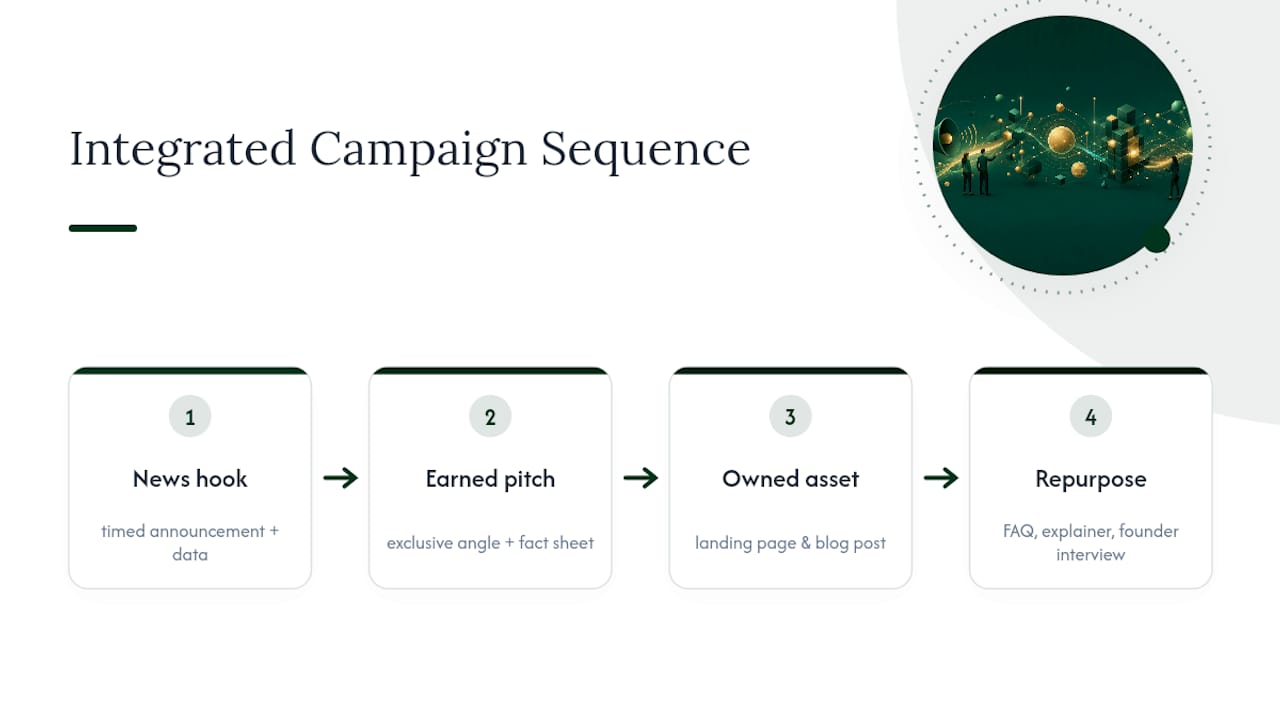
A typical version looks like this: a company times a product announcement to a data release, pitches journalists with an exclusive angle and a one-page fact sheet, and simultaneously publishes a detailed landing page and blog post that expands on the data. When the story runs, the coverage links to (or gets summarized alongside) the owned asset, which now has both press credibility and search-friendly depth working in its favor at once.
Crisis-response campaigns follow a similar logic in reverse. A company facing reputational pressure issues a fast, transparent PR statement to control the immediate narrative, then follows with owned content, an FAQ page, a detailed explainer, a founder interview, that gives search engines and AI answer engines a corrected, authoritative version of events to surface going forward. The PR move buys time; the content move buys permanence.
What separates a campaign that compounds from one that fizzles isn’t the size of the placement. It’s whether someone on the team had already built the owned asset before the earned mention showed up, so the two reinforced each other instead of running on separate clocks.
How Do Digital and Social Media Change PR vs Content Marketing?
Digital channels didn’t just add new distribution options to PR and content. They changed what counts as a “placement” and blurred a line that used to be clean.
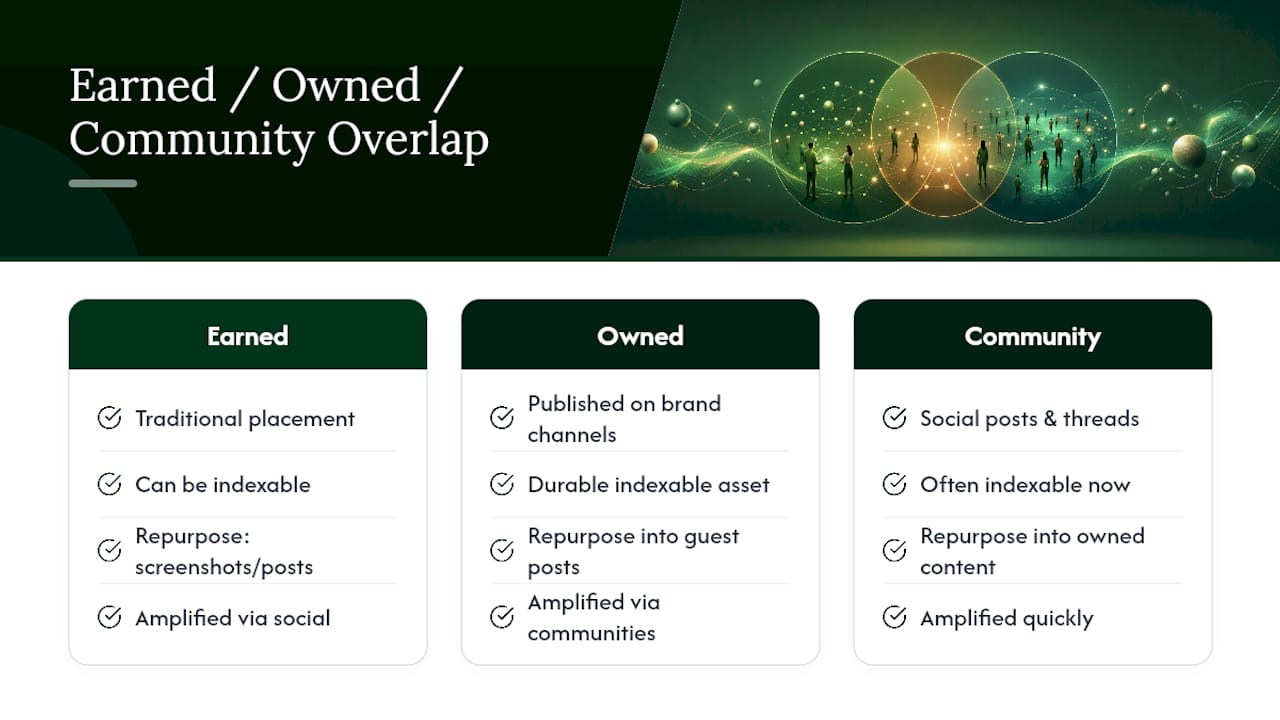
A decade ago, PR meant getting into a newspaper or trade publication, and content marketing meant publishing on your own blog. Now, a well-placed guest post, a podcast appearance, or a Reddit thread that gains traction can function as both earned exposure and a durable, indexable content asset at the same time. Social platforms compress the feedback loop further. A journalist finds a source through a LinkedIn post; a piece of owned content gets amplified through a community discussion; an earned mention gets screenshotted and shared long after the original article stops getting traffic.
This overlap matters most in how AI-driven search now works. Systems that generate answers instead of just ranking links tend to draw on sources that show consistent authority across multiple trusted domains, not just one. That means a brand’s presence across earned coverage, owned content, and community discussion functions less like three separate efforts and more like one signal that AI systems weigh when deciding who to cite as a credible answer.
Practically, that means a social mention or a niche podcast spot deserves the same repurposing treatment as a major press hit. Scale doesn’t determine long-term value nearly as much as whether the mention gets converted into something searchable.
My Take: Stop Treating This as a Budget Fight
The PR versus content marketing debate persists mostly because budgets are finite and teams like clean categories. But the real mistake isn’t picking the wrong discipline, it’s picking one team to “win” the argument instead of building a workflow where earned coverage and owned content trade assets back and forth. Pick one workhorse channel, whether that’s search, email, or social, and use PR as the accelerator for that pillar rather than trying to dominate every channel at once.
The AI search shift makes this more urgent, not less. Systems generating answers instead of ranking links reward brands with consistent, cross-channel authority, which is exactly what integration produces and silos never do. If you want a deeper look at how the measurement side plays out, or want to see documented case outcomes, the case study archive is worth a read before you rebuild your workflow from scratch.
— Nik
Need Help Turning Earned Coverage Into Lasting Visibility?
Some agencies offer success-based billing for earned placements and convert those mentions into owned, searchable assets that AI answer engines and search platforms treat as credible references.

If your team is stuck choosing between chasing press hits and writing blog posts nobody sees, that’s precisely the gap Storyline Pros closes: earned-media-first execution paired with the technical layer that turns each placement into long-term authority instead of a one-week spike. Read more about the methodology and guarantees, then start a conversation about what an integrated program could look like for your next launch or funding round.
Sources
- Why is content marketing today’s marketing? — Content Marketing Institute
- What Is Content Marketing? How It Works in 2026 | WordStream
- Benefits of content marketing — CoSchedule
- All about public relations — PRSA