
Six Press Kit Essentials for Startups That Get Coverage Fast
A startup press kit needs to live on one public page or in one downloadable ZIP, and it needs six things: a one-line company description, a short boilerplate, a press contact, logos, one or two editorial-quality images, and your recent press releases. Skip any of those six and a journalist moves to the next tab. The next step is simple: publish a press page at a URL like yoursite.com/press, or build a ZIP with the same six elements, and link it somewhere obvious.
TL;DR:
- Use a single public page or ZIP containing company overview, founder bios, logos, images, press contact, and recent releases, all linked clearly.
- Format assets with SVG and PNG logos, JPG/WebP photos, MP4 videos, and organize files predictably with descriptive names, including alt text and captions.
- Write a boilerplate following a clear structure: aspiration, solution, proof, and call to action, tailored with defended metrics and key facts.
- Maintain an online newsroom that chronologically displays news and releases, keeping content current, searchable, and archived for researcher credibility.
- Connect a real, named press contact with consistent details across channels, including social handles, and respond within one business day to maximize media engagement.
Table of Contents
- What Goes Into a Press Kit for Startups
- Brand Assets and Downloads: Formats, Naming, and Accessibility
- How to Write a Boilerplate That Actually Gets Reused
- Organizing Press Releases and Building a Newsroom
- Eight Press Kit Examples Worth Modeling
- Publishing, Distribution, and Keeping Your Kit Discoverable
- Setting Up Your Press Contact and Response Process
- Why Storyline Pros Builds Press Kits Differently
- How Storyline Pros Can Help You Get Covered
- Sources
What Goes Into a Press Kit for Startups
A journalist deciding whether to cover you spends roughly 90 seconds on your press page before deciding whether you’re worth a follow-up email. That’s the entire budget you’re working with, so structure matters more than volume.
Start with your company one-liner, ideally under 15 words, followed by an extended boilerplate of 40 to 80 words. Most effective startup press kits pair a short overview with founder bios, brand assets, and clear contact details, and that combination isn’t arbitrary. It’s what a reporter on deadline actually needs, in the order they need it.
Here’s what belongs in each part:
- Company overview and boilerplate: one sentence, then a 40 to 80 word paragraph covering what you do and for whom.
- Press contact: a named person, a direct email, and, if you have the traffic to justify it, a PR request form with a stated response window (24 to 48 hours is standard).
- Founder and leadership bios: 75 to 100 words each, written in third person, with a quote-ready sentence baked in so a writer can lift it directly.
- Press releases and news summary: a short “at a glance” block listing your three most recent announcements with dates, sitting above the full release archive.
The bios matter more than founders usually think. A one-line quote embedded in a bio, something like “we built this because X was broken,” saves a reporter an interview and often becomes the pull quote in the final piece.
Brand Assets and Downloads: Formats, Naming, and Accessibility
Format choice determines whether your assets actually get used. A journalist working against a deadline will not open Photoshop to convert a file, and a broken link kills the placement before it starts.
- Logos: provide SVG for anything that needs to scale (web embeds, print), plus a PNG fallback with a transparent background for tools that don’t render vector files.
- Photos and screenshots: JPG or WebP for photography, PNG for screenshots with sharp edges and text. Offer at least two sizes: a 1200px web version and a print-ready 300 DPI version.
- Video: MP4, H.264 encoded, under 100MB where possible, with a separate thumbnail image so it previews correctly in email.
- Naming and structure: use a flat, predictable naming pattern like
companyname_logo_dark.svgorcompanyname_founder_janedoe.jpg, grouped into folders by asset type rather than by date. - Delivery: a single ZIP works for most startups; switch to CDN-hosted links once your asset library exceeds a few dozen files or changes often.
Don’t skip alt text and captions on every image, even in the downloadable version. It’s not just an accessibility requirement, it’s also what search engines read when your assets get reused elsewhere.
Pro Tip: Name your logo files by background, not just color, “logo_for_dark_bg.svg” instead of “logo_black.svg.” Designers on deadline grab the wrong file constantly, and this one habit stops it.
How to Write a Boilerplate That Actually Gets Reused
A high-impact boilerplate follows a specific formula: aspiration, core solution, evidence, and a call to action, in that order. Skip the formula and you get either a vague mission statement or a features list, and neither gets copied into a journalist’s draft.
Try this structure: “[Company] helps [audience] [achieve outcome] through [core product]. Founded in [year], the company [proof point, like funding or user count]. Learn more at [URL].” A boilerplate built this way stays reusable across every press release you write for the next year, which is the entire point.
For your quick facts section:
- Founding year and headquarters location
- Founder names and one-line roles
- Funding stage and lead investor, only if public
- Core product category, stated in plain language, not jargon
- Notable metrics, but only ones you can defend if a reporter asks a follow-up question
Skip metrics you can’t stand behind under scrutiny. A vague “thousands of users” line invites a fact-check you don’t want.
Organizing Press Releases and Building a Newsroom
Your press releases need a home that behaves like a timeline, not a folder dump. An online newsroom that centralizes announcements and keeps them dated and searchable earns more repeat visits from journalists than a static PDF ever will.
- List releases newest first, each with a headline, publish date, and a two-sentence summary above the fold.
- Reserve full press releases for genuine news (funding, product launches, executive hires); route smaller updates to a blog or a short-form announcement format instead.
- Version your downloadable kit with a visible date or version number, and archive older releases rather than deleting them, since a reporter researching your history will want the trail.
Eight Press Kit Examples Worth Modeling
Real examples beat advice every time, because they show you the tradeoffs founders actually made. Brands like AWeber, Squarespace, and Expensify demonstrate a few recurring patterns worth copying, and each of the eight styles below fits a different stage of company.
- The single-page overview: everything above the fold, best for pre-seed startups with only a handful of assets.
- The tabbed asset library: logos, photos, and releases in separate tabs, common once you have more than 20 downloadable files.
- The coverage-first layout: recent media mentions pulled to the top, used by companies that already have earned placements to show off.
- The founder-forward kit: bios and headshots lead the page, effective for solo-founder or personal-brand startups.
- The print/web split kit: separate downloads for print-resolution and web-resolution assets, useful for consumer product companies.
- The ZIP-only kit: one download button, no page navigation, fast for lean teams without design bandwidth.
- The newsroom-style hub: dated releases, searchable archive, best once you’re publishing news monthly or more.
- The FAQ-embedded kit: brand usage rules and common questions built directly into the page, which cuts down on repeat emails asking the same thing.
For most early-stage startups, a single-page press page beats a ZIP as the primary format. Keep the ZIP available as a secondary download for anyone who wants everything offline at once.
Publishing, Distribution, and Keeping Your Kit Discoverable
A press kit only works if people can find it without asking. Public, fast-loading press pages linked from your main navigation or footer get used far more than anything hidden behind a form or an email request.
- Host the page at a predictable URL (
/pressor/media) and link it from your footer, not just a blog post. - Add basic structured data (Organization schema) so search engines and AI tools can parse your boilerplate and contact info directly.
- Keep a pitch checklist: boilerplate, one relevant image, a link to the full kit, and a subject line naming the news, not the company.
- Follow up once, five to seven business days after the initial pitch, never more than twice total.
Gated press kits lose value fast: if a journalist has to fill out a form to see your logo, most will just skip the story rather than ask.
Startups searching AI answer engines for press kit templates are increasingly running into their competitors’ names before their own, simply because those competitors published a clean, structured press page and got cited for it.
Setting Up Your Press Contact and Response Process
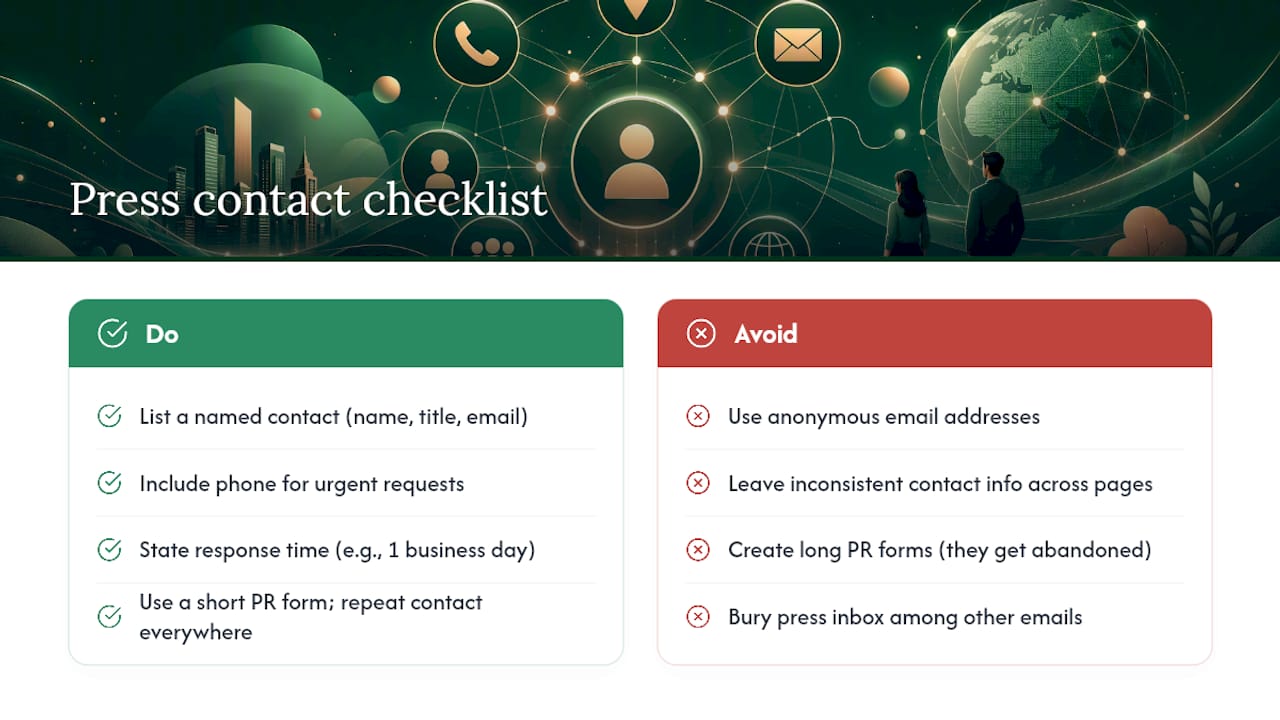
Every press kit needs one clearly named human at the end of it. “Media inquiries: press@company.com” without a name attached reads as a black hole, and reporters skip black holes.
List a real name, title, direct email, and, if your volume justifies it, a phone number for time-sensitive requests. State your expected response window explicitly, “we respond within one business day,” because reporters on deadline decide whether to wait for you or move to your competitor based on that one line alone.
If you’re fielding more than a handful of inquiries a month, add a short PR request form that asks for the reporter’s outlet, deadline, and specific question upfront. This routes urgent requests to the top of your inbox instead of burying them between newsletter replies and investor emails. Keep the form to four fields maximum; a long form gets abandoned.
Route the same contact information consistently across your press page, your boilerplate, and any press release footer. Inconsistent contact info across those three places is one of the more common reasons a legitimate media request never reaches the founder at all, it lands with an old team member or an inbox nobody checks anymore.
If you have a social team or a founder who’s active on X or LinkedIn, list those handles alongside the press contact. Reporters increasingly DM founders directly when a formal email channel feels slow, and having those handles listed saves everyone a step.
Why Storyline Pros Builds Press Kits Differently
Most press kits get built once, sit static for two years, and quietly stop matching how people actually search for companies now. That gap, between a static PDF and how AI search engines and journalists actually discover sources today, is where most startups lose visibility they don’t know they’re losing.
Storyline Pros treats a press kit as one input into a bigger discoverability system, not a standalone deliverable. The boilerplate, the bios, the release archive, all of it needs to feed into the same earned-media and citation strategy that gets a startup referenced by name when an investor or customer asks an AI search tool who the credible players in a category are. That’s a different design problem than writing a nice-looking page.
DIY works fine for a pre-seed startup with no coverage yet. Once you’re actively pitching and need placements that compound into citations, that’s when outside help starts paying for itself.
— Nik
How Storyline Pros Can Help You Get Covered
A well-built press kit gets you ready for coverage. It doesn’t get you the coverage itself, and that’s the gap Storyline Pros exists to close. Instead of a retainer that bills whether or not anything gets placed, Storyline Pros works on delivered outcomes: earned media placements, podcast guest spots, and the kind of citation footprint that shows up when someone asks an AI search engine who the real players in your category are.

For a startup with a press kit already built and a growth story ready to tell, a pilot engagement is usually the right starting point, small enough to test fit, focused enough to show results within weeks. For a company still shaping its narrative, Storyline Pros’ about page walks through the broader methodology behind the placements. If you want to see what delivered outcomes actually look like before committing to anything, the case studies page has the specifics. From there, requesting a consult is the natural next step.