

Reactive PR: Build a 24–72 Hour Response System for Comms Teams
Reactive PR is the practice of monitoring news and social trends in real time and responding fast, either with expert commentary that earns coverage or with corrective messaging that contains damage. It’s the right tool the moment a relevant story breaks and your brand has something genuine to add, or the moment your brand becomes the story. The catch is always the same: speed only helps you if approval, facts, and tone keep pace with it.
TL;DR:
- Reactive PR is most effective when a story is genuinely newsworthy, your brand offers a credible angle, and a spokesperson is available to respond quickly.
- Success depends on preparation, including having pre-approved templates, spokespeople, and a data hub ready within 24 to 72 hours, not improvising during a crisis.
- Rapid responses that add real value, such as unique data or expertise, outperform vague or defensive statements, which can worsen reputational damage.
- Using monitoring tools and targeted journalist outreach shortens response times but still requires judgment to avoid overreacting or chasing irrelevant stories.
- The biggest risk of reactive PR is saying the wrong thing fast rather than moving too slowly, making consistency and honesty vital in crisis messaging.
Table of Contents
- What Reactive PR Actually Covers
- Reactive vs. Proactive PR: Which One Fits the Moment?
- Why Reactive PR Pays Off Beyond Damage Control
- Reactive PR in Action: What Worked and What Backfired
- The Reactive PR Workflow, Step by Step
- Tools That Help You Catch and Act on Reactive Opportunities
- The Risks: How Reactive PR Backfires
- How Storyline Pros Builds Reactive Capacity for Growth Brands
- When Reactive PR Is the Wrong Tool
- Get Reactive PR Capacity Built Before You Need It
- Sources
What Reactive PR Actually Covers
Reactive PR isn’t a single tactic. It’s a category of fast-turnaround activities that all share one constraint: a closing window. Newsjacking sits at the center of it, where a brand offers expert commentary, a data angle, or a case example tied to something already trending. But the category extends well past commenting on someone else’s headline.
- Monitoring news cycles and social chatter for openings relevant to your industry
- Producing quick-turn content: a quote, a data note, a one-page FAQ for reporters
- Pitching journalists who are actively writing on a live topic, often within hours
- Posting rapid social responses that stake out a position before competitors do
- Issuing corrective statements when your own brand needs to set the record straight
None of this replaces proactive PR, the planned campaigns, product launches, and thought-leadership pushes built weeks or months in advance. The two work together. Proactive work builds the reputation and relationships; reactive work capitalizes on or defends that reputation when the news cycle moves faster than any campaign calendar could.
Reactive vs. Proactive PR: Which One Fits the Moment?
The two approaches differ on nearly every operational axis, not just timing. Proactive PR runs on a planning horizon measured in weeks; reactive PR runs on one measured in hours. That single difference changes staffing, approval chains, and how you measure success.
- Planning horizon: proactive campaigns are scheduled months out; reactive moves get built and shipped same day
- Resource intensity: reactive work demands standing spokespeople and pre-approved templates, since there’s no time to build assets from scratch
- Risk profile: proactive messaging goes through full legal and executive review; reactive messaging often skips steps, which raises the stakes of every sentence
- Measurement: proactive PR tracks brand lift over quarters; reactive PR tracks placements, share of voice, and referral traffic within days
Not every trending story deserves a response. A reactive move is warranted when three things line up: the story is genuinely newsworthy for your audience, your brand has a relevant and credible angle, and a spokesperson is actually available to go on record. Miss any one of those and silence beats a rushed, generic quote. Most high-growth brands do well allocating the majority of PR capacity to proactive campaigns and holding a smaller portion in reserve for reactive response, adjusting as needed during volatile news cycles in the brand’s own sector.
Why Reactive PR Pays Off Beyond Damage Control
Reactive PR’s biggest misconception is that it’s purely defensive. Most of its value actually comes from offense: catching a live story and adding something to it that only your brand could say.
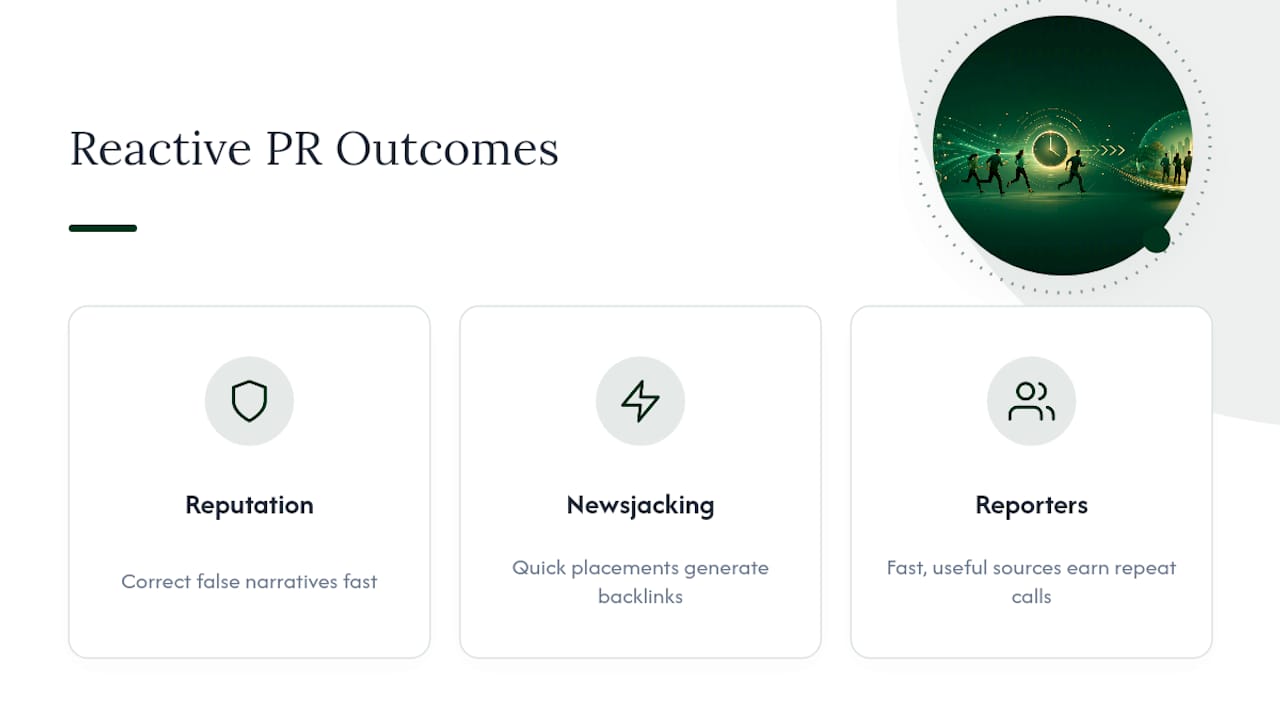
Done right, reactive PR delivers on three fronts at once. It protects reputation by letting you correct a false narrative before it hardens, since rapid, accurate response controls the story instead of chasing it. It captures opportunity through newsjacking, and reactive digital PR placements built quickly and accurately can generate backlinks that lift both search visibility and referral traffic. And it builds journalist relationships that compound: reporters remember which sources answered fast with something useful, and they come back to those sources first on the next story.
Pro Tip: Track reactive placements separately from proactive ones. Reactive coverage often drives a short, sharp spike in referral traffic and share of voice, and mixing the two data sets hides which program is actually earning its budget.
The through-line across all three benefits is the same: reactive PR works best when it adds real value to a story, whether that’s data, a novel angle, or a genuine first-person example, not just speed for its own sake.
Reactive PR in Action: What Worked and What Backfired
Patterns repeat across reactive PR wins and failures. The wins share two traits; the failures share different ones.
- The data-backed quick take. When a market shock hits, brands that already had relevant internal data ready, like usage trends or search volume shifts, could publish a fast, sourced take while competitors were still drafting a generic statement. Speed plus a unique data point beat speed alone.
- The credible expert on a breaking regulatory story. A spokesperson with real subject-matter authority, briefed and available within hours, earned coverage that a marketing team’s boilerplate comment never would have.
- The defensive non-answer. A brand facing public criticism issued a vague statement heavy on legal hedging and light on facts. Coverage of the original issue kept running, and outlets added a second story about the weak response itself.
- The late correction. A brand waited a full news cycle to respond to a viral complaint, hoping it would fade. It didn’t. By the time the statement went out, the story had already calcified in the public’s mind, and the correction read as damage control rather than transparency.
The lesson repeats: speed only works when it’s paired with a genuine value-add, whether that’s data, expertise, or straight facts. Defensiveness, vagueness, and lateness turn a manageable moment into a longer, worse one.
The Reactive PR Workflow, Step by Step
A reactive program without a repeatable process is just a team scrambling every time something happens. Here’s the sequence that holds up under pressure.
- Monitor continuously. Set threshold triggers, not just alerts, so the team knows what volume or tone of mention actually warrants action versus what’s background noise.
- Triage fast. Run every opportunity through a short checklist: Is it relevant to our expertise? Is our angle credible? Can we move within the window? Is there legal risk? Is a spokesperson actually free right now?
- Craft the response in a pre-built format. Keep a bank of formats ready: a one-line executive quote, a 200-word data note, a short Q&A sheet for reporters, a formal statement template. Building the format from scratch under deadline is where most delays happen.
- Approve through a shortcut, not the full chain. Streamlined approvals, standing spokespeople, and pre-drafted templates are what let a reactive program actually meet tight windows instead of missing them waiting on sign-off.
- Distribute where the story is live. That might mean a direct pitch to the reporter already writing the piece, a social reply, or a short press note, depending on where attention currently sits.
- Follow up and amplify. Once a placement runs, share it through owned channels and track how it performs, since the coverage itself is only half the value; the amplification decides how far it travels.
Pro Tip: Build a standing “reactive kit” now, before you need it: pre-approved spokespeople, a set of templated Q&As, and a small internal data hub you can pull from inside a 24 to 72-hour window. Teams that wait to assemble this mid-crisis lose the exact hours that mattered most.
Tools That Help You Catch and Act on Reactive Opportunities
Spotting the moment worth responding to is half the job; getting a response out the door fast is the other half. Most reactive PR programs lean on a small, consistent tool set rather than anything exotic.
- Monitoring: social listening tools, Google Trends, and journalist-request services surface breaking angles before they peak, giving you a head start measured in hours, not minutes
- Journalist targeting: a rapid-built media list matched to the specific story, paired with a short, direct email that leads with the angle instead of a company introduction
- Distribution: social-first replies for fastest visibility, a short press note for broader pickup, and occasionally an exclusive pitch to one outlet when the story warrants depth over speed
- Measurement: placements earned, referral traffic in the days following, and share of voice against competitors covering the same story
None of these tools replace judgment. They just shorten the distance between spotting a story and having something worth saying about it.
The Risks: How Reactive PR Backfires
Reactive PR’s biggest danger isn’t moving too slowly. It’s saying the wrong thing quickly and confidently. That’s the boomerang effect: defensive, vague, or evasive messaging can cause more reputational damage than the original incident ever would have.
Timing makes this worse, not better, because crisis communication research treats the first hours after an incident as decisive, and teams without pre-agreed lines tend to either freeze or overcorrect.
A few principles hold up consistently:
- Speed without accuracy is worse than a short, honest delay
- One spokesperson, one consistent message, across every channel
- Empathy and plain facts beat legal hedging every time
- Prepare and anticipate, steal the thunder by disclosing bad news yourself first, speak with one voice, and listen with empathy rather than waiting to be asked
Crisis communication frameworks call for activating a Crisis Communication Team the moment known facts are established, and holding that team to consistent, empathetic messaging across every channel until the situation resolves.
Escalate to full crisis protocol the moment a reactive issue touches legal exposure, safety, or sustained negative coverage across multiple outlets. A single-channel complaint is a reactive PR job. A multi-outlet story with legal implications is a CCT job, full stop.
How Storyline Pros Builds Reactive Capacity for Growth Brands
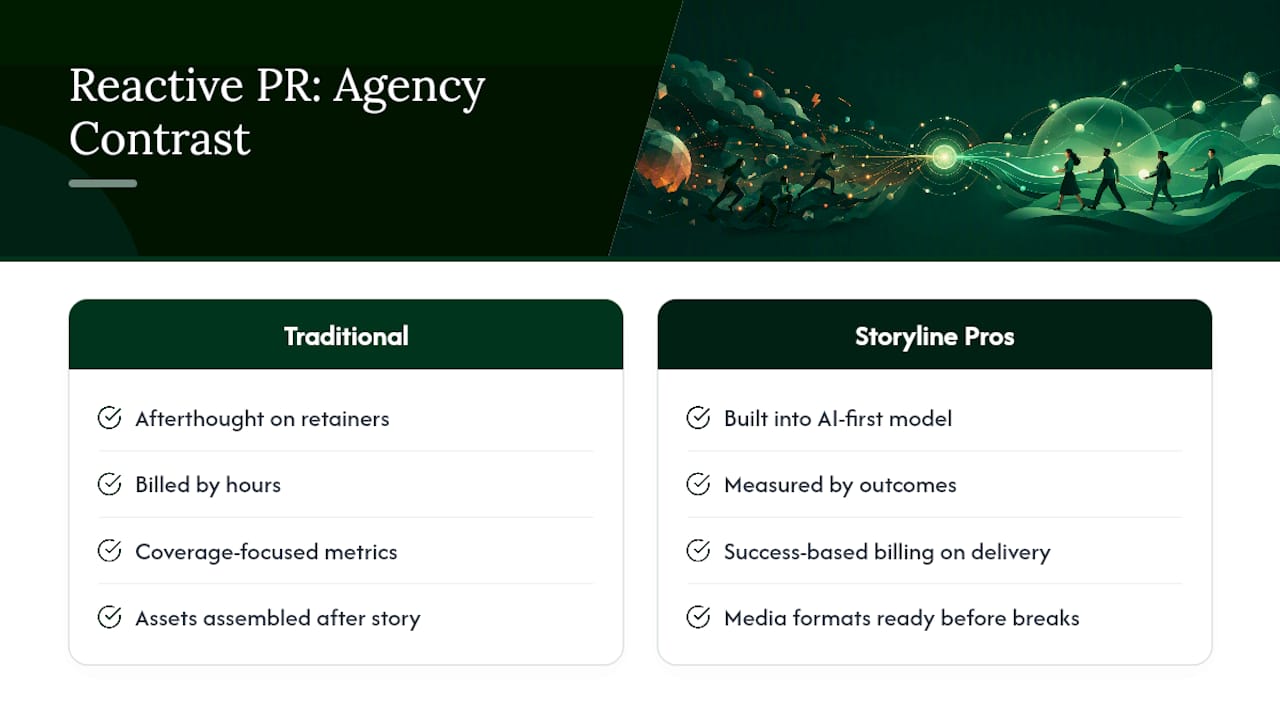
Most agencies treat reactive PR as an afterthought bolted onto a retainer. Storyline Pros builds it into an AI-first visibility model designed around measurable outcomes rather than billed hours. The approach pairs earned media placements, podcast appearances, and community amplification with a proprietary tracking layer that shows exactly which reactive moves actually moved the needle in AI-driven search results, not just traditional coverage.
Startups working with Storyline Pros get a system built for speed: media relationships and content formats ready before a story breaks, not assembled after. The case studies documenting these outcomes show what a success-based reactive program looks like when placements are billed on delivery instead of promised on a retainer.
When Reactive PR Is the Wrong Tool
Chasing every trending story dilutes a brand faster than staying silent ever would. If your team is reacting constantly and building nothing proactively, you’re renting attention, not earning authority. Reserve reactive capacity, but protect the majority of your budget for campaigns you actually control.
— Nik
Get Reactive PR Capacity Built Before You Need It
Most brands discover they need reactive PR at the worst possible moment: mid crisis, with no spokesperson briefed and no template ready. Storyline Pros builds that capacity in advance, pairing AI-driven media placements with a measurement layer that shows exactly which reactive moves generated coverage, referral traffic, and share of voice, not just clippings.

A first engagement typically starts as a pilot: Storyline Pros audits your current monitoring gaps, builds your spokesperson and template bank, and runs a small batch of reactive or newsjacking placements to prove the model before any longer commitment. For distribution partners handling rapid creative turnaround on reactive assets, production support can round out the kit. Visit Storyline Pros to scope a pilot, or review the case studies to see what a success-based reactive program actually delivers before you commit budget to it.