

Get AI Citations for Startups: PR Schema Without Hiring
Schema for PR means wrapping press releases and newsroom pages in schema.org JSON-LD, mainly PressRelease or NewsArticle paired with an Organization record, so AI parsers can extract who said what and cite the brand as the source. The immediate move: emit that JSON-LD inside the page <head>, lock the release to one canonical newsroom URL, and run it through both validators before it goes live. Markup alone won’t force a citation. It just makes the release legible enough to earn one.
TL;DR:
- Use the
PressReleaseschema type for brand-issued announcements, and ensure it includes essential fields likeheadline,datePublished,dateModified,author, and a properly formattedpublisher.logo.- Place the JSON-LD markup directly in the
<head>section, reference a canonicalOrganizationfile, and run validator tools before publishing to prevent errors.- Make sure quotes are properly structured with linked
Personobjects positioned early in the release for better AI attribution.- Maintain an up-to-date schema by updating
dateModifiedwith every correction, and track citations to evaluate AI-driven visibility and attribution.- Build the newsroom as a canonical, API-like URL with structured data feeds and implement validation checks to ensure consistent schema deployment across all releases.
Table of Contents
- Which Schema Type Fits a Press Release?
- Minimum Fields a Press Release Needs (and a Template)
- How Should a Newsroom Be Built for Machine Crawling?
- What’s the Pre-Publish Validation Checklist?
- How Do You Structure Quotes So Parsers Attribute Them Correctly?
- Building the Internal Workflow: Who Owns What
- Keeping Schema Accurate as Releases Get Corrected
- How Do You Track Whether Schema Is Actually Working?
- Getting the JSON-LD Embed Right in HTML
- A Few Ready-to-Adapt Snippets
- Publishing for Machines and Humans at the Same Time
- Getting the Technical Layer Built Without Hiring for It
- Sources
Which Schema Type Fits a Press Release?
Three schema types do the work, and picking the wrong one is the most common implementation mistake.
PressRelease is the right root type for anything the brand issues itself, an announcement, a funding milestone, a product launch. It’s a subtype that inherits from NewsArticle, so parsers already know how to read it, but it signals “this came from the company” rather than an outlet. NewsArticle (or plain Article) belongs on earned coverage, the piece a reporter wrote about the company on their own publication. Don’t retrofit PressRelease onto a journalist’s story; that mismatch confuses attribution more than it helps.
Organization JSON-LD is the third leg, and it’s the one startups skip most often. It functions as the canonical brand entity record, the thing every release, quote, and mention should point back to.
A few implementation notes that matter more than they seem:
- Attach a
sameAsarray (LinkedIn, Crunchbase, Wikipedia, Wikidata) to theOrganizationobject so parsers can disambiguate a five-person startup from a similarly named enterprise. - Nest a
publisherobject inside everyPressReleaseandNewsArticlepointing to that sameOrganizationrecord. - Keep one
Organizationfile as the single source of truth rather than redeclaring it inline on every page.
Minimum Fields a Press Release Needs (and a Template)
Parsers have a short list of fields they expect, and Google’s Article structured data guidance lays out most of them: headline, image, datePublished, dateModified, author, and publisher with a nested logo. Miss dateModified and a corrected release can look stale or, worse, get treated as duplicate content.
A few formatting details trip people up. Dates need ISO 8601 format (2026-03-12T09:00:00-05:00), not a human-readable string. Images should offer multiple aspect ratios (16x9, 4x3, 1x1) since Google’s own guidance recommends it for broader image-result eligibility. The logo inside publisher needs explicit width and height as an ImageObject, not a bare URL.
| Field | Status | Why it matters |
|---|---|---|
headline |
Required | Primary signal for topic and match |
datePublished |
Required | Freshness and timeline placement |
dateModified |
Required | Signals corrections, avoids stale flags |
author |
Required | Ties content to a Person or Organization |
publisher.logo |
Required | Must be ImageObject with width/height |
about / mentions |
Recommended | Links entities named in the release |
citation / isBasedOn |
Recommended | Ties claims to source evidence |
sameAs |
Recommended | Disambiguates brand or person identity |
{
  "@context": "https://schema.org",
  "@type": "PressRelease",
  "headline": "Acme Raises a Series A",
  "datePublished": "2026-03-12T09:00:00-05:00",
  "dateModified": "2026-03-12T09:00:00-05:00",
  "author": { "@type": "Organization", "name": "Acme Inc." },
  "publisher": {
    "@type": "Organization",
    "name": "Acme Inc.",
    "logo": { "@type": "ImageObject", "url": "https://acme.com/logo.png", "width": 600, "height": 60 }
  }
}
Pro Tip: Keep the headline concise and make it a complete claim, not a teaser. Parsers weight the headline heavily, and a vague one gives them nothing to extract. If you need a refresher on writing tight headlines, this headline writing guide is a useful reference for comms teams building templates.
How Should a Newsroom Be Built for Machine Crawling?
The single biggest architecture mistake is letting wire copies outrank the original. If a release goes out through a distribution service, that copy often ranks and gets crawled before your own newsroom page does, and now the wire service is the “source” instead of you.
Fix that by treating the newsroom as one canonical URL per release, with every syndicated copy pointing back to it. The Prfect architecture writeup frames this well: treat the newsroom like an API, not a blog.
That means a specific stack of outputs:
- Inline JSON-LD in the
<head>of every release page, not injected after load by JavaScript. - A canonical
Organizationrecord hosted at a stable path (something like/press/about.jsonld) that every release references. - RSS and JSON feeds plus a dedicated news sitemap so crawlers find new releases without waiting on a full site crawl.
- CDN hosting with cache invalidation tuned to push updates fast when a release gets corrected.
- Optionally, a partner-facing API endpoint (
/newsroom/api/releases) so syndication partners pull structured data directly instead of scraping HTML.
That last point matters more as more of your distribution runs through partners and aggregators rather than direct visits.
What’s the Pre-Publish Validation Checklist?
Two tools catch different problems, and skipping either leaves gaps. Google’s Rich Results Test flags warnings specific to how Google’s own systems parse the markup. The schema.org Markup Validator checks straight vocabulary conformance, whether the types and properties you used actually exist and nest correctly.
Run both, every release, before it ships:
- Paste the live URL into the Rich Results Test and confirm
PressReleaseorNewsArticleis detected with no critical errors. - Run the same URL through the schema.org validator to catch vocabulary mismatches the Google tool won’t flag.
- Confirm
publisher.logorenders as a validImageObjectwith numeric width and height. - Check that
authoris a structured object, not a bare string. - Verify
dateModifiedis present, even if it matchesdatePublishedon first publish. - Confirm the canonical tag matches the newsroom URL, not a staging or preview domain.
Pro Tip: Build this checklist into your release composer or CI pipeline as a pre-publish gate. A five-minute automated check beats catching a broken logo object after the release has already synced to twelve partner feeds.
How Do You Structure Quotes So Parsers Attribute Them Correctly?
Every quoted person should map to a structured Person object with jobTitle and organizational affiliation attached. “A spokesperson said” gives a parser nothing to attribute. A named Person entity gives it a graph node.
Placement matters as much as structure. Prfect’s analysis of releases AI engines actually cite found that early, named, atomic quotes get pulled far more often than quotes buried past paragraph five.
- Put your most citable, factual quote in the first three attributions of the release, not the boilerplate close.
- Keep each quote short and single-claim; a quote stacking three ideas is harder to extract cleanly than three separate one-line quotes.
- Use
about,mentions,citation, andisBasedOnto connect claims in the release to supporting product pages or data.
Building the Internal Workflow: Who Owns What
A release composer that emits JSON-LD from typed fields (headline, quote, date, author) beats hand-coding markup for every release, because hand-coded JSON-LD drifts and breaks the moment someone copies last quarter’s template.
Four roles need to be explicit, even at a five-person startup:
- Comms or product drafts the release content and identifies quoted sources with title and affiliation.
- Engineering maintains the template that turns those fields into valid JSON-LD automatically.
- A validation owner runs the pre-publish checklist, ideally as an automated gate, not a manual afterthought.
- An analytics owner tracks whether the schema-driven release actually shows up in AI answers.
That last role is the one most startups skip entirely.
Track citation incidence (how often the brand’s own domain, not a wire copy, gets named in AI-generated answers), attribution share relative to syndicated versions, and earned-coverage growth over time. Storylinepros’s case studies show what that tracking looks like when it’s done as a continuous measurement discipline rather than a one-off audit after a big launch.
Keeping Schema Accurate as Releases Get Corrected
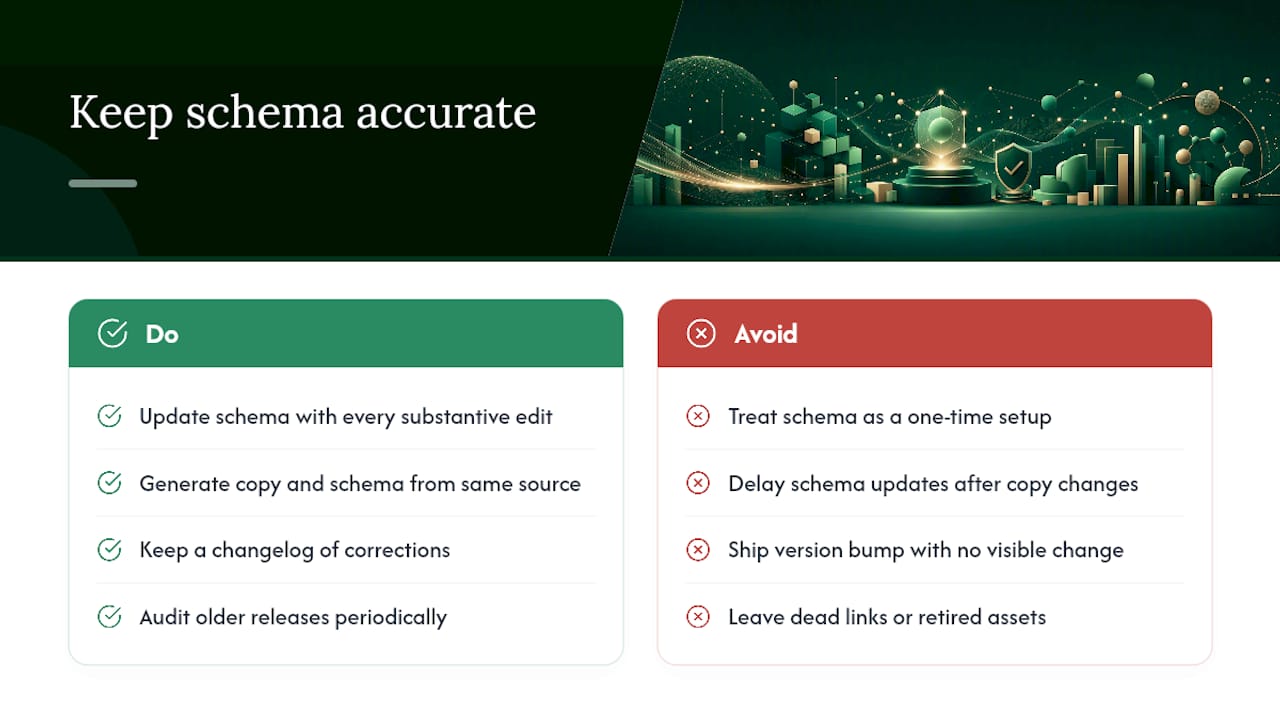
A press release isn’t static. Numbers get corrected, executives get updated titles, and sometimes a whole announcement gets walked back. Schema markup has to move with the content, and most startups treat it as a one-time setup instead of a living record.
The fix is simple in principle: every substantive edit to a release updates dateModified, not just the visible text. If a funding figure changes from the funding figure was updated after a correction after a correction, the JSON-LD needs to reflect that number the moment the page does, not a day later after someone remembers to touch the markup separately from the copy. Treat the schema block and the visible content as one unit, ideally generated from the same underlying data so they can’t drift apart.
Version control helps more than people expect. Keep a changelog, even an internal one, noting what changed and when, because if a reporter or an AI system cites an outdated figure, you want a clear record of when the correction went live. For material corrections (numbers, names, legal claims) update the headline too if the original headline stated the wrong figure directly. A dateModified bump with no visible change signals nothing useful to a parser.
Audit older releases periodically, especially ones still getting organic traffic or citations. A press release from eighteen months ago with a dead sameAs link or a publisher.logo pointing to a retired brand asset is a small thing that quietly degrades trust signals across the whole newsroom, not just that one page.
How Do You Track Whether Schema Is Actually Working?
The honest answer: most startups have no visibility into this at all, and that’s the gap worth closing first.
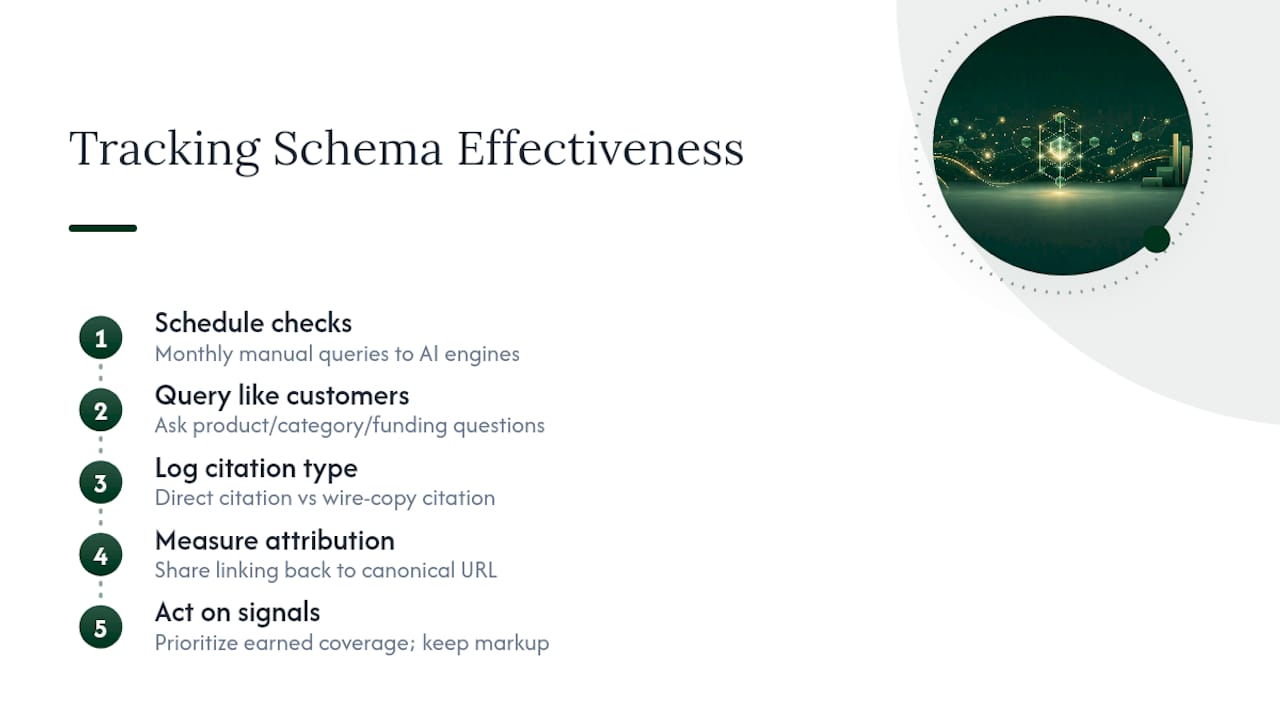
Start by checking whether AI search tools cite your domain directly when asked about your company, your funding, or your product category, versus citing a wire service or an aggregator that republished your release. That distinction, direct citation versus wire-copy citation, is the clearest signal that your canonicalization and markup are doing their job.
Set up a recurring manual check, monthly at minimum, where someone queries AI engines with the kinds of questions your target customers or investors might ask (“who makes [category] software for [use case]”) and logs which sources get cited. It’s manual work, but there’s no mature third-party tool yet that tracks AI citation share the way rank trackers handle traditional search.
Beyond citation checks, watch attribution share: when a release gets syndicated across ten outlets, how many of those ten link back to your canonical newsroom URL versus just republishing the wire text with no link. That ratio tells you whether your canonicalization setup (rel=canonical, isBasedOn) is holding up in practice, not just in theory. As Meltwater’s analysis of press distribution and AI search notes, structured markup helps, but earned coverage on authoritative outlets remains what actually moves visibility, schema just makes that coverage easier for AI systems to parse and credit correctly.
Getting the JSON-LD Embed Right in HTML
Most schema failures aren’t wrong field choices, they’re embedding mistakes. The markup is correct; it just never gets read.
Place the JSON-LD script directly in the <head>, not injected client-side after the page loads. Parsers that don’t execute JavaScript, and many AI crawlers fall into that category, will never see markup that only appears after a script runs. If your CMS injects structured data via a tag manager or a JavaScript widget, test the rendered HTML source, not just what you see in a browser DevTools panel after rendering.
Use exactly one <script type="application/ld+json"> block per distinct entity graph on the page. Stacking multiple separate JSON-LD blocks is valid, but a single malformed comma in one block can silently break the entire object, so keep the JSON clean and validate it as actual JSON before it ever hits a page.
Escape characters correctly. Quotes inside quoted statements, apostrophes in names, ampersands in company names, all need proper escaping or the JSON parser fails silently and the whole block gets ignored. Avoid HTML entities inside JSON-LD; use plain UTF-8 characters instead.
Don’t duplicate conflicting markup. If a CMS plugin auto-generates generic Article schema and your template also outputs PressRelease schema, you now have two competing type declarations on one page, and parsers have to guess which one to trust. Audit for plugin-generated schema before adding your own.
A Few Ready-to-Adapt Snippets
A funding announcement, a product launch, and a partnership release each lean on slightly different fields, even though the skeleton is the same.
For a funding announcement, prioritize about (the company itself), a Person object for the CEO quote with jobTitle, and a mentions array naming the lead investor as an Organization.
For a product launch, add a citation or isBasedOn field pointing to a spec sheet or documentation page, since AI systems increasingly try to verify product claims against a source page rather than accepting the release text alone.
For a partnership or integration announcement, both companies should ideally reference each other’s Organization records via mentions, so a parser resolves the relationship as a graph edge rather than plain text mentioning a partner’s name.
{
  "@context": "https://schema.org",
  "@type": "PressRelease",
  "headline": "Acme Partners With Beta Corp on Joint Integration",
  "datePublished": "2026-04-02T08:00:00-05:00",
  "dateModified": "2026-04-02T08:00:00-05:00",
  "mentions": [
    { "@type": "Organization", "name": "Beta Corp", "sameAs": "https://betacorp.com" }
  ],
  "author": {
    "@type": "Person",
    "name": "Jordan Reyes",
    "jobTitle": "Chief Executive Officer",
    "worksFor": { "@type": "Organization", "name": "Acme Inc." }
  }
}
Keep a small internal library of these patterns by release type. It saves engineering time and keeps every release from reinventing the field structure from scratch.
Publishing for Machines and Humans at the Same Time
The tradeoff people miss: a great quote that no parser can extract does nothing for AI visibility, and structured delivery is what closes that gap in 2026’s search environment. Before your next release goes out, make it machine-ready first, headline, dated fields, named Person quotes, canonical URL, validated JSON-LD, then distribute. Storylinepros builds this into client campaigns as a default step, not an afterthought, and it shows up in the placement patterns behind their case studies.
— Nik
Getting the Technical Layer Built Without Hiring for It
Most startups don’t need a full-time engineer just to maintain JSON-LD templates, but they do need someone who treats it as ongoing infrastructure rather than a one-time favor from whoever built the website. Storylinepros approaches this as AI-first newsroom engineering paired with earned-media placement, meaning the structured-data layer isn’t a bolt-on after the PR work happens, it’s built alongside the placements from day one, with validation gates and citation measurement included rather than left for someone to figure out later.
That combination, technical templates plus actual earned coverage on outlets AI systems already trust, is what separates a schema-compliant release from one that shows up when someone asks an AI engine who’s building in your category. Storylinepros’s case studies walk through what that attribution pattern looks like across different launches. If your next release, funding announcement, or product launch needs to be machine-citable from the start rather than retrofitted after the fact, Storylinepros can scope what that looks like for your specific launch calendar. Learn more about the team and approach and get a sense of what a properly engineered release cycle takes off your plate.
Sources
- Does Press Release Distribution Affect AI Search?
- Schema
- Article structured data (Google Developers)