
Targeted Podcast Guest Tours Build Founder Authority Fast
The fastest predictable way to build measurable authority and pipeline as a founder is a targeted podcast guest tour: a niche-first run of appearances backed by one marquee placement for halo credibility. Run right, this barbell approach turns a handful of interviews into pipeline, content assets, and inbound investor interest within 60 days. Storyline Pros builds these tours as a success-based program, tying the work to placements delivered rather than hours billed.
TL;DR:
- A targeted podcast guest tour, especially with niche shows, can generate meaningful pipeline and content leverage within 60 days, balanced with one marquee appearance.
- Show vetting should focus on audience relevance, host trust, format compatibility, publishing consistency, and the ability to include trackable calls to action.
- A strong episode pitch relies on a clear stance, a named framework, and practiced stories that naturally lead to a low-friction call to action near the end.
- Post-episode activities like promotion, relationship nurturing, and personalized follow-up significantly increase the chances of repeat invitations and pipeline conversion.
- Success-based, outcome-driven podcast outreach and tracking are more effective than chasing high-profile shows alone, especially when combined with a structured post-show motion.
Table of Contents
- Why Podcast Guesting Builds Founder Authority Faster Than Other Channels
- How Do You Vet Shows Before You Pitch Them?
- Building a Message That Hosts Can Actually Use
- Running a 60-Day Guest Tour That Actually Converts
- What Proof Should You Expect From a Guesting Partner?
- How Do You Research Hosts Before You Ever Pitch Them?
- What Outreach and Follow-Up Actually Move the Booking Needle?
- How Should You Prepare for a High-Impact Recording?
- How Do You Turn One Appearance Into Repeat Invitations?
- Turning Listeners Into Real Pipeline
- Why the Barbell Strategy Beats Chasing Big Shows Alone
- Work With Storyline Pros on a Guest Tour Built for Pipeline
- Sources
Why Podcast Guesting Builds Founder Authority Faster Than Other Channels
A 40-minute interview does something a LinkedIn post or a paid ad cannot: it lets you walk through a real decision, with the reasoning intact, in front of an audience that already trusts the host. That depth is what builds durable founder authority instead of a one-time impression. Ads buy attention. Guest appearances earn it, and the effect compounds because trust transfers from the host to you.
There’s also a referral engine hiding inside every good episode. Hosts talk to other hosts. When you give a host a clean, repeatable framework to point to, they tend to introduce you to their peers, and your booking rate climbs without any additional outreach on your part.
One appearance rarely means one asset. A single conversation can generate 10 to 20 repurposed pieces of content: audiogram clips, a LinkedIn thread, quote graphics, a transcript-based blog post, sales enablement snippets, and a backlink from the show notes page. Multiply that across an eight-to-twelve show tour, and you’ve built a quarter’s worth of content leverage from interviews you’d have done anyway. Founders running their own show have to produce that volume from scratch every week. Guesting lets someone else’s audience and someone else’s production budget do the heavy lifting.

How Do You Vet Shows Before You Pitch Them?
Most founders waste months chasing shows that sound impressive and convert nobody. A five-filter checklist fixes that before you send a single email.
- ICP density. Ask what share of listeners actually match your buyer persona, not how many total downloads the show gets. A show with 2,000 monthly listeners where 60% are your exact buyer beats a show with 50,000 listeners where 2% are.
- Host trust. Listen to two recent episodes. Does the host ask real follow-up questions, or just run down a script? A host who protects listener attention with sharp editing and genuine curiosity delivers guests who convert better.
- Format match. Long-form conversational shows suit founders selling complex, considered-purchase products. Tactical, list-style shows suit founders with a narrow, quick-win pitch. Mismatch the format and your best material lands flat.
- Cadence and discoverability. A show publishing weekly with a three-year archive has proven staying power. A show that’s posted four episodes in eighteen months is a gamble, no matter how good the host sounds.
- Bridge compatibility. Confirm the host allows a link or CTA in show notes or during the episode. Without that, you have no way to trace who actually converts.
Score each show 1 to 10 on every filter, add the totals, and keep anything above 35. That typically prunes a long wish list down to a working shortlist of 10 to 20 shows worth pitching, which matches how strong founder-fit shows get sourced in practice: customer referrals first, cold research second.
Pro Tip: Keep a simple spreadsheet with your five scores per show. Six months from now, when a producer reaches out cold, you’ll already know whether the show is worth a yes.
Building a Message That Hosts Can Actually Use
Every strong appearance starts with a one-sentence stance you can say without notes. Something like: “Most founders lose their first ten enterprise deals because they pitch features instead of the cost of inaction.” That sentence needs three proof points behind it, each built the same way: an outcome, a number, and the context that makes the number credible.
Name your framework. A host who can say “ask her about the Cost of Inaction model” refers you far more easily than one who has to summarize a vague conversation. Referrals built on a named, repeatable framework outperform generic guest appearances because the host has language to hand off.
Inside a 40 to 60 minute interview, four story types do almost all the work:
- The origin story explains why you started, used early to build rapport.
- The failure or rebuild story shows judgment under pressure, best placed midway once trust is established.
- The pivot or insight story demonstrates the “aha” that shaped your current model, ideal for tying into your framework.
- The pattern story shows you’ve seen the same problem across multiple customers, which is what makes the bridge ask land.
The bridge ask itself should be a single, low-friction line, like a resource or a short assessment, offered near the close so it never feels like a pitch that hijacked the interview.
Pro Tip: Practice your bridge ask out loud until it takes under ten seconds. Hosts cut long asks; they rarely cut short ones.
Running a 60-Day Guest Tour That Actually Converts
A tight sprint beats a scattered, months-long trickle of bookings. Booking several appearances inside roughly two months keeps your message sharp across every recording and gives you enough volume to measure results honestly.
- Week 1 to 2: Finalize your shortlist, batch-record when possible, and cluster interviews by topic so your message stays consistent.
- Week 3 to 8: Record on a rolling basis, mixing 3 to 8 niche shows with one marquee appearance, the barbell mix that balances pipeline against halo credibility.
- Within 48 hours of each release: Run the five-step post-show motion: announce the episode, send direct outreach to relevant listeners or contacts who might have heard it, drive traffic to a tracked landing page, publish repurposed clips, and send a short follow-up email sequence to anyone who clicked through.
Build a dedicated landing page for each show before the episode airs, matched to that episode’s promise, since a show-specific page with one tracked CTA converts better than sending listeners to your general homepage.
| Metric | What it tells you |
|---|---|
| Branded search lift | Whether the appearance moved people to look you up by name |
| Qualified inquiries | Whether listeners took the bridge ask seriously enough to reach out |
| Partner or investor intros | Whether the halo effect reached people outside the listener base |
| Pipeline per appearance | Whether the show is worth repeating or should be cut from future tours |
Niche shows tend to convert listeners to qualified inquiries at a noticeably higher rate than large generalist shows, which is why conversion-focused measurement matters more than download counts when you decide who gets a return invitation.
What Proof Should You Expect From a Guesting Partner?
A guesting partner earns trust the same way a good guest earns a host’s referral: by showing rather than telling. Storyline Pros structures its podcast guesting work around outcomes it can point to, not promises it can’t measure.
- Success-based billing. You pay for delivered placements and tracked outcomes, not retainer hours, which keeps incentives pointed at the same goal you have: booked shows that actually move pipeline.
- Show vetting built in. The ICP-density, host-trust, and format-match filters above are the same criteria applied before a founder’s name goes out in a pitch.
- Case-based results. Campaign outcomes, media reach, and placement volume are documented in Storyline Pros’ case studies, giving founders a realistic sense of what a 60 to 90 day campaign tends to produce.
A niche show converting listeners to qualified inquiries at a materially higher rate than a top-tier generalist show, a gap documented across founder-focused shows, is exactly why success-based models make sense here: the fee structure only works if the placements are chosen well in the first place.
How Do You Research Hosts Before You Ever Pitch Them?
The five-filter checklist gets you a shortlist. Real vetting happens after that, one show at a time. Start by listening to the two most recent episodes in full, not the trailer or the most popular back-catalog episode. Recent episodes tell you what the show actually sounds like now, which matters if a host has drifted format or tightened their guest criteria.
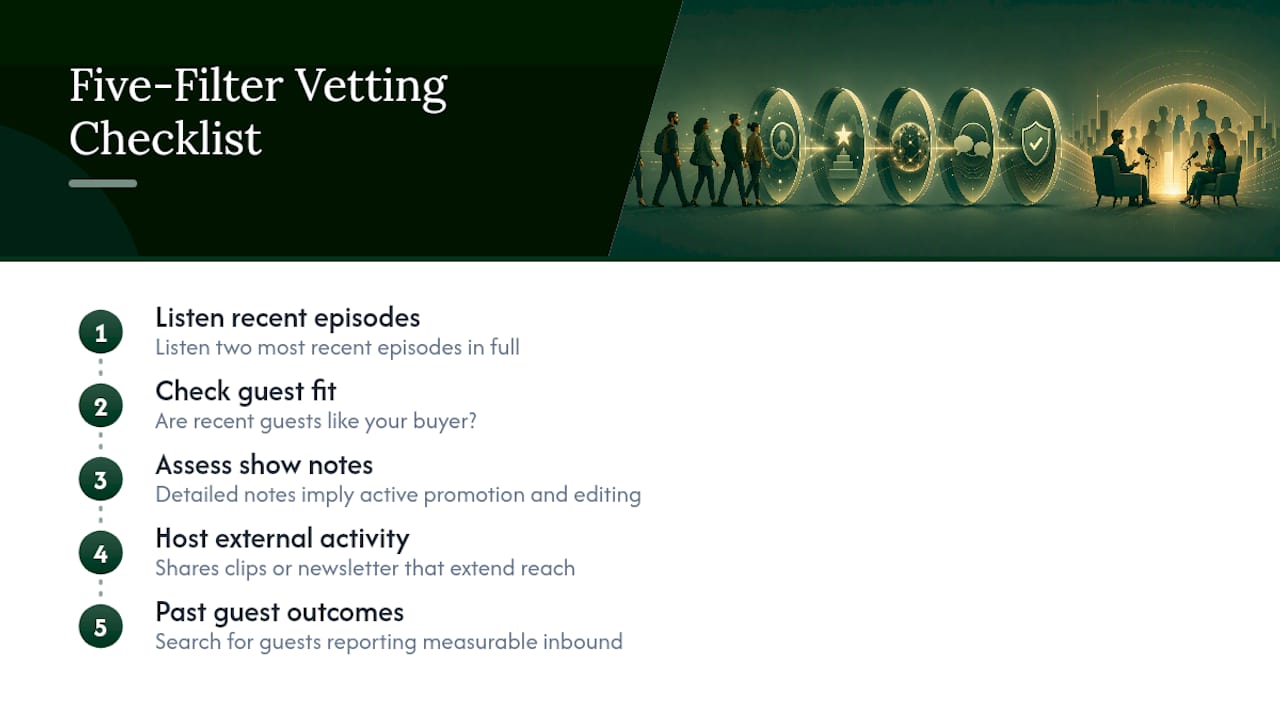
Check who else has appeared in the last three months. A run of guests who look nothing like your buyer is a signal, even if the show’s stated topic matches yours on paper. Read the show notes for those episodes too. Notes packed with named frameworks, links, and specific takeaways suggest a host who edits carefully and drives real listener engagement. Thin, generic show notes usually mean thin promotion after the episode airs.
Look at where the host is active outside the podcast. A host who shares clips on LinkedIn or writes a companion newsletter extends your reach well past the original download count. That’s often the difference between a show with modest listenership that outperforms and a show with a big number that quietly underdelivers.
Finally, search for the host’s name alongside past guests to see whether those guests mention measurable results. A pattern of past guests reporting real inbound interest is a stronger signal than any stated download figure the show promotes.
What Outreach and Follow-Up Actually Move the Booking Needle?
Cold pitches fail for a predictable reason: they talk about the founder, not the listener. Keep the initial pitch to six to eight sentences, lead with the specific outcome the host’s audience will walk away with, and skip the resume-style bio entirely. Hosts get dozens of pitches a week; the ones that name a concrete listener benefit in the first line get opened.
Attach something the host can watch in under a minute. A 40-second Loom or a 90-second reel showing your speaking style does more to secure a yes than three paragraphs of credentials, because it removes the host’s biggest risk: booking someone who freezes on air or rambles without a point.
Follow up once, seven to ten days later, and make the second message shorter than the first. Reference one specific detail from a recent episode to prove you actually listened, then restate your one-sentence stance in a single line. If there’s no response after that, move on. Chasing a host past two touches rarely produces a booking and often burns the relationship for a future pitch.
Track every pitch in the same spreadsheet you used for scoring shows. Response rate, time to booking, and eventual show performance all belong in one place so you can see which pitch angles actually work across your specific shortlist.
How Should You Prepare for a High-Impact Recording?
Preparation for a podcast interview looks nothing like preparation for a keynote. You’re not filling airtime. You’re answering specific questions well, which means your prep should focus on your three proof points and your four story types, not a full script.
Run a mock interview with a colleague using the host’s actual episode format as the template. If the show usually runs a “walk me through your worst month” segment, rehearse that story out loud until the number and the context land cleanly in under ninety seconds. Recording yourself and listening back catches filler words and rambling tangents far faster than reading a script silently.
Prepare a one-page reference sheet with your stance, proof points, and named framework, and glance at it right before recording starts, not during. Reading from notes on air is audible even when video isn’t involved, and it undercuts the authority you’re there to build.
Confirm technical details a day ahead: microphone, quiet room, and a wired internet connection if remote. A dropped call or muddy audio can bump your episode from the release calendar entirely, wasting weeks of scheduling effort on a show that mattered to your tour.
How Do You Turn One Appearance Into Repeat Invitations?
A single good episode is a transaction. A relationship with a host is an asset that pays out over years. Send a short, specific thank-you within 24 hours of recording, referencing one moment in the conversation you found genuinely useful, not a generic “great chat.”
Promote the episode as hard as the host does, or harder. Share it across your own channels with a real pull quote instead of a bare link, and tag the host every time. Hosts notice which guests actually move the download needle, and that memory shapes who gets invited back.
Offer something back that costs you little but helps the host directly: an introduction to another strong guest, a quote for their newsletter, or a share of your own audience data on how the episode performed. Reciprocity is what turns a one-off booking into a recurring segment or an annual return invitation.
Stay visible between appearances. A short note when the host publishes a milestone episode, or a comment on a post they’re proud of, keeps you top of mind without asking for anything. Founders who treat host relationships like customer relationships, worth nurturing quietly over time, get invited back far more often than those who vanish after their episode airs.
Turning Listeners Into Real Pipeline
A podcast listener is not a lead until you give them somewhere specific to go. The tracked, episode-specific landing page mentioned earlier is the first step. The second is what happens after someone lands on it: a short form, a single clear offer, and immediate confirmation that sets expectations for what comes next.
Segment your follow-up by what the listener actually requested. Someone who downloaded a framework PDF needs a different nurture sequence than someone who booked a call directly. Mixing both into one generic drip sequence wastes the intent signal you just captured.
Keep the nurture sequence short, four to six emails over three weeks, each one referencing the specific episode or story that likely drove them there. A listener who heard your pivot story responds better to a follow-up email that opens with that same story than to a generic product pitch.
Route every qualified inquiry to a real person within 24 hours. Podcast-driven leads convert on urgency and warmth; a listener who felt a connection during the episode cools fast if your team takes a week to respond.
Why the Barbell Strategy Beats Chasing Big Shows Alone
Founders default to chasing the biggest, most recognizable shows because that’s the version of podcast guesting that looks best on a slide. The research doesn’t back that instinct as a standalone strategy. Niche shows convert listeners to qualified inquiries at a meaningfully higher rate than top-tier generalist shows, which means a tour built entirely around marquee names often produces impressive screenshots and disappointing pipeline.
The barbell approach, a handful of niche shows carrying the pipeline load with one marquee appearance for halo credibility, is the version that actually survives contact with a sales team’s quota. What gets underrated is the post-show motion. Founders spend weeks landing a booking, then send one LinkedIn post the day it airs and move on. That’s where most of the available pipeline gets left on the table.
Prioritize the show-vetting rubric before you touch outreach templates. A well-pitched appearance on a poorly matched show still produces nothing. Get the shortlist right first, then build the assets around it.
— Nik
Work With Storyline Pros on a Guest Tour Built for Pipeline
Building the show shortlist, pitch assets, and post-show tracking described above takes real time, time most founders would rather spend closing deals than researching hosts. Storyline Pros runs this entire process as a managed engagement, applying the same ICP-density and host-trust filters covered here, then handling outreach, booking, and post-show conversion tracking directly.

The engagement uses success-based billing tied to delivered placements, not hourly retainers, so the incentive stays aligned with getting you booked on shows that actually convert. A typical 30 to 90 day pilot covers show vetting, pitch and one-pager development, booking coordination, and tracked landing pages for each episode. Founders who want to see how this plays out in practice can review documented campaign outcomes before committing to a pilot.
If a guest tour built around measurable pipeline sounds like the right next move, visit Storyline Pros to request a pilot scope or a walkthrough of a recent case study.
Sources
A short set of tools and habits covers most of what you need to get started without overbuilding your process on day one.
- How Founders Use Podcast Guesting to Build Authority Faster - MillionPodcasts Blog
- Founder Podcast Strategy That Drives Real Pipeline
- Niche Podcasts vs Top-Tier Shows for Founders | Convokast