
Guide 02
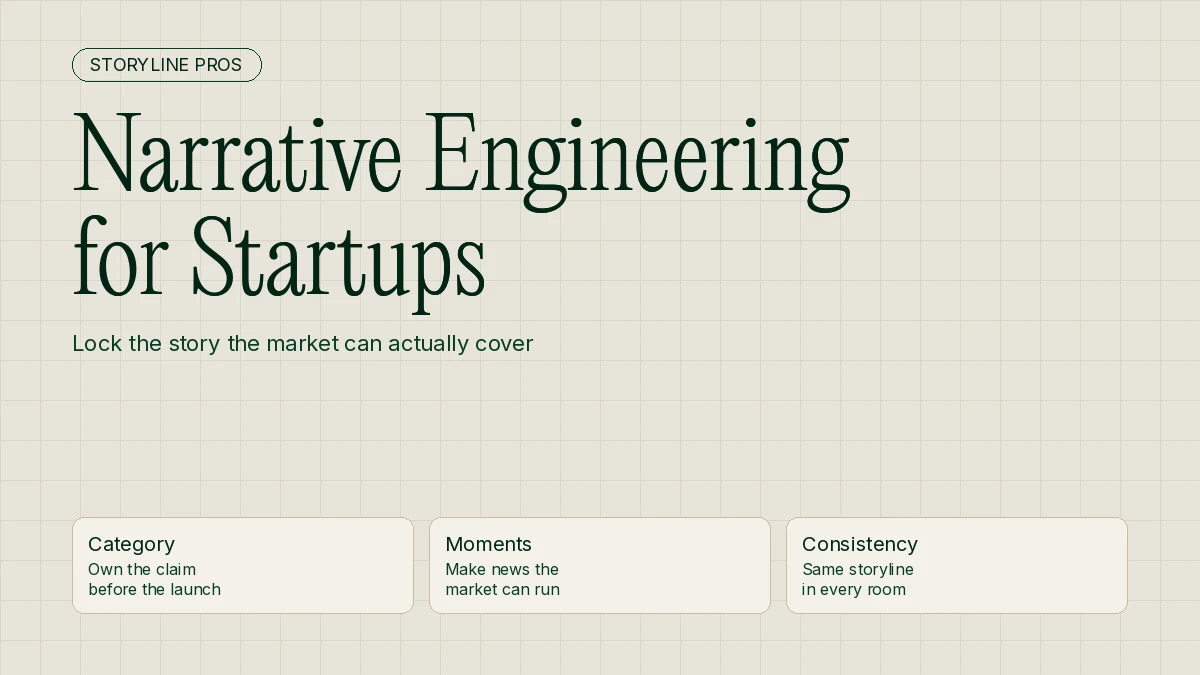
Narrative Engineering for Startups
Narrative engineering is the systematic process of optimizing messaging, positioning, and proof so a company’s public story is coherent, newsworthy, and repeatable by third parties (press, buyers, and AI), creating differentiation that drives brand mentions, sales, and investment. It is not a press release factory.
For Seed to Series B founders, that distinction matters. Reporters and large language models do not cover generic product pitches. They cover newsworthy moments, industry trends, and proof that something in the market changed. Narrative engineering builds those moments on purpose, then places them where authority actually forms.
This guide defines the practice, shows how it differs from hype-driven PR, and outlines how startups use it to earn coverage and AI visibility.
Why startups need more than a pitch deck story
B2B buyers already research with AI. Forrester reports that 94% of business buyers use generative AI in their buying process, and generative AI or conversational search now ranks as a more meaningful information source than vendor websites or sales for a large share of buyers (https://www.forrester.com/blogs/b2b_buyers_make_zero_click_buying_number_one/).
G2's March 2026 survey of B2B software buyers found that 51% now start research with an AI chatbot more often than with Google, and 69% chose a different vendor than they initially planned based on chatbot guidance (https://www.prnewswire.com/news-releases/new-g2-research-half-of-b2b-software-buyers-now-start-their-research-with-ai-chatbots-302742807.html).
Edelman's 2026 Brand Growth work underscores the trust side: what unpaid advocates and peers say outweighs what a brand says about itself (https://www.edelman.com/trust/2026/trust-barometer/special-report-brands). A founder blog post rarely carries the same weight as a tier-one feature or a well-placed industry citation.
What narrative engineering is (and is not)
Narrative engineering is the systematic process of optimizing messaging, positioning, and proof so a company’s public story is coherent, newsworthy, and repeatable by third parties (press, buyers, and AI), creating differentiation that drives brand mentions, sales, and investment.
It is not: inventing drama, stuffing keywords into listicles, or buying "guaranteed" coverage that no editor would run.
The operating unit is a newsworthy moment. Funding news can be one. So can a customer outcome with numbers, a regulatory shift you are positioned for, a research finding, or a founder POV that reframes a category debate. The engineer asks what a skeptical editor would need to say yes.
How startups run it in practice
Start with Brand DNA. Lock the claims you will repeat: who you serve, what you change, what proof you can show, and what you will never overclaim.
Build an event calendar. Map the next 90 days of real milestones. For each, write the angle, the proof, and the outlets or communities that already cover that beat.
Engineer the story before the pitch. Lead with the market change or the buyer problem, then place the company inside it. Product features alone rarely clear the bar.
Execute on two tracks. PR placements (news, features, podcasts, listicles, community) create third-party authority. GEO-optimization (on-page assets and contextual backlinks) makes that authority findable for AI systems that scrape and cite.
Measure like an operator. Track delivered placements against a floor. Track prompt-level AI visibility separately. Do not confuse a vanity hit with a citable one.
Narrative engineering vs traditional startup PR
Traditional retainers often sell activity: outreach volume, media lists, monthly reports that list emails sent. Narrative engineering sells publishable angles and delivered placements, then ties commercial risk to that delivery through performance-based make-good rules where the package includes them.
The startup version also accepts that AI search is part of the buyer journey. Coverage that never becomes a citation source is unfinished work.
Where Storyline Pros fits
Storyline Pros runs narrative engineering as the core method for high-growth tech startups: Brand DNA, category analysis, GEO strategy, then parallel PR and GEO-optimization execution, reported through GEOview AI Visibility Technology. Commercial paths include a one-time AI Visibility Boost, a monthly GEOview tech on-ramp, and Full-Service narrative plus 6-channel media. Fees are scoped in proposals, not published as a public rate card.
FAQ
What is narrative engineering for startups?
Narrative engineering is the systematic process of optimizing messaging, positioning, and proof so a company’s public story is coherent, newsworthy, and repeatable by third parties (press, buyers, and AI), creating differentiation that drives brand mentions, sales, and investment.
Can a founder do narrative engineering in-house?
Parts of it, yes: claim discipline, milestone calendars, and honest angles. Placement at tier-one outlets and systematic GEO usually need a desk that lives in newsrooms and citation ecosystems every week.
How soon does it show up in ChatGPT?
It depends on category competitiveness, existing citation sources, and whether placements land in domains models already trust. Treat AI visibility as a measured outcome over weeks and months, not a same-week switch.
Bottom line
Startups win coverage when they give journalists and AI systems something true and newsworthy to carry. Narrative engineering is the systematic process of optimizing messaging, positioning, and proof so a company’s public story is coherent, newsworthy, and repeatable by third parties (press, buyers, and AI), creating differentiation that drives brand mentions, sales, and investment.
Book a strategy session: https://cal.com/nik-vassev/30min