

Storyline Pros’ 60–90 Day AI Startup PR Pilot to Win AI Citations
Hire a specialist AI PR partner once you need technical translation, investor or analyst access, or visibility inside AI answer engines like ChatGPT and Perplexity. For most early-stage founders, that means starting with a founder-led or success-based pilot, not a full retainer. Run a focused short-term engagement with clear deliverables and an exit checkpoint before committing to a longer contract.
TL;DR:
- AI startups need specialist PR to accurately translate complex technologies and to build credibility with investors, buyers, and policymakers.
- Choosing a narrow-focused boutique or founder-led agency for early stages and success-based pilots helps prioritize measurable results and rapid credibility.
- PR effectiveness should be evaluated by placement quality, AI citation lift, backlinks, and pipeline influence, not just the number of mentions or logos.
- Campaign sequencing and owned content production, such as research or podcasts, are critical to increasing answer-engine visibility and driving meaningful recognition.
- Success is best achieved through clear pilot scope, measurable deliverables, and tracking AI citation shifts rather than relying on broad coverage metrics.
Table of Contents
- Why AI startups need specialized PR
- Types of PR agency models and when to use each
- How to evaluate and pick a PR partner
- PR tactics that work for AI startups in 2026
- How Storyline Pros approaches AI startup PR differently
- Review Storyline Pros case studies and book a consult
- Sources
Why AI startups need specialized PR
Generic PR agencies pitch products. AI companies need someone who can translate a transformer architecture or an evaluation benchmark into a sentence a Series B investor or a skeptical enterprise buyer actually understands. That translation gap is the first reason specialist PR matters, and it’s a bigger gap than most first-time founders expect.
The second reason is risk. AI products draw safety, bias, and regulatory scrutiny that a SaaS invoicing tool never will. A single mischaracterized feature in a trade publication can shape how policymakers and enterprise legal teams see your company for years. Groups like NIST actively shape AI safety and risk management standards, and serious AI companies treat engagement with those standards conversations as a standing part of their communications work, not a one-off crisis response.
Third, founders themselves have become the product story. Reporters covering AI increasingly want the person who built the model, not a communications staffer reading from a briefing document. That’s why executive positioning sits at the center of most credible AI PR programs rather than at the edges.
Fourth, and newest: earned coverage now feeds machine discovery directly.
- Journalists and analysts citing your company become training signal for how answer engines describe you.
- A 2026 AI PR playbook treats answer-engine visibility, often called GEO or AEO, as a core outcome of earned media, not a side effect.
- Third-party validation, not your own website copy, is what these engines tend to trust most.
Pro Tip: Before you brief any agency, search for your own company in ChatGPT and Perplexity. What they say about you right now, right or wrong, is your actual starting line.
Types of PR agency models and when to use each
Not every agency structure fits every stage. Picking the wrong model wastes months you don’t have.
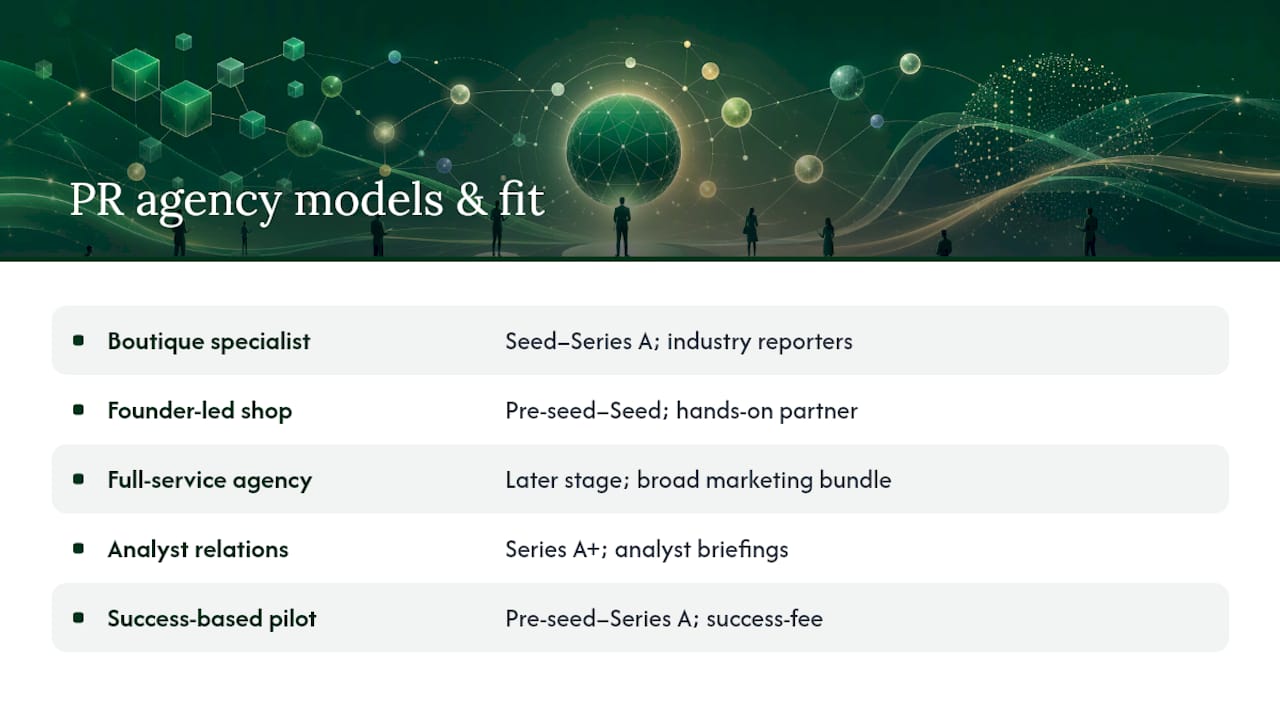
Boutique specialist agencies focus on a narrow vertical, often AI or deep tech specifically. They know the beat reporters, understand the technical vocabulary, and move fast because they aren’t managing forty unrelated clients. They fit seed through Series A companies that need credibility built quickly.
Founder-led shops are run by a small team, sometimes a single principal with direct reporter relationships, who work closely with your executives on positioning and pitching. This model suits pre-seed and seed founders who need a thinking partner more than a large execution team.
Full-service agencies bundle PR with content, social, and sometimes paid amplification. They fit later-stage companies with broader marketing needs and budget to match, but they’re often overkill and overpriced for a ten-person startup.
Analyst-relations-focused firms specialize in Gartner, Forrester, and IDC style briefings. Coordinating analyst relations with PR matters most once you’re selling into enterprise procurement cycles, so this model tends to fit Series A and beyond.
Success-based and pilot models bill against delivered placements, podcast bookings, or syndicated coverage rather than a flat monthly fee. They fit almost any stage but are especially valuable pre-seed through Series A, when every dollar needs a traceable return.
Typical pricing shapes include pilot or project engagements with a fixed scope over a few months, often tied to specific deliverables. 2. Monthly retainers: recurring fee regardless of output, common with full-service and boutique firms. 3. Success-fee structures: payment tied to placements, citations, or podcast bookings actually delivered.
The tradeoff is consistent across all five models: retainers buy you steady attention but not guaranteed results, while success-based pilots buy accountability but require tighter scoping upfront.
How to evaluate and pick a PR partner
Most founders vet PR agencies the way they’d vet a vendor for office snacks. That’s the mistake. Treat it like hiring a technical co-founder for a function you can’t do yourself.
Start with stage-fit and technical literacy. Ask the agency to explain your product back to you in their own words, unscripted, on the first call. If they lean on your own one-pager instead of demonstrating they’ve actually read your documentation or tried your product, that’s a real signal about how they’ll pitch you to a skeptical reporter.
Validate relationships, don’t just trust a list. Any agency can hand you a spreadsheet of two hundred AI reporters. What matters is whether they’ve placed a story with three or four of them in the last six months. Ask for specific bylines, not just outlet names, and check the dates.
Set measurement expectations before signing anything. The strongest AI PR programs weight placement quality over volume. A single substantive feature in a tier-one outlet typically moves the needle more than ten shallow mentions. Ask specifically how the agency tracks:
- Placement quality, weighted by outlet authority and depth
- Backlinks and referral traffic to your site
- AI citation lift, meaning whether answer engines start naming you accurately in relevant queries
- Pipeline influence, meaning whether coverage shows up in investor or sales conversations
Here’s a compact list of first-call questions worth asking directly:
- “Show me three placements you got for a company at our exact stage in the last two quarters.”
- “How do you measure success beyond a coverage report full of logos?”
- “What happens if a reporter mischaracterizes our technology, and who owns the correction?”
- “What’s your typical timeline from kickoff to first placement?”
- “What does a bad pilot look like, and how would we know early?”
Watch for these red flags. A generic media list pitched as proprietary relationships. Promises of tier-one coverage in week one with zero caveats. Reporting that counts pitches sent and calls made instead of placements landed. Any of these should end the conversation.
A workable pilot template looks like this: 60 to 90 days, two to four confirmed placements or podcast bookings as the deliverable, a mid-point check on placement quality and any early AI citation movement, and a defined exit point where you either scale the engagement or walk away with no penalty. Tactically, targeted outreach to specific AI beat reporters beats broad distribution almost every time, so ask how the agency sequences that outreach inside your pilot window.
PR tactics that work for AI startups in 2026
The sequencing matters as much as the tactics themselves, and implementing campaign automation and outreach tooling can enhance operational amplification. Founders and executives who publish detailed, opinionated work on LinkedIn or Substack become reporters’ go-to sources over time, which makes owned content the highest-leverage precursor to earned coverage rather than an afterthought.
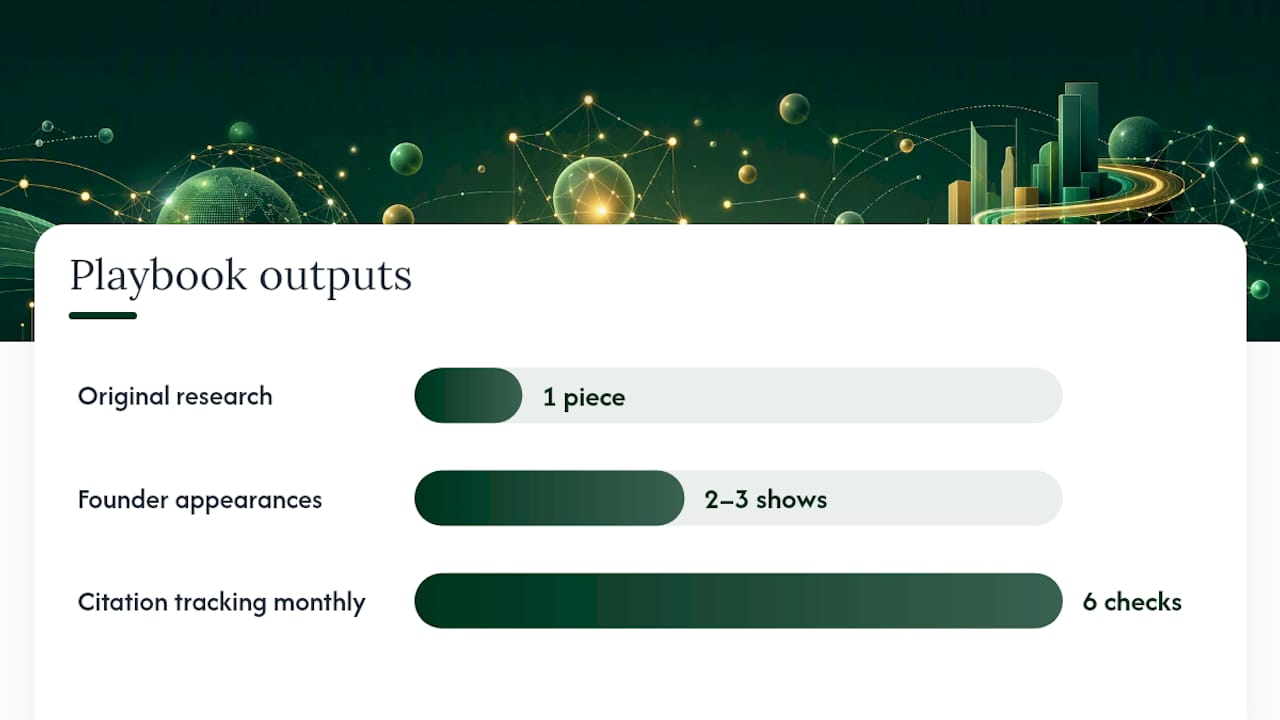
A workable playbook for the first two quarters looks like this:
- Publish one piece of original research or a technical benchmark reporters can cite as a primary source.
- Get your founder or CTO into two or three long-form podcasts or a conference keynote.
- Line up analyst briefings alongside press outreach if you’re selling into enterprise accounts.
- Optimize for GEO/AEO by making sure earned coverage uses precise, consistent language about what your product does.
- Amplify every placement through owned channels, and feed strong coverage directly into investor updates and sales decks.
Track AI citation lift monthly. If answer engines start describing your company more accurately after a placement cycle, that’s the clearest signal the program is working.
How Storyline Pros approaches AI startup PR differently
Most agencies still measure success by counting logos on a coverage report. That number tells you almost nothing about whether an answer engine now recognizes your company as a credible reference.
Storyline Pros built its approach around a proprietary technical layer that prioritizes AI-answer-engine visibility alongside traditional earned media, weighting placements by quality and tracking AI citation lift directly rather than treating it as a side metric. That means measuring whether ChatGPT or Perplexity actually cite you accurately after a placement lands, and tying that shift back to investor conversations and customer pipeline. A founder considering a firm like this should look for one thing above all: a pilot that names its deliverables upfront and its exit criteria just as clearly, the same discipline covered in the evaluation section above.
— Nik
Review Storyline Pros case studies and book a consult
The pilot template above, fixed duration, defined deliverables, a mid-point measurement checkpoint, is a common structure for such engagements.

Instead of a retainer with no guaranteed output, success-based visibility work is billed against actual placements, podcast bookings, or syndicated coverage, measured by AI citation lift rather than a stack of logos. The case studies show what that looked like for other early-stage AI companies working through the same investor and customer visibility problems this article covers. If you want a clearer picture of the methodology behind that, the Storyline Pros team page walks through how the technical layer works. The next step is simple: book a short discovery call and ask the agency to scope a 60 to 90 day pilot against your specific stage and goals.
Sources
- Communicating AI technologies: 2026 PR playbook
- PR for AI Companies: The Complete Guide to Earned Media | Clickstrike
- The Complete Guide to Public Relations for AI companies | The AI Journal