

B2B Content Syndication: A Demand-Gen Playbook
B2B content syndication is the practice of distributing your owned content — white papers, reports, articles, and webinars — through third-party channels to reach targeted audiences and capture leads. Run it when your ACV is above $10,000, you have at least one high-performing gated asset, and your team can follow up within 24 hours. If those three conditions are true, a 30-day pilot with one pay-per-lead partner and one editorial placement is the right immediate move.
Key Takeaways
B2B content syndication produces qualified pipeline when the asset is strong, the partner audience matches the ICP, and lead follow-up happens within 24 hours.
| Point | Details |
|---|---|
| When to run syndication | Use it when ACV exceeds $10,000, you have a gated asset converting above 3%, and sales can follow up within 24 hours. |
| Mixed channel stack | Combine one pay-per-lead network with one editorial or newsletter placement for dependable CPL and brand authority. |
| SEO protection | Always request a canonical tag or attribution link from syndication partners to prevent duplicate content from outranking your original. |
| Measure what matters | Track CPL, MQL rate, and pipeline-to-spend ratio; cut partners who fall below your MQL threshold at the 30-day review. |
| Storylinepros pilot | Storylinepros delivers earned placements and verified leads on a success-based model with no retainer, billed per delivered result. |
Table of Contents
- What B2B content syndication actually is (and how it differs from similar tactics)
- How a B2B syndication campaign runs from start to finish
- Which syndication channels and platforms fit your goals
- The real benefits and the limits you need to know
- How to evaluate and choose syndication partners
- KPIs and reporting that tell you whether syndication is working
- Best practices that separate high-performing syndication programs from average ones
- What to budget and how long to expect before results
- How Storylinepros runs syndication and earned-placement programs
- Storylinepros delivers syndication with measurable results
- Sources
What B2B content syndication actually is (and how it differs from similar tactics)
Syndication covers several distinct formats. Paid pay-per-lead networks host your white paper or report behind their own gate and deliver contact records to your CRM. Newsletter advertorials place your content in front of a curated subscriber list. Editorial republication puts your article on a third-party publication with a canonical link back to the original. Podcast and webinar placements distribute your ideas through audio or live-event formats. Lead-syndication libraries aggregate gated assets from multiple vendors and let buyers self-select.
The gated versus ungated distinction matters more than most teams realize. A gated syndication placement on NetLine or BrightTALK produces a named lead record with job title, company, and email. An ungated editorial republish on an industry publication builds brand authority and backlinks but generates no direct lead data. Both are legitimate; they serve different stages of the demand program.
| Dimension | Content syndication | Guest post | Native ad |
|---|---|---|---|
| Primary goal | Lead capture or reach | Authority and backlinks | Traffic and awareness |
| Payment model | CPL, flat fee, or rev-share | Usually free or editorial | CPM or CPC |
| Lead ownership | You own the lead record | No lead data | No lead data |
| Typical buyer intent | Medium to high (gated) | Low to medium | Low |
| SEO risk | Duplicate content if unmanaged | Minimal | None |
How a B2B syndication campaign runs from start to finish
The campaign flow has seven distinct steps, and skipping any one of them is where programs fall apart.
-
Audit and select your asset. Choose content that already converts on your own site. A white paper with a 4%+ gate conversion rate is a better syndication candidate than a blog post with 0.5%. Repurpose long-form content into shorter derivative assets — a 12-page report becomes a two-page executive summary — as Leadfeeder’s distribution guide confirms, email and repurposed short assets consistently deliver strong ROI.
-
Define your ICP and intent signals. Map the job titles, company sizes, industries, and technologies your ideal buyer uses. Gartner’s guidance on B2B technology buyers is clear: account-level targeting and research-driven content are what move mid-market and enterprise deals. Generic demographic targeting produces volume, not pipeline.
-
Select your partner mix. Plan for at least two channel types: one pay-per-lead network for volume and one editorial or newsletter placement for quality. A mixed stack consistently outperforms a single-channel bet.
-
Set your gate and form. Keep the form to five fields maximum: first name, last name, business email, company, and job title. Every additional field cuts completion rates. Use a business-email validator to block free-domain submissions at the point of capture.
-
Set up tracking and verification. Tag every syndication source with a unique UTM parameter (utm_source=partner_name, utm_medium=syndication, utm_campaign=asset_name). Require your partner to pass lead source and asset name in the data feed. Without this, attribution collapses.
-
Route leads to CRM within four hours. Leads delivered the same day they are captured convert at materially higher rates than those batched weekly. Build a Salesforce or HubSpot workflow that assigns syndicated leads to a dedicated nurture queue on arrival.
-
Launch a nurture sequence. The first email goes out within 24 hours and references the specific asset the lead downloaded. A three-touch sequence over 10 days (content reference, related resource, soft ask for a call) is a workable starting template.
Pro Tip: Require your syndication partner to include a “lead source URL” field in every record. If a partner cannot tell you which specific page or asset generated each lead, you cannot validate quality or attribution — and that is a contract-level requirement, not a nice-to-have.
The sample flow: a buyer visits a partner’s content hub, sees your gated report, fills out the five-field form, and receives the asset by email. The partner’s system passes the record to your CRM via API or CSV within four hours. Your marketing automation fires the first nurture email. Your sales team sees the lead flagged in their queue the next morning.
Which syndication channels and platforms fit your goals
Channel selection is where most demand-gen teams make their first mistake: they pick the platform they have heard of rather than the one that matches their audience’s intent level.
Paid pay-per-lead networks are the workhorse of B2B digital syndication. They deliver named leads against a defined ICP and charge per record delivered. NetLine is the largest self-serve pay-per-lead content syndication platform in the U.S., with targeting by job function, seniority, company size, and industry. It suits teams that need predictable lead volume against a defined CPL target.
Webinar and virtual event platforms produce higher-intent leads because the buyer invests time, not just a form fill. BrightTALK specializes in B2B webinar syndication and hosts a large library of on-demand content across technology, finance, and marketing verticals. A BrightTALK webinar registration typically signals stronger purchase consideration than a white paper download.
Programmatic native networks distribute content at scale across publisher sites. Taboola and Outbrain are the two dominant players in this space. Taboola places sponsored content across premium publisher sites and works best for top-of-funnel awareness and retargeting. Outbrain operates similarly and frames syndication as a way to extend content life across curated editorial environments, as their B2B syndication primer explains. Neither platform produces named lead records by default; they drive traffic to your own gated landing page.
LinkedIn sits in its own category. Sponsored content and document ads on LinkedIn let you target by job title, seniority, company, and even specific account lists. The cost per lead is higher than most pay-per-lead networks, but the audience match for B2B is unmatched. LinkedIn Lead Gen Forms remove friction by pre-filling contact data from the user’s profile.
Intent-based tools like Leadfeeder identify companies visiting your content by resolving IP addresses to company records. Leadfeeder does not deliver named contacts, but it surfaces account-level intent signals that feed directly into ABM plays and sales prioritization.
CMI’s 2025 B2B research shows that 92% of B2B marketers use short articles and posts, while webinars and in-person events remain among the highest-performing formats. The implication: syndication programs that include webinar placements alongside written content tend to produce a richer mix of intent signals.
| Channel type | Audience intent | Typical cost shape | Best format |
|---|---|---|---|
| Pay-per-lead network (e.g., NetLine) | High | CPL per record | White paper, report |
| Webinar platform (e.g., BrightTALK) | High | CPL or flat fee | Webinar, on-demand video |
| LinkedIn sponsored content | Medium to high | CPM or CPL | Document ad, Lead Gen Form |
| Programmatic native (Taboola, Outbrain) | Low to medium | CPM or CPC | Article, infographic |
| Newsletter/editorial placement | Medium | Flat fee or CPL | Article, advertorial |
| Intent tool (e.g., Leadfeeder) | Account-level signal | SaaS subscription | Account list, ABM feed |
The real benefits and the limits you need to know
Content syndication for B2B delivers genuine advantages, but the risks are specific enough to plan around before you sign a contract.
Benefits:
- Reach audiences you cannot build organically in a reasonable timeframe — a partner’s newsletter list of 80,000 CFOs took them years to build.
- Generate lead volume at a predictable CPL, which makes budget planning more reliable than paid social.
- Access newsletter inboxes directly, bypassing the algorithm dependency that plagues organic social.
- Build backlink authority when editorial syndication partners include a canonical link or attribution link to your original content.
- Accelerate pipeline velocity by putting your content in front of buyers who are already in research mode on a relevant topic.
Common pitfalls:
- Low-intent leads from partners who prioritize volume over quality — a lead who downloaded your report six months ago and has since changed jobs is not a pipeline asset.
- Recycled lead lists, where the same contact appears across multiple partners’ databases and has already been contacted by three of your competitors.
- Duplicate content cannibalization, where a syndicated article outranks your original in search results.
- Data quality problems: misspelled emails, personal addresses, and role-generic titles (e.g., “Manager”) that tell sales nothing useful.
SEO guidance. The duplicate content risk is real but manageable. The CMO’s syndication guide recommends two approaches: ask the partner to add a canonical tag pointing to your original URL, or request a “published with permission” attribution link in the article header. The canonical tag is the cleaner technical fix:
<link rel="canonical" href="https://yourdomain.com/original-article/" />
If a partner will not implement a canonical tag, a noindex directive on their version prevents it from competing in search results. Never syndicate content to a partner who refuses both options — the SEO downside outweighs the reach benefit.
Pro Tip: Before syndicating any article, submit it to Google Search Console and confirm it is indexed on your domain. That timestamp establishes priority. If the partner’s version later outranks yours, you have a documented case for requesting the canonical fix.
How to evaluate and choose syndication partners
Partner selection is where the quality gap between good and mediocre syndication programs opens up. The decision is not just about reach; it is about data integrity, audience match, and contractual protections.
| Evaluation dimension | What to ask | What good looks like |
|---|---|---|
| Audience fit | Share a sample lead record from a recent campaign in my ICP | Named contacts with matching job titles and company sizes |
| Lead validation | How do you validate email addresses and screen duplicates? | Real-time email verification, duplicate suppression within 90 days |
| Attribution transparency | What fields are included in the lead data feed? | Lead source URL, asset name, capture date, partner ID |
| Exclusivity and recency | How recently were these contacts added to your database? | Contacts active within 12 months; no shared leads across competitors |
| Privacy compliance | Can you provide proof of GDPR/CCPA-compliant consent? | Documented opt-in consent records available on request |
| Refund/quality SLA | What is your policy for undeliverable or duplicate leads? | Credit or replacement within 30 days for invalid records |
DemandNexus advises prioritizing partners who supply first-party contact data — name, title, company, and direct email — over those who deliver only anonymous IP signals or intent scores. An IP-level signal is useful for ABM account lists, but it cannot feed a sales sequence.
Three contract clauses to insist on before signing: a data handoff cadence (daily or real-time API, not weekly CSV batches), a lead exclusivity window (your leads are not simultaneously sold to competitors for at least 30 days), and a written privacy compliance attestation covering both GDPR and CCPA.
KPIs and reporting that tell you whether syndication is working
The reporting setup matters as much as the campaign itself. Without the right fields in your dashboard, you cannot distinguish a high-performing partner from one burning your budget.
| Dashboard field | Why it matters | How to calculate |
|---|---|---|
| Cost per lead (CPL) | Primary efficiency metric | Total spend ÷ total leads delivered |
| MQL conversion rate | Measures lead quality post-scoring | MQLs ÷ total syndicated leads |
| SQL conversion rate | Measures sales-readiness | SQLs ÷ MQLs from syndication |
| Opportunity rate | Pipeline contribution | Opportunities created ÷ total leads |
| Time to opportunity | Velocity signal | Days from lead capture to opportunity creation |
| ACV attribution | Revenue impact | Sum of ACV on opportunities sourced from syndication |
A sample CPL calculation: if you spend $8,000 on a NetLine campaign and receive 80 leads, your CPL is $100. If 12 of those leads become MQLs, your cost per MQL is $667.
Reporting rhythm: Run a daily validation check on incoming lead records (email format, domain type, duplicate flag). Conduct a weekly quality audit comparing MQL rates by partner. At 30 days, review lead-to-opportunity conversion by source and cut any partner below your MQL threshold. At 90 days, calculate full pipeline attribution and decide whether to scale, maintain, or replace the channel mix.
Privacy and compliance. Every lead record from a syndication partner must carry documented consent for your specific use case. Under CCPA, California residents have the right to opt out of the sale of their personal data; under GDPR, EU contacts require explicit opt-in consent. Request a consent attestation from your partner before importing records into your CRM. Build a suppression list workflow so that opt-out requests are honored within 24 hours across all active sequences.
Best practices that separate high-performing syndication programs from average ones
Asset and gating decisions:
- Gate research reports, benchmark studies, and buyer’s guides — content with standalone value that a buyer would pay for.
- Leave blog posts and thought leadership articles ungated for editorial syndication; they build authority without friction.
- Use progressive profiling for returning visitors: if a contact has already filled out your form once, ask for company revenue or technology stack on the second download rather than repeating the same five fields.
- Never gate a product demo or pricing page through a syndication partner — buyers who want that content are already in your pipeline.
Form field recommendations:
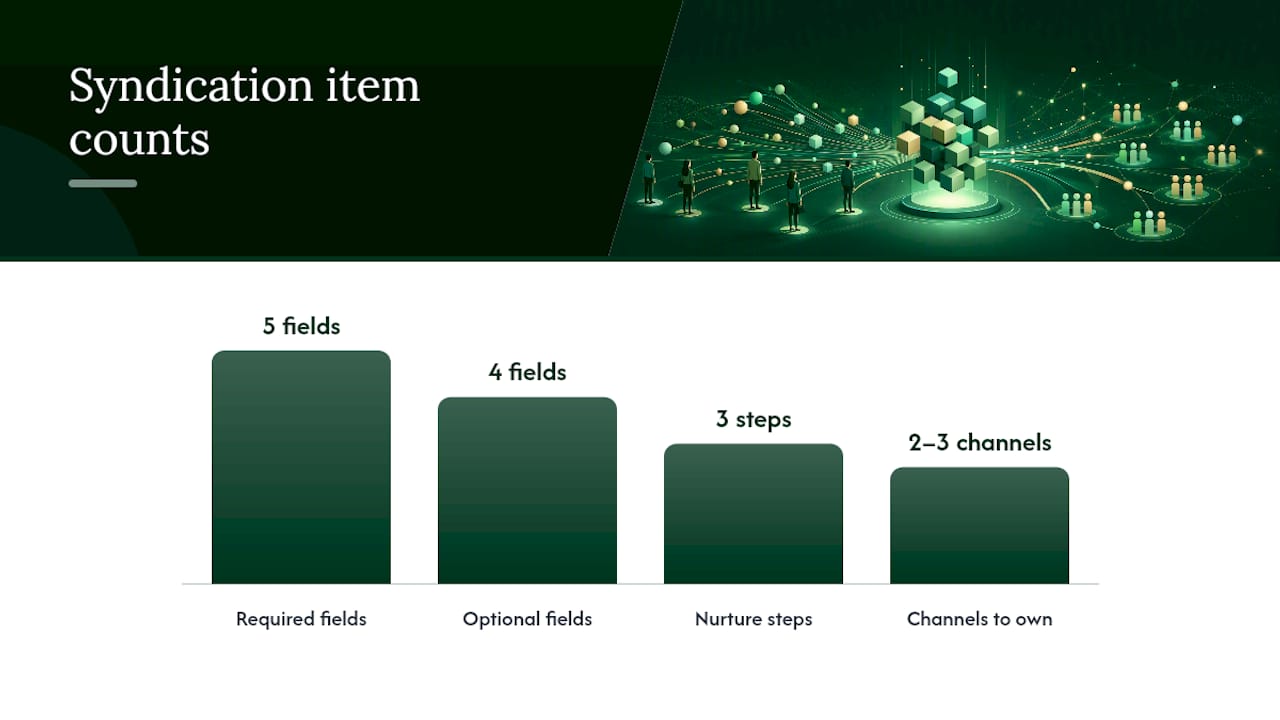
- Required: first name, last name, business email, company name, job title.
- Optional (progressive profiling only): company size, phone number, technology in use, timeline to purchase.
- Never required: personal email, home address, or any field that triggers CCPA/GDPR sensitivity without clear consent language.
Nurture sequence for syndicated leads:
- Day 1: Deliver the asset and reference the specific topic. No pitch.
- Day 4: Send a related resource (a case study or a short video) tied to the same problem.
- Day 10: Soft ask — offer a 20-minute conversation to discuss findings from the report.
ABM integration. Feed account-level data from intent tools like Leadfeeder into your ABM platform to score accounts that have engaged with syndicated content. A company where three employees downloaded your report in the same week is a high-priority account regardless of whether any individual has raised their hand. Gartner’s account-focused targeting guidance reinforces this: buying decisions in mid-market and enterprise accounts involve multiple stakeholders, so account-level signals matter more than individual lead scores.
Pro Tip: Test two creative variants of your asset title with the same partner before committing full budget. A title framed as a benchmark (“2026 State of [Industry] Report”) typically outperforms a generic one (“Guide to [Topic]”) by a meaningful margin on download rate — and a higher download rate directly lowers your CPL.
Backlinko’s distribution framework makes the case for mastering a small channel set rather than spreading effort across many. For most B2B teams, that means owning two or three syndication channels deeply rather than running shallow tests on six.
What to budget and how long to expect before results
Syndication is not a same-week channel. The setup, partner onboarding, and lead validation cycle means most programs take three to four weeks before the first qualified leads land in CRM.
| Phase | Duration | Key milestones |
|---|---|---|
| Preparation | Weeks 1–2 | Asset finalized, ICP defined, partner contracts signed, tracking configured |
| Launch | Week 3 | Campaign live, first leads delivered, CRM routing verified |
| Initial optimization | Weeks 4–6 | Daily validation running, first quality audit completed, underperforming partners flagged |
| Pilot review | Day 30 | CPL, MQL rate, and partner comparison reviewed; scale or replace decision made |
| Ongoing program | Month 2+ | Budget reallocated to top performers, new assets tested, nurture sequences refined |
Typical cost models. Toolradar’s 2026 syndication playbook reports that pay-per-lead syndication CPLs vary by audience seniority and targeting depth, and notes that well-run syndication programs often outperform LinkedIn ads on CPL in B2B SaaS scenarios where the ACV supports the investment. Newsletter and editorial placements typically run on flat fees, which vary widely by audience size and niche authority. Programmatic native (Taboola, Outbrain) runs on CPM or CPC and is generally the lowest-cost entry point, though it produces traffic rather than named leads.
Pilot checklist (30-day minimum viable program):
- One gated asset with a proven on-site conversion rate above a modest threshold.
- One pay-per-lead partner with a signed data quality SLA.
- One editorial or newsletter placement for brand authority.
- UTM tracking and CRM routing verified before launch.
- A three-touch nurture sequence loaded and tested.
- A 30-day review date on the calendar with CPL and MQL rate as the two primary decision metrics.
A realistic pilot budget for a U.S. B2B SaaS company targeting director-level and above is $5,000–$15,000 for 30 days, covering one pay-per-lead network and one newsletter placement.
How Storylinepros runs syndication and earned-placement programs
Storylinepros approaches syndication as one component of a broader earned-authority program, not as a standalone lead-buying exercise. The methodology covers six stages:
- Asset design: Identify or create the one piece of content that demonstrates a specific, defensible point of view — not a generic guide, but a benchmark or original research piece that gives a buyer a reason to engage.
- Partner mapping: Match the asset to partners whose audience composition overlaps with the defined ICP at the account level, using first-party audience data from the partner rather than self-reported reach figures.
- Editorial framing: Position the asset as earned media where possible — a contributed article, a podcast appearance, or a report cited by a trade publication — rather than a paid placement. This produces backlinks and brand authority alongside lead data.
- Lead capture design: Build the gate with the minimum viable form fields and a business-email validator. Every form submission triggers an immediate CRM entry and a same-day nurture email.
- Data validation: Run every incoming lead record through email verification and duplicate suppression before it enters the sales queue. Invalid records are flagged for partner credit within 48 hours.
- Attribution: Tag every placement with source-level UTMs and map leads to pipeline in the CRM. Monthly attribution reports show CPL, MQL rate, and pipeline contribution by partner and asset.
The case studies on the Storylinepros site show the outcomes this methodology produces: measurable increases in earned media placements, improved CPL versus paid social, and pipeline attribution that holds up in quarterly reviews. The success-based model means clients pay for delivered placements and verified leads, not retainer hours.
Syndication works best when it is treated as an earned-authority play with a lead-capture layer — not as a list-buying exercise with a content wrapper. The programs that produce durable pipeline are the ones where the asset is genuinely worth reading, the partner audience genuinely matches the ICP, and the follow-up is fast enough that the lead still remembers downloading the report when sales calls.
What a healthy syndication program actually feels like in practice
A well-run program has a rhythm you can feel within two weeks of launch. Leads arrive daily rather than in a Friday batch. The quality audit on Monday morning shows a consistent MQL rate rather than a spike-and-crash pattern. Sales reps are engaging with syndicated leads rather than ignoring them — which only happens when the lead quality is high enough that the conversation is worth having.

The one thing worth testing in your next pilot: send the first nurture email from a named sales rep’s address rather than a marketing alias. The reply rate difference is often significant, and a reply from a syndicated lead within 48 hours of download is one of the strongest early signals that the partner’s audience genuinely matches your ICP.
Storylinepros delivers syndication with measurable results
Most syndication programs fail not because the channel is wrong but because the asset is generic, the partner is unvetted, and the follow-up is slow. Storylinepros fixes all three.

The Storylinepros model is built around earned placements and verified lead delivery — no retainer fees, no vague reach metrics. Clients get a defined pilot scope: one high-value asset positioned across a curated partner mix, with UTM tracking, CRM integration, and a data validation layer that filters out recycled and invalid records before they reach sales. Every placement is billed on delivery, not on time spent.
What that means in practice: your pilot produces a CPL you can defend in a budget review, a partner shortlist you can scale with confidence, and a nurture sequence that is already running by the time the 30-day review arrives. Request a sample campaign outline and see the methodology applied to your specific ICP and asset before committing to a full program.
Sources
- How to market to B2B technology buyers — Gartner
- B2B Content Distribution: 11 Channels That Work in 2026 — Backlinko
- B2B content distribution channels guide — Leadfeeder
- What Is Content Syndication? A B2B Guide To Extending The Life Of Your Content — The CMO