

Prove ROI: Digital PR vs Link Building for Marketers, 5 Signals
Digital PR and link building solve different problems: link building targets backlinks to move rankings, while digital PR engineers earning visibility and entity signals that compound authority across search and AI platforms. Neither replaces the other. Startups chasing fast rankings on a handful of pages lean link building; those building category credibility for investors and AI-driven discovery need digital PR running alongside it.
TL;DR:
- Digital PR generates entity recognition and third-party validation that can improve search and AI visibility, while link building mainly boosts rankings.
- Key KPIs for digital PR include branded search lift, media coverage quality, and AI citation rate, rather than just link volume.
- Successful campaigns link digital PR efforts to revenue pages, focusing on quality assets like data studies rather than mass outreach.
- Combining digital PR and link building in a strategic sequence enhances long-term authority, with digital PR building credibility first.
- Measuring ROI across multiple dimensions such as coverage quality, search impact, and business outcomes ensures a more accurate assessment of success.
Table of Contents
- Digital PR vs Link Building: What Each One Actually Means
- What KPIs Actually Prove Each Tactic Is Working?
- What Do Link Building and Digital PR Campaigns Look Like in Practice?
- How Do You Combine Digital PR and Link Building Into One System?
- How Do You Measure ROI Beyond Just Counting Links?
- Should You Prioritize Digital PR, Link Building, or Both?
- How Storylinepros Approaches This Differently
- An Editorial Take on Choosing Between Them
- Get Digital PR That Actually Moves Your AI Visibility
- Sources
Digital PR vs Link Building: What Each One Actually Means
Link building is the practice of acquiring hyperlinks from other websites back to yours, usually with the explicit goal of improving search rankings for target keywords. Classic tactics include guest posting, resource-page outreach, broken-link replacement, and directory submissions. The link is the product being pursued.
Digital PR is the practice of earning media coverage, journalist mentions, and third-party validation through newsworthy stories, original data, or expert commentary. The output is coverage, and links are often a byproduct rather than the goal itself. Digital PR provides editorial backlinks, entity mentions, and third-party validation that help search and AI engines prioritize brands. Link building alone doesn’t build that same layer of entity recognition.
The functional difference comes down to intent:
- Link building asks: “Will this site give us a link?”
- Digital PR asks: “Is this story worth a journalist’s time?”
Both can generate backlinks, but digital PR generates them as a side effect of genuine editorial interest, which is why those links tend to carry more topical relevance and trust. Link building can be scaled through direct outreach even without a compelling story. Digital PR link building specifically refers to earning coverage and authoritative backlinks through newsworthy, data-driven stories, and it doesn’t work without something genuinely worth covering.
If you run an SEO program that only does link building, you get rankings without recognition. If you only do digital PR without any link discipline, you get press clippings that never touch your revenue pages. The mistake is treating either as a complete strategy on its own.
What KPIs Actually Prove Each Tactic Is Working?
Judging link building and digital PR by the same metric is where most reporting breaks down. Link building’s core business outcome is ranking movement on defined keywords, usually inside three to six months. Digital PR’s core outcome is broader: brand authority, referral demand, and increasingly, whether AI systems mention you as a credible source in a category.
KPIs for link building:
- Number of referring domains (not total links, since one domain linking ten times counts once for authority purposes)
- Keyword rank position changes on pages that received links
- Domain rating or similar authority score movement
- Referral traffic from the linking pages themselves
KPIs for digital PR:
- Placement count and outlet tier (a mention in a trade publication read by 50,000 relevant buyers matters more than a low-authority blog)
- Branded search volume lift following a campaign
- Share of voice against named competitors in coverage
- Sentiment of coverage, not just volume
- AI citation rate, meaning how often tools like ChatGPT or Perplexity surface your brand when answering category questions
Pro Tip: Pull your branded search volume from Google Search Console before and after a PR push. A spike that holds for weeks, not days, is a far more reliable signal of real brand lift than any vanity link count.
Raw link volume tells you almost nothing on its own. Ten links from irrelevant directories can outnumber two links from major trade outlets and still deliver a fraction of the ranking or trust benefit. Digital PR drives authority and relevance by building brand mentions that help both human readers and algorithmic systems understand what a company does and whether it’s credible. That understanding doesn’t show up in a link count at all.
What Do Link Building and Digital PR Campaigns Look Like in Practice?
The tactics look different because the audience being pitched is different. Link builders pitch site owners and editors who manage a resource page or blog. Digital PR pitches journalists and reporters who need a story their readers will care about, not a favor.
Here’s what each looks like when it’s done well, not lazily:
- Resource and skyscraper outreach. You build a genuinely useful guide, tool, or dataset, then contact site owners already linking to weaker versions of the same resource. This only works when the asset is actually better, not just longer.
- Broken-link replacement. You find dead links on relevant pages and offer your content as the fix. Low effort, low reward, but steady.
- Original data studies. You survey a sample of your industry, analyze proprietary usage data, or aggregate public records into a new finding, then package it for press. This is the backbone of most digital PR wins.
- Journalist-ready summaries. Journalist-focused assets perform best when they’re packaged with clear data, short quotable lines, and a one-paragraph executive summary that reduces the editorial effort required to run the story.
- Interactive tools and calculators. These earn organic links over time because they’re genuinely reusable, not one-and-done pitches.
Modern link building has shifted away from template outreach toward the same principle. The strongest link acquisition now comes from resources, data, and journalist-friendly packaging rather than mass email blasts asking for a favor. That convergence matters: the line between “good link building” and “good digital PR” has gotten thinner every year.
Timeline expectations differ sharply. Link building outreach on a solid resource typically sees pickup within two to six weeks of active pitching. Digital PR is lumpier. A well-timed data study tied to a news cycle can get picked up within 48 hours or sit for a month before a journalist circles back. Budget for that unevenness rather than judging a campaign a failure at the three-week mark.
Pro Tip: Build one journalist-ready asset that answers three related angles, not just one. A single data study on remote work trends can pitch a labor reporter, a real estate reporter, and a tech reporter with three different framings from the same dataset.
How Do You Combine Digital PR and Link Building Into One System?
The two work best when the digital PR asset is built first and the link building motion follows it, pointed at pages that actually make money. Running them as separate, unconnected workstreams is the most common reason companies feel like PR “isn’t working for SEO.”
A workable sequence looks like this:
- Map the asset to a revenue page before you build it. Decide which product, category, or service page should receive authority from the campaign, then design the data study or expert commentary angle around that theme.
- Build the asset, then pitch it as a story, not a promotion. A study on “the true cost of employee turnover” earns coverage. A press release about your HR software does not.
- Capture links from coverage as they land, and track which outlets link back versus which only mention the brand by name without a hyperlink. Unlinked mentions still carry entity value, just not direct link equity.
- Internally link from any new authoritative pages back to the mapped revenue page, transferring some of that earned authority downstream.
- Prioritize the outreach list by relevance to the revenue page’s topic, not by outlet size alone. A mid-tier trade publication in your exact niche often outperforms a general business outlet for both traffic and topical signal.
High-quality, relevant links to product and category pages can outperform a much larger volume of generic links pointed at top-of-funnel blog content, which is the whole argument for planning digital PR with money pages in mind rather than treating coverage as an end in itself.
Resourcing this well usually means one person or team owns the story angle and journalist relationships, while a separate function (in-house SEO or an agency partner) handles the technical mapping: which pages need authority, which internal links to build once coverage lands, and which outlets to prioritize next. Trying to have one person do both story development and technical SEO mapping tends to produce weaker versions of each. A diversified always-on program, mixing reactive newsjacking with smaller ongoing campaigns, spreads that workload and improves your odds of landing coverage in any given month rather than betting everything on one big push.
How Do You Measure ROI Beyond Just Counting Links?
Counting links as your only success metric is how PR budgets get cut. A defensible measurement framework covers five dimensions instead of one: coverage quality, link acquisition, search impact, AI citation rate, and business outcomes. Reporting on all five, even briefly, gives executives a much harder case to argue against than a single link count ever will.
- Coverage quality: outlet authority, relevance to your category, and whether the piece includes a hyperlink or just a brand mention.
- Link acquisition: referring domains gained, and whether they point to revenue-relevant pages.
- Search impact: ranking movement on mapped pages, plus organic traffic to those pages over 90 days.
- AI citation rate: how often your brand or data appears when you or a third party queries AI assistants about your category.
- Business outcomes: branded search lift, demo or trial requests attributable to a coverage spike, and investor or partner inquiries that mention seeing you in press.
| Dimension | Short-term signal (within a month) | Medium-term signal (up to six months) |
|---|---|---|
| Coverage quality | Outlet tier and mention type | Repeat coverage frequency |
| Link acquisition | New referring domains | Domain authority movement |
| Search impact | Impressions on mapped pages | Ranking and organic traffic shift |
| AI citation rate | Manual query spot checks | Consistency across repeated AI queries |
| Business outcomes | Branded search spike | Inbound leads citing coverage |
Attribution here is never as clean as a paid ad click, so treat each dimension as a signal rather than a single proof point. Run experiments where you can, like pausing outreach for a comparable page and comparing performance, and don’t declare a campaign a win or a failure off one month of data. This kind of multi-dimension tracking is what separates programs that survive budget reviews from ones that get labeled “nice to have.”
Should You Prioritize Digital PR, Link Building, or Both?
Start with your business goal, not your channel preference. If you need to move rankings on five specific commercial pages within a quarter, link building is the faster lever. If you’re raising a funding round or entering a new category where nobody has heard of you yet, digital PR builds the credibility layer that link building can’t touch on its own.
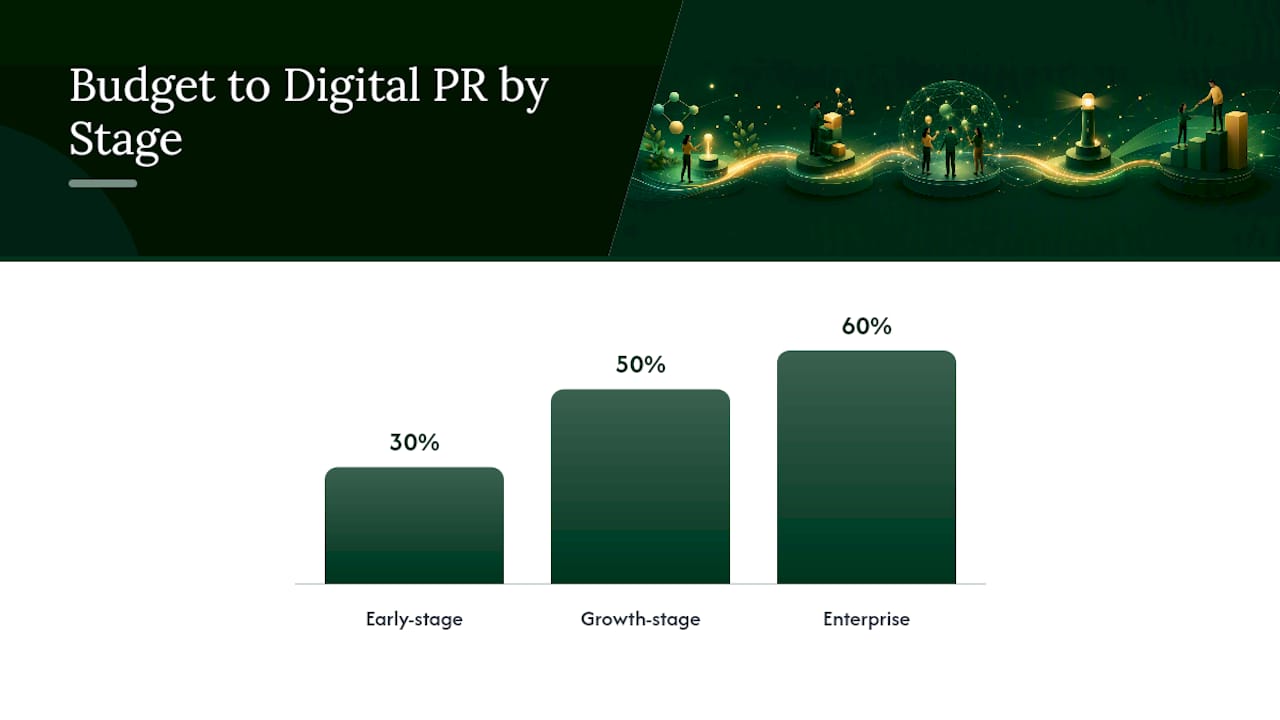
A rough budget framework:
- Early-stage or lean budgets: put 70% into a handful of high-quality link building efforts on your most important pages, 30% into one or two small, always-on digital PR pushes to start building entity recognition.
- Growth-stage programs: closer to a 50/50 split, with digital PR assets built quarterly and link capture happening continuously off the back of them.
- Enterprise or funded startups facing investor scrutiny: digital PR should lead, often 60% or more of the budget, because entity recognition and third-party validation matter more than incremental rank gains at that stage.
Watch for two red flags. First, an agency promising a fixed number of links per month with no mention of the story or asset behind them, that’s templated outreach dressed up as strategy. Second, a PR firm that reports only “impressions” or “reach” with no tie to search visibility or business outcomes.
Pro Tip: Weigh time to impact against certainty of impact, not just cost. Link building on an existing page is lower risk and faster. A digital PR data study is higher risk (it might not get picked up) but higher ceiling when it lands.
How Storylinepros Approaches This Differently
Most agencies bill retainers regardless of whether coverage lands. Storylinepros ties its work to delivered placements, podcast appearances, and syndicated coverage, not promises. The firm’s AI-first narrative engineering approach is built specifically around making startups a citable, credible reference in AI search results, not just a ranking target in traditional Google results.
That distinction matters for founders raising capital or trying to convert customers who now discover brands through AI assistants rather than a list of blue links. Storylinepros treats each placement, community mention, and syndicated piece as a data point across the same five-dimension framework covered above: coverage quality, link acquisition, search impact, AI citation rate, and business outcome. The mere exposure effect, where repeated relevant mentions build both human recall and algorithmic recognition, underpins why steady, always-on placements matter as much as one big media hit. Specific campaign outcomes and placement counts are detailed in the firm’s case studies.
An Editorial Take on Choosing Between Them
The real failure isn’t picking the wrong tactic, it’s treating this as a choice at all. Link building without a story behind it produces links that decay in relevance fast. Digital PR without any link discipline produces press clippings your CFO can’t tie to pipeline. Both are necessary when they’re pointed at the same goal. Three moves for the next 90 days: audit your last six months of off-page activity and sort it into “link” versus “story” work, pilot one journalist-ready asset mapped to a real revenue page, then set up tracking across all five ROI dimensions before you spend another dollar. If your current program can’t answer which dimension it’s winning on, it’s time to rebuild the strategy, not just the outreach list.
— Nik
Get Digital PR That Actually Moves Your AI Visibility
If you’ve read this far, you already know link counts alone won’t get your startup cited when investors or customers ask an AI assistant who the credible players in your category are. Storylinepros is built for exactly that gap: instead of a retainer that pays regardless of results, campaigns tie to delivered media placements, podcast spots, and syndicated coverage designed to make your brand the answer AI engines recommend.

The approach pulls together earned media, Reddit community amplification, and programmatic syndication under the same measurement framework covered above, tracked with proprietary attribution technology so you can see exactly which placements moved rankings, branded search, or investor inquiries. For teams distributing that coverage further on platforms like X, this operator’s guide to organic reach is a useful companion piece. Check the case studies for specifics on past results, then visit Storylinepros to book an assessment of where your current visibility stands.
Sources
The Search Engine Land breakdown of digital PR for SEO anchors the definitions section and the entity-recognition argument throughout this piece. The Search Engine Journal piece on AI search and link building informed the tactical shift toward resource-first outreach described in the tactics section. The Search Engine Land digital PR secrets article shaped the KPI, mapping, and mere-exposure points used across the benefits and integration sections.