

Earned Media Strategy for Marketing Leaders in 2026
An earned media strategy is a deliberate plan to generate third-party coverage, mentions, and endorsements that build trust and visibility without paying for placement. Start by identifying the two buyer segments who most influence your pipeline and mapping the five outlets, communities, or creators they actually read. Everything else in this guide builds from that foundation.
Here is what the rest covers:
- Narrative development: Crafting the story angle that makes journalists and creators want to write about you
- Pitching and media relations: Who to contact, how to frame the ask, and what kills a pitch
- Asset library: The multimedia materials that make coverage easy for reporters and podcasters
- Measurement: The KPIs that connect earned placements to business outcomes, including AI citation frequency
- Modern channels: Podcasts, Reddit, LLM visibility, and programmatic syndication
One action you can complete in under an hour: open a spreadsheet, list your two primary buyer segments across the top, and fill in five trusted outlets or communities for each. That list becomes your first target media map.
Key Takeaways
A well-executed earned media strategy compounds over time: the first placements build credibility, which makes the next placements easier, which feeds AI citation and pipeline influence in ways paid media cannot replicate.
| Point | Details |
|---|---|
| Start with narrative, not pitching | Define one defensible, differentiated claim before contacting a single journalist. |
| Expect a 3–6 month timeline | Meaningful business results from earned programs typically take 3–6 months to materialize. |
| Measure beyond mentions | Track branded search lift, referral traffic, backlinks, and LLM citation frequency alongside EMV. |
| Connect placements to the funnel | Feed earned coverage into sales enablement, retargeting audiences, and CRM pipeline tracking. |
| Storylinepros delivers placements, not promises | The success-based model charges per delivered placement, making earned media accountable from day one. |
Table of Contents
- Why earned media matters more now than it did five years ago
- How earned, owned, and paid media differ and how to combine them
- What types of earned media actually work today
- A stepwise earned media strategy you can implement
- Practical pitching and media relations: what journalists and creators want
- How to measure earned media and attribute impact to business outcomes
- Modern earned-media tactics: AI, audio, multimedia, and community activation
- Common earned-media challenges and how to avoid or mitigate them
- Narrative engineering in practice: how Storylinepros approaches earned visibility
- How earned media insights connect to your marketing and sales funnels
- What actually matters in earned media (and what most teams get wrong)
- Storylinepros builds earned visibility without the retainer model
- Sources
Why earned media matters more now than it did five years ago
Earned coverage has always carried more credibility than paid advertising. What changed is the mechanism. AI and LLMs increasingly cite third-party sources when generating answers, which means a byline in a trade publication or a mention in a respected newsletter now does double duty: it influences the human reader and trains the model’s sense of who is authoritative on a topic.
That shift has real business consequences. A brand that appears consistently in trusted third-party sources gets cited by ChatGPT, Perplexity, and Claude when buyers ask category questions. A brand that exists only in its own blog and paid ads does not. The practical implication: earned placements are no longer just a PR vanity metric. They are raw material for AI-driven discovery.
Pro Tip: Prioritize placements that carry credibility signals: trade analyst mentions, bylines in publications your buyers bookmark, and niche creator endorsements. A single mention in a respected industry newsletter often carries more LLM citation weight than ten mentions in low-authority aggregator sites.
The business case for prioritizing earned media comes down to three compounding effects:
- Trust transfer: Third-party coverage signals independence. Buyers who encounter your brand through a journalist’s analysis or a peer’s recommendation arrive with a different level of skepticism than those who clicked a display ad.
- Funnel reach: Earned placements appear at every stage, from awareness (a news story) to evaluation (an analyst comparison) to decision (a peer review or community recommendation).
- AI citation potential: LLM citation frequency is emerging as a headline KPI for brands that care about AI-driven discovery. Track how often your brand appears in AI-generated answers to category questions your buyers ask.
The headline KPI to bring to your next stakeholder meeting: earned media value (EMV), which translates coverage volume and placement quality into an advertising-equivalent dollar figure. It is imperfect, but it gives finance teams a number they can compare against paid spend.
How earned, owned, and paid media differ and how to combine them
Understanding the three-channel model is less about theory and more about knowing where to put your next dollar and your next hour.
Owned media acts as the central source of truth: your website, blog, podcast, and newsletter are the places you control completely. Earned media adds credibility by putting third-party voices behind your claims. Paid media extends reach by distributing proven content to audiences you have not yet reached organically.
| Dimension | Owned media | Earned media | Paid media |
|---|---|---|---|
| Control | Full | None | Full |
| Cost | Production cost | PR effort and time | Direct spend |
| Trust level | Moderate | High | Low to moderate |
| Funnel stage | All stages | Awareness and evaluation | Awareness and retargeting |
| Best use | Source of truth, SEO, nurture | Credibility, discovery, AI citation | Reach, retargeting, scale |
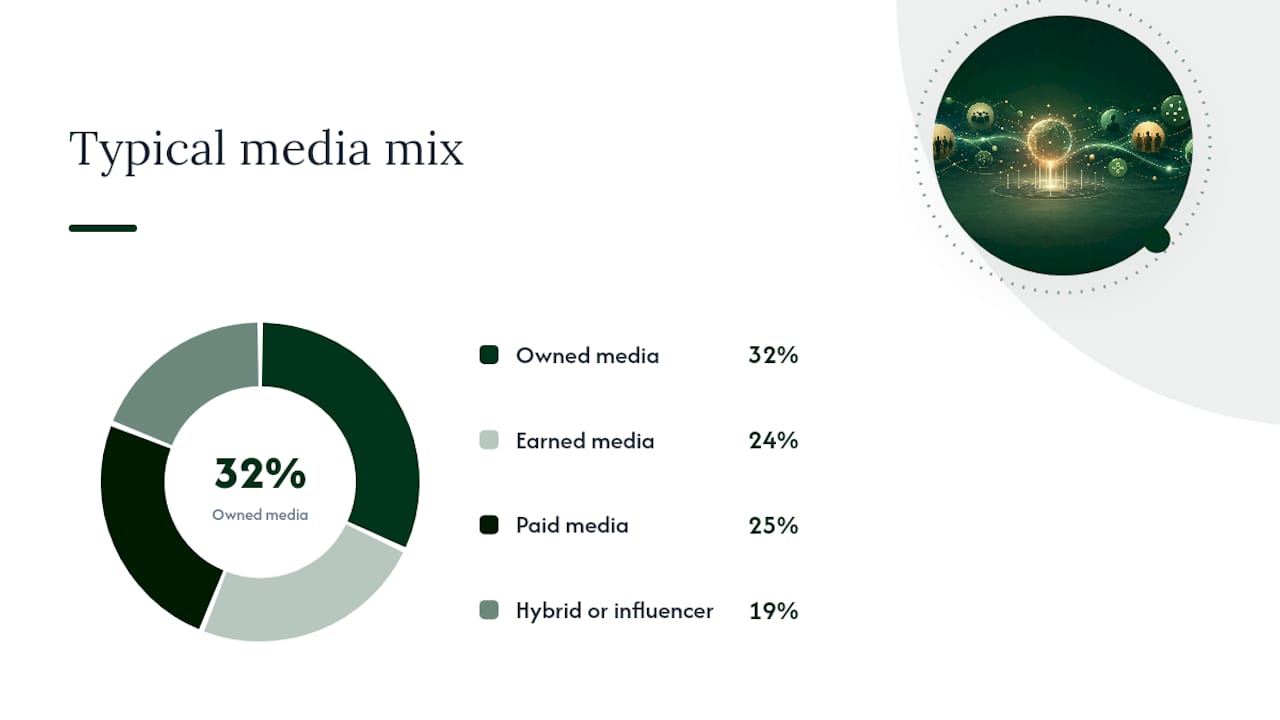
A practical media mix often lands around 24% earned, 25% paid, and 32% owned, with the remainder in hybrid or influencer activity. Those proportions shift by company stage: early-stage startups often over-index on owned and earned because paid budgets are thin; scaling companies add paid to amplify what earned has already validated.
The sequencing that works in practice: publish a well-researched owned asset (a data report, a definitive guide, a proprietary survey), pitch that asset to journalists and creators as the source material for their stories, then use paid promotion to push the resulting coverage to lookalike audiences. The earned placement gives the paid ad social proof it could never manufacture on its own. That loop, owned to earned to paid, is where the leverage lives.
One practical note on budget: do not invest heavily in paid amplification before you have proven that an earned narrative resonates. Paying to distribute a story that journalists ignored is expensive confirmation that the angle needs work.
What types of earned media actually work today
Earned media is not just press releases and newspaper mentions. The channel set has expanded considerably, and the most effective programs use several types simultaneously.
- Press coverage: News stories, feature articles, and product reviews in trade and national publications. Works best when you bring data or a contrarian angle, not a product announcement.
- Bylined articles: Op-eds and contributed pieces under your name in industry publications. These establish thought leadership and are indexed by LLMs as authoritative source material.
- Analyst mentions: Inclusion in Gartner, Forrester, or niche analyst reports. High-trust, high-effort, and often decisive at the evaluation stage.
- Podcast interviews: Guest appearances on shows your buyers already listen to. Particularly effective for evaluation-stage audiences because the format allows depth.
- Creator and influencer mentions: Organic endorsements from niche creators with engaged audiences. Micro-creators (10,000–100,000 followers in a specific vertical) often outperform mass-reach influencers on conversion.
- User-generated content: Customer reviews, social posts, and community discussions. Authenticity is the asset; the brand’s job is to create conditions that make UGC likely, not to script it.
- Reddit and community mentions: Organic recommendations in subreddits, Slack communities, and Discord servers. These carry outsized LLM citation weight because they represent genuine peer opinion.
- Awards and speaking slots: Industry recognition and conference appearances that signal credibility to buyers and journalists alike.
- Wikipedia citations: Inclusion as a cited source on relevant Wikipedia pages. LLMs treat Wikipedia as a high-authority reference; being cited there increases the probability of AI citation.
Two examples of what success looks like in practice:
A B2B SaaS company published a proprietary benchmark report on sales cycle length across industries. Three trade journalists covered it within two weeks, generating backlinks and mentions that pushed the brand into AI-generated answers for “average B2B sales cycle” queries. The report cost roughly 40 hours to produce and generated coverage that a paid campaign could not have replicated.
A consumer brand seeded product samples with 50 micro-creators in a specific lifestyle vertical. The resulting UGC posts, combined with Reddit community discussions those creators sparked, produced a sustained lift in branded search volume over the following 90 days.
Pitch angles that focus on narrative and audience value, not company self-promotion, earn higher response rates. Journalists prefer data, independent sources, and a clear answer to “why does my reader care about this today?”
A stepwise earned media strategy you can implement
Earned media programs typically take 3–6 months to show meaningful business results. The plan below is staged to match that reality: the first 30 days build the foundation, the next 60 days generate the first placements, and the 90–180 day period scales what works.
Day 0: Set goals, audiences, and success metrics before anything else
Before you write a single pitch, answer three questions in writing: What business outcome does this program serve (pipeline, investor credibility, category authority)? Which two buyer segments matter most? What does a successful placement look like for each segment?
Define your baseline metrics now: current branded search volume, existing backlink profile, share of voice in your category, and whether your brand appears in any AI-generated answers to category questions. You cannot measure progress without a starting point.
The 30/90/180-day plan
1. Days 1–30: Foundation
- Develop your core narrative (the one-sentence story that is true, differentiated, and useful to a journalist’s audience)
- Build a target media list of 30–50 contacts across your priority channels
- Create a minimum asset library: one data point or proprietary insight, one spokesperson bio, one high-resolution image set, and one short video clip
- Set up media monitoring (Google Alerts at minimum; Mention or Muck Rack for more coverage)
- Publish the owned asset that will anchor your first pitches
2. Days 31–90: First placements
- Send your first 15–20 personalized pitches, targeting trade publications and niche podcasts first
- Follow up once, seven days after the initial pitch, with a new angle or additional data
- Secure two to three placements and document what angle worked
- Begin community seeding: participate authentically in two to three relevant Reddit communities or Slack groups before mentioning your brand
- Track referral traffic and branded search lift from early placements
3. Days 91–180: Scale and iterate
- Expand the media list based on what worked in the first 90 days
- Add a byline program: pitch two contributed articles per month to trade publications
- Launch a podcast guest campaign targeting five to ten shows in your buyers’ listening rotation
- Begin paid amplification of your two best-performing earned placements
- Conduct a monthly narrative audit: are journalists and AI tools describing your brand the way you intend?
| Phase | Priority activities | Expected signals | Business outcome |
|---|---|---|---|
| Days 1–30 | Narrative, asset library, media list, monitoring setup | Baseline data captured | Foundation for outreach |
| Days 31–90 | Pitching, first placements, community seeding | 2–3 placements, referral traffic lift | Early credibility signals |
| Days 91–180 | Bylines, podcast guests, paid amplification, narrative audit | 10+ placements, branded search lift | Pipeline influence, AI citation |
Pro Tip: Personalize every pitch to the specific journalist’s recent work. A two-sentence reference to their last article, explaining why your angle extends their coverage, increases response rates more than any subject-line trick. Generic pitches go to the trash; specific ones start conversations.
Practical pitching and media relations: what journalists and creators want
The single biggest mistake in earned media outreach is treating a pitch like a press release. Journalists and creators are not your distribution channel. They are independent professionals whose job is to serve their audience, not yours.
What reporters and niche creators actually want:
- An answer-first angle: Lead with the insight or data point, not the company name. “Sales cycles in SaaS have lengthened by 23% since 2022” is a story. “We launched a new CRM feature” is not.
- Data they cannot get elsewhere: Proprietary surveys, original research, or access to a trend before it becomes obvious.
- Sources beyond your own company: A journalist who quotes only your spokesperson has written an ad. Offer to connect them with customers, analysts, or independent experts.
- Ease of use: A media kit with ready-to-use images, a short video clip, and a one-paragraph summary saves a reporter 30 minutes. That saves you a follow-up email.
Three subject lines that work
For trade publications: “New data: [Specific finding] in [Their Coverage Vertical]”
For national media: “[Counterintuitive claim] — here’s what the numbers show”
For creator outreach: “Thought your audience would find this useful: [Specific insight tied to their recent content]”
Pitch dos and don’ts
Do:
- Research the journalist’s last five articles before writing a word
- Lead with the audience benefit, not the product feature
- Include one data point in the subject line
- Offer exclusivity when the story is time-sensitive
- Follow up once, with new information, not a “just checking in” note
Don’t:
- Send the same pitch to 200 contacts simultaneously
- Attach a press release as the pitch itself
- Use “I hope this email finds you well” or any similar opener
- Pitch a story that the outlet covered three months ago
- Ignore the journalist’s stated beat and coverage area
Build your contact list in a simple CRM or spreadsheet. Track the journalist’s name, outlet, beat, last article date, and your last interaction. A beat tracker that notes what each contact has covered recently is worth more than a purchased media database you never update.
Pro Tip: Treat media relationships like sales relationships. A journalist who passes on your pitch today is not a dead lead. Send them a useful piece of data with no ask attached two months later. That goodwill compounds.
How to measure earned media and attribute impact to business outcomes
Earned media measurement uses different lenses than paid media. CPM and CPA are the wrong units. The metrics that matter for earned coverage are the ones that capture trust, reach, and downstream business behavior.
| Metric | What it measures | How to track it | Key limitation |
|---|---|---|---|
| Earned media value (EMV) | Dollar equivalent of coverage based on ad-rate benchmarks | Media monitoring tools (Mention, Muck Rack) | Methodology varies; not comparable across tools |
| Branded search lift | Increase in searches for your brand name after coverage | Google Search Console, Google Trends | Lags coverage by 2 weeks |
| Referral traffic | Visitors arriving from earned placements | Google Analytics (source/medium) | Dark social and direct traffic obscure some referrals |
| Backlinks | Domain authority signals from coverage | Ahrefs, Semrush | Quality varies widely by source domain |
| Sentiment | Tone of coverage (positive, neutral, negative) | Media monitoring tools, manual review | Automated sentiment is often inaccurate for nuanced coverage |
| Share of voice | Your brand’s mention volume vs. competitors | Mention, Brandwatch | Requires consistent competitor tracking |
| LLM citation frequency | How often AI tools cite your brand in category answers | Manual prompting, emerging tools (Profound, Otterly.ai) | No standardized measurement yet |
Measurement checklist and cadence
- Daily: Google Alerts for brand name, key executives, and primary competitors
- Weekly: Review new placements, check referral traffic from earned sources, note any narrative drift in how journalists describe your brand
- Monthly: Branded search volume trend, backlink profile changes, EMV calculation, LLM citation audit (prompt 10–15 category questions in ChatGPT and Perplexity and record whether your brand appears)
- Quarterly: Share of voice analysis, pipeline influence review (which deals touched earned content), narrative alignment check
Connecting earned media to pipeline requires a deliberate setup in your CRM. Tag contacts who engaged with earned content before entering the pipeline. Ask in discovery calls how the prospect first heard of you. Over time, a pattern emerges: which placements drive qualified conversations, and which drive traffic that never converts.
Modern earned-media tactics: AI, audio, multimedia, and community activation
The channel mix for earned media in 2026 looks different from what it did even three years ago. AI-powered monitoring, podcast placements, UGC amplification, and multimedia press assets are now standard components of programs that perform.
Optimizing for LLM visibility
AI tools cite sources that appear authoritative, consistent, and specific. To increase citation frequency:
- Publish definitive, well-sourced content on your owned properties that answers the exact questions buyers ask AI tools
- Earn placements on high-authority domains that LLMs treat as trusted references (major trade publications, Wikipedia, established newsletters)
- Use consistent language across all placements: if you want to be cited as “the leading platform for X,” every byline, press quote, and community mention should use that framing
- Track citation frequency monthly by prompting AI tools with 10–15 category questions and recording results in a simple spreadsheet
Audio and podcast placements
Podcast interviews are among the highest-trust earned formats available. A 45-minute conversation with a host whose audience trusts them produces a depth of credibility that a 300-word news mention cannot match. Target shows where your buyers are in evaluation mode, not just awareness mode. A podcast that covers implementation challenges, vendor selection criteria, or ROI measurement is more valuable than one that covers industry news.

Build a one-page podcast pitch kit: your bio, three topic angles with audience benefit statements, and two or three questions the host can use verbatim. Hosts with small teams will use that kit. It removes friction and increases your booking rate.
Community activation and UGC
Reddit, niche Slack communities, and industry Discord servers are where peer recommendations happen without brand involvement. The right approach is to participate genuinely before you ever mention your product. Answer questions, share useful data, and build a reputation as a knowledgeable contributor. When the moment is right to mention your brand, it lands as a recommendation, not an ad.
For UGC, create conditions that make sharing likely: an exceptional product experience, a referral incentive, a community challenge, or a template that customers want to share. Do not script the content. Authenticity is the asset.
Pro Tip: Build an owned content machine that repurposes earned assets. A podcast interview becomes a blog post, a quote card, a newsletter section, and a LinkedIn post. A press mention becomes a case study sidebar. Every earned placement should generate at least three owned content pieces. That loop feeds AI answers because your owned content reinforces the same narrative the earned placement established.
Common earned-media challenges and how to avoid or mitigate them
Most earned media programs fail not because the strategy is wrong but because execution breaks down in predictable ways. Here are the failure modes worth designing around.
Pitch fatigue: Sending too many pitches to the same contacts, or sending generic pitches to large lists, trains journalists to ignore your name in their inbox. Stagger outreach: no more than one pitch per contact per month, and rotate your contact list so no single journalist receives more than four pitches per year from your team.
Measurement gaps: Without a baseline, you cannot prove progress. Set up monitoring and record your starting metrics before the first pitch goes out. A program that cannot show movement after 90 days is either working and unmeasured, or not working and undetected.
Inconsistent narratives: If your CEO says one thing in a podcast, your PR team pitches another angle to journalists, and your website says a third thing, LLMs and journalists will reflect that confusion back to you. Maintain a narrative ledger: a single document that defines your core claims, supporting data points, and approved language for each audience.
Negative coverage: It happens. The mitigation is speed and transparency, not silence. Have a one-page crisis response framework ready before you need it: who approves the response, what the default posture is (acknowledge, correct, or no comment), and which channels you use to respond.
Overreliance on a single channel: A program built entirely on press pitching is one editorial calendar change away from zero placements. Diversify across press, podcast, community, and UGC from the start.
Pro Tip: On legal and ethical considerations: always disclose material relationships when content is sponsored or when a creator has received product or payment. The FTC’s endorsement guidelines apply to earned-adjacent tactics like influencer seeding. Reusing a journalist’s published work in your marketing materials requires permission. When in doubt, ask.
Narrative engineering in practice: how Storylinepros approaches earned visibility
The principles in this guide are the same ones that Storylinepros applies in practice. The firm’s approach starts with what it calls narrative engineering: identifying the specific claim a client needs to own in its category, building the evidence base that makes that claim credible to journalists and LLMs, and then distributing it across the channels where buyers and investors look for validation.
A representative pattern from the Storylinepros case study portfolio: a high-growth startup enters a crowded category with no existing media presence. The narrative intervention begins with a proprietary data point or contrarian insight that gives journalists a reason to write. That angle is pitched to trade publications and niche podcasts simultaneously. The resulting placements are then seeded into relevant Reddit communities and amplified through the client’s owned channels. Within 90 days, the brand begins appearing in AI-generated answers to category questions.
The most durable earned media programs are built on a single, defensible narrative claim — not a product feature list. When a journalist can explain your brand in one sentence that their audience finds useful, you have earned coverage. When they cannot, you have a press release.
Playbook checklist for startups
- Build a narrative ledger before the first pitch (core claim, supporting data, approved language)
- Set a pitching cadence: 10–15 personalized pitches per month, tracked in a CRM
- Publish one owned asset per month that gives journalists source material
- Seed community channels with useful content before mentioning the brand
- Track LLM citation frequency monthly using manual prompting
- Amplify every earned placement through owned channels within 48 hours of publication
Adaptation notes by company stage
Early-stage startups (pre-Series A) should concentrate on three to five high-authority placements rather than volume. One byline in a respected trade publication carries more weight than 20 mentions in aggregator sites. Keep the team small: one person owning narrative and outreach is more effective than a committee.
Scaling companies (Series A and beyond) can add podcast guest campaigns, a byline program, and paid amplification of proven placements. At this stage, the measurement infrastructure matters more: connect earned placements to CRM data and track pipeline influence explicitly.
How earned media insights connect to your marketing and sales funnels
Earned coverage does not live in a PR silo. The most effective programs treat every placement as a signal that feeds the broader marketing and sales operation.
At the top of the funnel, earned placements in high-reach publications drive branded search volume and direct traffic. Track these in Google Search Console and Google Analytics. When a placement drives a measurable spike in branded searches, that is evidence the narrative resonated. Feed that insight back to your content team: the angle that worked for a journalist will likely work for a paid ad headline or a landing page.
In the middle of the funnel, earned content becomes sales enablement. A prospect who has read a third-party article about your company arrives at a sales call with a different level of trust than one who only saw a paid ad. Equip your sales team with a “coverage deck”: a one-page summary of recent placements, organized by the buyer concern each one addresses. When a prospect raises a specific objection, the sales rep can share a relevant third-party article rather than a company-produced white paper.
At the bottom of the funnel, peer reviews and community recommendations often tip decisions. Monitor review platforms (G2, Capterra, Trustpilot for consumer brands) and community discussions for the language buyers use when they recommend or criticize your product. That language is your next pitch angle.
The integration point that most teams miss: earned media insights should flow into your demand generation targeting. If a specific placement drove high-quality referral traffic from a particular outlet, build a retargeting audience from that outlet’s readers. If a podcast episode drove a spike in demo requests, pitch similar shows. Earned media tells you where your buyers are paying attention. Paid media lets you go back to that same attention with a direct offer.
What actually matters in earned media (and what most teams get wrong)
Most earned media programs underperform because teams treat narrative as an afterthought. They build the product, write the press release, and then wonder why journalists do not respond. The sequence is backward.
Narrative has to come first. Before you know which outlets to pitch, you need to know the one thing your brand can say that is true, differentiated, and useful to a journalist’s audience. Not a tagline. Not a mission statement. A specific, defensible claim about the world that your brand is positioned to make. “Sales cycles are getting longer and here is the data” is a narrative. “We help companies close deals faster” is a brochure.
The second thing most teams get wrong is measurement. They track mentions and coverage volume without connecting those numbers to business outcomes. A hundred mentions in low-authority outlets is worth less than two mentions in the publications your buyers actually read. Quality over volume is not a cliché here; it is a measurement choice. Define what a high-quality placement looks like before you start, and track that metric, not just total mention count.
The third mistake is impatience. Earned media compounds. The first placement is the hardest. The second is easier because you can reference the first. By the tenth, journalists are reaching out to you. Teams that abandon the program after 60 days because they have not seen pipeline impact are quitting before the compounding starts.
One thing I would push back on in the conventional PR playbook: the press release as a primary tactic. For most companies, a well-researched pitch email to five specific journalists will outperform a wire distribution to five hundred. The press release has its place (regulatory announcements, major funding rounds), but as a day-to-day earned media tactic, it is mostly noise. Spend the time on the pitch instead.
Storylinepros builds earned visibility without the retainer model
Most PR agencies charge a monthly retainer regardless of whether placements happen. Storylinepros operates differently: the model is success-based, meaning you pay per delivered placement, podcast appearance, or syndicated content piece, not for hours of effort that may or may not produce results.

For startups that need to show investors and customers that they are credible references in their category, that distinction matters. Storylinepros combines narrative engineering, AI search optimization, and community amplification into a single program with measurable outputs. No long-term contract required to get started. The case studies document what that looks like in practice: measurable media reach, AI citation gains, and investor engagement driven by earned placements rather than paid ads.
If you are ready to build a program with trackable placements and a narrative that feeds both journalists and AI tools, see how Storylinepros works and book a conversation with the team.
Sources
Building measurement capability does not require an enterprise budget. The right tool depends on where your program is.
Media monitoring:
- Paid, owned and earned media (HBS Online)
- Paid vs earned vs owned media: A guide for modern PR teams | Presspage
- Earned Media vs Paid Media Guide
LLM visibility tracking:
SEO and backlink tools:
Podcast tracking:
For startups: Start with Google Alerts, Google Search Console, and manual LLM prompting. Add Mention or Muck Rack when you are pitching actively and need to track coverage in real time. Invest in Ahrefs or Semrush once you have enough placements to measure backlink quality meaningfully.
For mid-market and enterprise teams: Add Muck Rack for journalist relationship management, Brandwatch for share-of-voice, and Profound or Otterly.ai for LLM visibility. Connect all data sources to a central dashboard (Looker Studio works for most teams) so earned media metrics appear alongside paid and owned performance in a single view.
Useful references: