

Get Recognized by Investors in 90 Days with Entity SEO for Startups
Entity SEO for startups means getting your company recognized as a distinct, verified concept in the databases that Google and AI models pull from, not just ranking for keywords. The single highest-leverage move is building an “Entity Home”: a homepage or about page carrying Organization JSON-LD with a stable @id and sameAs links to Wikidata and Crunchbase. Do that first, then let corroboration and a partner like Storylinepros build outward from there.
TL;DR:
- Creating a verified Entity Home with stable
@idand cross-referenced profiles is essential for clear disambiguation and accurate machine recognition.- Claiming and properly populating your Crunchbase and Wikidata entries establishes verifiable signals that feed into knowledge graphs and AI models.
- Building a network of relationships through content, media placements, and schema links reinforces your startup’s entity profile and improves AI citation frequency.
- Consistent name usage, schema validation, and proactive maintenance prevent conflicting signals that weaken your entity recognition.
- Focusing on core entities like your flagship product, founder, and category yields the highest authority impact, rather than spreading effort across many topics.
Table of Contents
- What Is Entity SEO and How Do Knowledge Graphs Work?
- Why Entity SEO Matters for Startups Right Now
- How Do You Get a Knowledge Panel and Claim Your Entity Home?
- Mapping Entities to Pillar and Cluster Pages
- How Do You Write Copy That Search Engines Can Disambiguate?
- What Tools and Signals Prove Entity SEO Is Working?
- Common Pitfalls That Undo Entity SEO Work
- Your First 90 Days: The Entity SEO Checklist
- Building and Leveraging Entity Relationships in SEO
- Fitting Entity SEO Into Startup Marketing and Branding
- A Publisher’s Perspective on Entity SEO for Startups
- Some agencies exist because most of the checklist above takes longer to execute well than founders have time for, especially the parts that depend on relationships: landing earned media placements, getting podcast bookings, or seeding genuine community discussions. The work maps directly onto the recommended playbook: podcast guest spots and earned media placements build the co-citation signals that strengthen entity relationships, programmatic news syndication extends the corroborated footprint across more indexed sources, and tracking layers measure whether placements actually translate into AI citations, not just backlinks. Unlike retainer-based PR agencies billing for activity, some engagements are structured around delivered placements and measurable visibility outcomes.
- Sources
What Is Entity SEO and How Do Knowledge Graphs Work?
An entity, in search terms, is any distinct thing a machine can identify and reason about: your company, your founder, your flagship product, a category you compete in. Google’s Knowledge Graph and the training data behind large language models don’t store keywords the way old-school search engines did. They store entities and the relationships between them, connected in a structure closer to a map than a filing cabinet.
That distinction changes how visibility actually works. When someone asks ChatGPT or Perplexity “who are the leading startups in supply chain AI,” the model isn’t scanning for a phrase match. It’s retrieving entities it has confidently linked to that category, and confidence comes from corroborated data, not clever copywriting. Query Computation Tree Optimization research shows that structured, well-identified entities dramatically improve answer accuracy in knowledge graph retrieval, with one study finding roughly a 22% accuracy gain over older embedding methods when queries are resolved against properly disambiguated entities. That’s the technical reason a clean @id and a verified external identifier aren’t busywork. They’re what lets a machine tell your startup apart from a same-named competitor, a personal blog, or a dormant shell company.
Disambiguation is the practical headache most founders underestimate. If your company is named after its founder, or shares a name with an unrelated business, search engines and AI models need explicit signals to separate “Acme, the fintech startup” from “Acme, the founder’s personal Twitter handle” or “Acme Corporation, the 1950s manufacturer.” Wikidata solves this with QIDs, unique numeric identifiers (like Q312 for Apple Inc.) that anchor an entity regardless of name collisions. Once your startup has a QID, every other system referencing that identifier inherits the disambiguation for free.
Why Entity SEO Matters for Startups Right Now
Ranking for competitive keywords costs real money, and early-stage startups rarely have the ad budget or the years of organic authority to win those fights against funded incumbents. Entity signals sidestep that entirely. Instead of outbidding competitors on a keyword, you’re establishing that you exist, verifiably, in the places machines already trust.
HubSpot’s guide to entity-based SEO makes the case plainly: schema markup and knowledge-base corroboration increase the odds that AI systems cite your content directly. That matters more for a startup than almost any other business type, because your prospective customers and investors are increasingly asking AI tools to summarize a market before they ever visit your website. If the model doesn’t recognize you as an entity, it can’t cite you, no matter how good your product page reads.
There’s a knowledge panel angle here too. A knowledge panel for brands, that box on the right side of a Google search result showing your logo, founding date, and social profiles, isn’t something you request. Google assembles it from corroborated entity data across sources like Wikidata and Crunchbase. Startups that build that corroboration early sometimes see a panel appear within months; startups that never touch entity data can go years without one, regardless of how much content they publish.
The ROI logic is straightforward: keyword rankings decay and require constant reinvestment, while entity recognition compounds. Once Google and the major LLMs have your entity mapped correctly, every new mention, press hit, or podcast appearance reinforces an existing structure instead of starting from zero.
How Do You Get a Knowledge Panel and Claim Your Entity Home?
Prioritize speed to verified corroboration over content volume in the first 90 days. Two databases carry outsized weight because both Google and most LLM training pipelines treat them as trusted reference points.
Crunchbase should be claimed first because it’s fast. Create or claim your company profile, fill in founding date, funding rounds, founder names with linked personal profiles, headquarters location, and a category tag that matches how you’d describe your market to a stranger. Incomplete profiles get indexed as low-confidence entities, so treat every field as mandatory, not optional.
Wikidata takes longer but carries more structural weight since it feeds directly into the Knowledge Graph and most open LLM training sets. A minimum viable entry needs: instance of (business/organization), inception date, headquarters location, founder (linked to their own Wikidata item if they have one), and official website. Wikidata rejects entries that read like marketing copy, so write it like an encyclopedia contributor, not a press release.
Your Entity Home, usually the homepage or About page, is where you tell machines “this is the canonical page for this entity.” The JSON-LD there needs:
- A stable
@id(a permanent URL fragment identifying the entity, unchanged across redesigns) sameAslinks pointing to your Wikidata item, Crunchbase profile, LinkedIn company page, and any verified social profilesknowsAboutlisting the specific topics or categories your company is authoritative on- A
disambiguatingDescriptionfield if your name has any collision risk - Linked
Personschema for your founder, connecting their individual entity to the organization
Once that’s live, close the loop: make sure your Wikidata item’s website field points back to the exact URL carrying that @id, and that Crunchbase links to the same canonical page. Bidirectional references are what convert isolated claims into a corroborated entity.
Mapping Entities to Pillar and Cluster Pages
Content architecture is where most startups waste the entity work they just did. A scattered blog with no structural logic tells search engines nothing new about who you are, even if every post is well written.
Start by naming your pillar entity. It’s almost never “the company” in the abstract. It’s usually the flagship product, the category you’re defining, or occasionally the founder if their personal brand is doing the heavy lifting (common in solo-founder SaaS or newsletter businesses). Everything else becomes a supporting entity page.
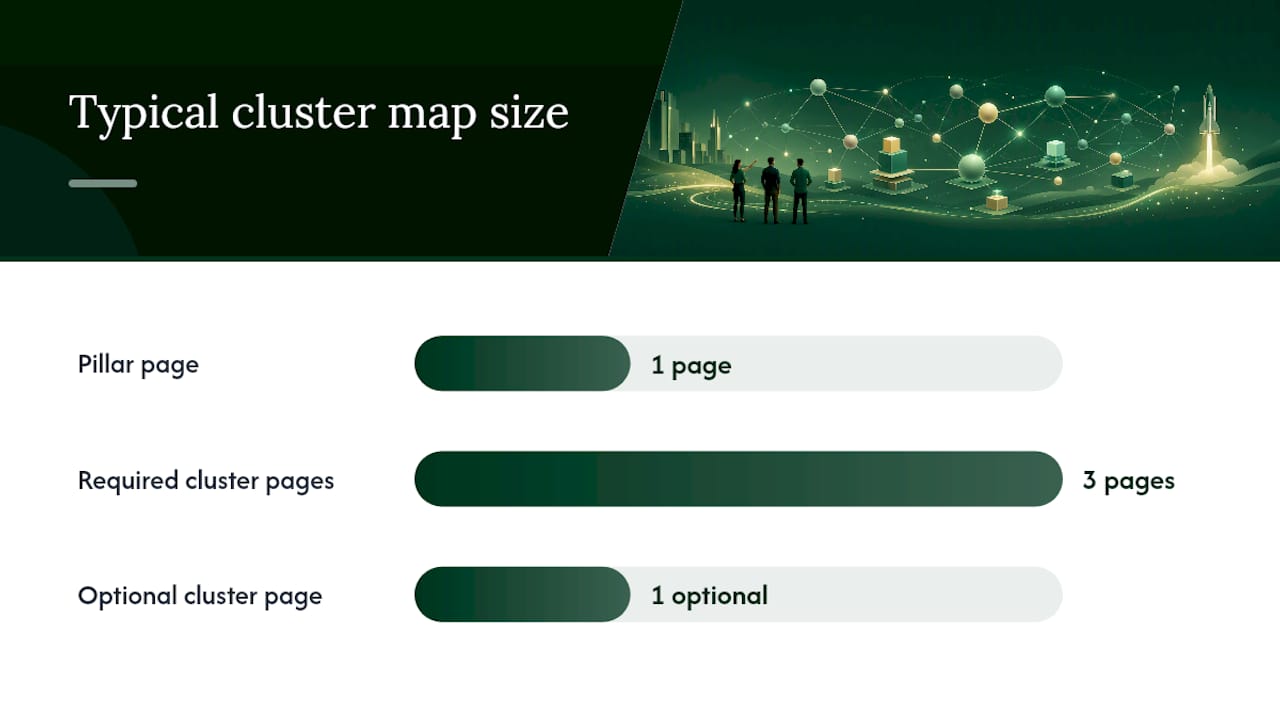
A workable cluster map for a typical B2B startup looks like this:
- Pillar page: the core product or platform (e.g., “AI-first visibility platform for startups”)
- Cluster page 1: the founder or leadership entity, with bio, credentials, and press mentions
- Cluster page 2: a specific use case or customer category the product serves
- Cluster page 3: the category or methodology you’re associated with (this is where “entity-based SEO” or a proprietary framework name lives)
- Cluster page 4 (optional): a comparison or evaluation page addressing how the category works broadly
Internal linking between these pages needs to read as genuinely explanatory, not manipulative. Link from the founder page to the pillar product page when you’re describing why they built it, not by dropping the same anchor text five times across unrelated paragraphs. Search Engine Land’s entity-first framework recommends mapping every URL on your site to a single canonical entity before you plan internal links, so you’re reinforcing a map that already exists rather than inventing connections after the fact.
Editorial ownership matters more than most startups assume. Assign one person, usually whoever owns content or marketing, to maintain the entity map as a living document. When you launch a new product line or bring on a co-founder, that person updates the cluster structure before new content gets published, not after. Startups that skip this step end up with orphaned pages that talk about entities the rest of the site never reinforces, which dilutes the very signal you’re trying to build.
How Do You Write Copy That Search Engines Can Disambiguate?
The first paragraph of any important page carries more disambiguation weight than people realize. If your About page opens with “We help teams move faster,” a machine learns nothing that separates you from ten thousand other startups. If it opens with “Acme Robotics builds warehouse automation software for mid-size logistics companies, founded in 2024 by Jordan Lee,” you’ve just handed a crawler and an LLM everything they need to place you correctly in a knowledge graph. Write that disambiguating sentence early, on every page that matters: homepage, About, product pages, founder bios.
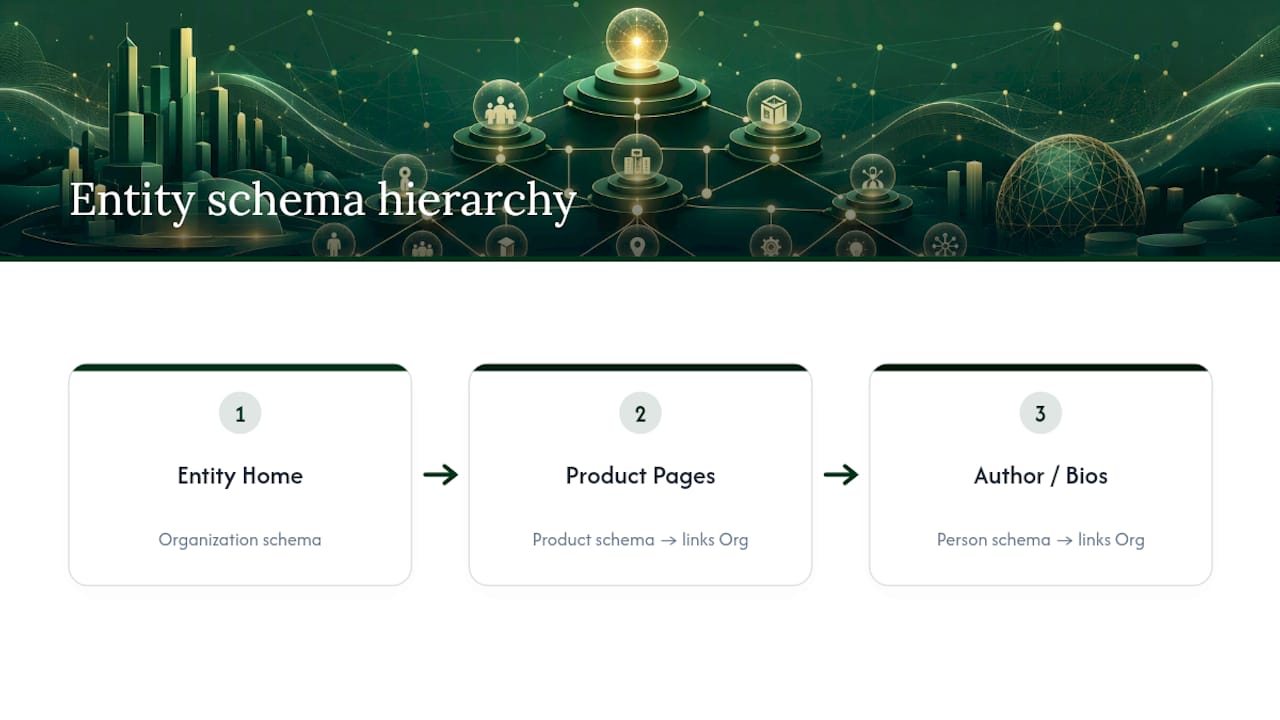
Schema placement follows a simple hierarchy. Organization schema with your @id belongs on the homepage or Entity Home. Product schema belongs on individual product pages, ideally referencing the parent organization’s @id so the relationship is explicit rather than implied. Author or Person schema belongs on bios and byline pages, linked back to the organization for the same reason. Semrush’s entity SEO guide points to this kind of layered schema, alongside content clusters, as a core tactic for reinforcing entity relationships across a site.
Natural entity density means mentioning your company name, product name, and category terms often enough that a machine can confidently associate the page with those entities, without turning every paragraph into a name-drop. A good gut check: read the page aloud. If it sounds like it’s trying to remind you who wrote it every third sentence, that’s stuffing.
sameAs misuse is a common and avoidable mistake. Correct use links only to profiles you actually control and that represent the same entity: your verified Crunchbase page, your Wikidata item, your official LinkedIn company page. Incorrect use links to a competitor’s directory listing that merely mentions you, a news article that isn’t your own profile, or a personal social account when the schema describes the organization. Every sameAs URL should be a page where a fact checker could independently verify it’s really you.
What Tools and Signals Prove Entity SEO Is Working?
Measurement here isn’t vanity metrics. It’s proof you can put in front of investors or a board that shows recognition compounding month over month.
Tools worth setting up:
- Google’s Natural Language API to see how Google’s own systems currently parse and categorize your existing content
- TextRazor for entity extraction and salience scoring on competitor and reference pages
- Semrush’s entity and topic tools for tracking which entities your domain is already associated with
- A Wikidata or Wikibase editor account so you can maintain your own entry rather than relying on someone else to update it
Primary signals to track quarterly:
- Whether a knowledge panel has appeared for your brand name, and how complete it is
- Presence and completeness of your Wikidata and Crunchbase entries
- Branded AI citations, meaning how often tools like ChatGPT or Perplexity name your company when asked about your category
- Co-mentions alongside recognized industry names in press, podcasts, or Reddit threads
Pro Tip: Set up a monthly Google Alert and a saved search on Perplexity or ChatGPT for your exact company name plus your category term. It takes five minutes and catches AI citations weeks before a formal audit would.
Backlinko’s research on entity visibility identifies co-citation in authentic channels, podcasts, Reddit, trusted industry media, as a high-leverage way to build entity associations that AI systems treat as independent corroboration, distinct from anything you publish yourself.
A simple quarterly dashboard needs four rows: knowledge panel status (yes/no/partial), database completeness score (Wikidata plus Crunchbase, scored against required fields), branded AI citation count from your saved searches, and co-mention count in earned media. Short-term KPIs are database completeness and Entity Home schema validation, both achievable in 30 to 60 days. Long-term KPIs are knowledge panel appearance and sustained AI citation frequency, which realistically take two to four quarters to show clear movement.
Common Pitfalls That Undo Entity SEO Work
Inconsistent naming kills more entity projects than bad schema does. If your legal name is “Acme Robotics, Inc.” but your Crunchbase says “Acme Robotics LLC,” your Wikidata says “Acme Robotics Inc,” and your LinkedIn says just “Acme,” you’ve built three weak, contradictory signals instead of one strong one. Pick a single canonical name and NAP (name, address, and any public contact detail) and enforce it everywhere, including old press releases you can still edit.
Third-party corroboration outweighs self-published claims because machines have learned that companies exaggerate about themselves. A Wikidata entry backed by references to independent news coverage carries more weight than the same facts stated only on your own site.
A monthly and quarterly maintenance routine:
- Check that your Entity Home JSON-LD still validates (schema breaks silently after site redesigns more often than founders expect)
- Confirm Wikidata and Crunchbase entries still match your current canonical name and details
- Search your own company name to catch any new, uncorroborated, or conflicting listing
- Escalate immediately if a major directory shows an old founder, wrong funding stage, or a defunct product, since stale entity data actively confuses AI retrieval rather than just looking outdated
Your First 90 Days: The Entity SEO Checklist
Entity SEO works because it shifts the fight from expensive keyword competition to verifiable recognition, and recognition compounds instead of decaying. Here’s the priority order:
- Build your Entity Home with Organization JSON-LD, a stable
@id, andsameAslinks - Claim and complete your Crunchbase profile with every required field filled in
- Create or clean up your Wikidata entry with independent references, not self-published sources
- Close the corroboration loop so Wikidata, Crunchbase, and your Entity Home all point to each other
- Map your pillar entity and two to four supporting cluster pages
- Set up entity extraction tools and start a quarterly measurement dashboard
- Run a NAP and naming consistency audit across every public profile
- Schedule your first monthly maintenance check
The next step is simple: pick the Entity Home task and finish it this week. Everything else builds on it.
Building and Leveraging Entity Relationships in SEO
Entities don’t build authority in isolation. They build it through relationships, meaning the explicit, machine-readable connections between your company, your founder, your product, and the category you operate in. A startup with a perfectly optimized homepage but no linked founder entity, no product entity, and no category association is still an island a knowledge graph struggles to place.
The practical move is treating every new piece of content as a relationship-building opportunity, not just a traffic play. When your founder gets quoted in an industry publication, that’s a relationship between the Person entity and the coverage. When your product gets compared in a category roundup, that’s a relationship between the Product entity and the category entity. Each one, tracked and reinforced with consistent naming and schema, adds another edge to the graph pointing at you.
This is also where the 80/20 shift happens. In keyword SEO, you chase hundreds of long-tail phrases. In entity SEO, a small number of core entities, your flagship product, your founder, your brand name, drive most of the perceived authority. Concentrate relationship-building effort there instead of spreading thin across every possible topic.
Leverage compounds when relationships reinforce each other in more than one direction. A podcast mention that links to your Entity Home, which links back to Wikidata, which cites the podcast as a reference, creates a small closed loop that’s far more resistant to being ignored by an AI model than any single mention standing alone.
Fitting Entity SEO Into Startup Marketing and Branding
Entity SEO isn’t a separate workstream bolted onto marketing. It’s the technical backbone underneath brand consistency, and most startups already have half the raw material sitting in their existing branding work without realizing it.
Your brand style guide, the one dictating exact company name usage, logo treatment, and tone, should extend to entity naming conventions. If marketing approves “Acme” as a casual shorthand in social captions but your legal and schema data always say “Acme Robotics, Inc.,” you’re creating the exact naming inconsistency that confuses corroboration. Get brand and technical SEO teams looking at the same style sheet.
PR and entity SEO overlap almost entirely. Every earned media placement, every podcast booking, every founder interview is simultaneously a branding win and a corroboration event, provided the outlet links back to a canonical profile. Startups that treat PR wins as one-off brand moments, without funneling them into Wikidata references or sameAs links, are leaving half the value of each placement on the table.
Founder personal branding deserves the same entity treatment as the company. Investors and journalists frequently research the founder before the company, so a Person schema, a Wikidata item where warranted, and consistent bio language across every platform reinforce the organization entity by association. Treat your founder’s LinkedIn, X profile, and any speaker bio pages as part of the same entity ecosystem, not a separate personal project.
A Publisher’s Perspective on Entity SEO for Startups
Some agencies approach this work differently than traditional PR shops, focusing on making a startup a citable, corroborated entity across the outlets and databases that AI models and investors actually trust, using proprietary technical layers built around data-driven earned media placement and community engagement.
Founders should consider bringing in outside help when speed matters more than internal learning curve, or when the entity map has gotten complicated enough (multiple products, a pivot, a rebrand) that DIY cleanup keeps slipping down the priority list. That complexity tax is real: a startup juggling fundraising and product launches rarely has a spare quarter to hand-edit Wikidata references. Some case studies document engagements where structured media placement and entity corroboration expanded a startup’s citable footprint well beyond what a single internal hire could produce in the same window.
The practical next step for a founder evaluating fit is straightforward: look at where your entity gaps actually are, whether that’s a missing Wikidata presence, weak media corroboration, or no AI citation footprint at all, and request an evaluation before committing budget.
— Nik
Some agencies exist because most of the checklist above takes longer to execute well than founders have time for, especially the parts that depend on relationships: landing earned media placements, getting podcast bookings, or seeding genuine community discussions. The work maps directly onto the recommended playbook: podcast guest spots and earned media placements build the co-citation signals that strengthen entity relationships, programmatic news syndication extends the corroborated footprint across more indexed sources, and tracking layers measure whether placements actually translate into AI citations, not just backlinks. Unlike retainer-based PR agencies billing for activity, some engagements are structured around delivered placements and measurable visibility outcomes.
If your Entity Home is live but your corroboration loop is thin, or you’re staring at a founder story with no media footprint behind it, that’s the exact gap this closes. Visit the Storylinepros site to see current services and request an evaluation of where your startup’s entity gaps actually are before your next funding conversation.
Sources
For readers who want to go deeper on the technical and strategic layers covered here: