

10 Founder Survey Ideas Built to Land Press Coverage in Weeks
The founder survey ideas that generate real coverage share one trait: they’re short, behavior focused, and built around a single headline before a single question gets written. Aim for a few minutes and around a dozen questions, pick one story you want the data to prove, and field it against a defined group. Specialized firms exist precisely because most founders skip that last step and end up with data nobody can quote.
TL;DR:
- Conduct short, behavior-focused surveys with about a dozen questions centered on a single headline to produce quotable, media-ready statistics.
- Tailor sample size and methodology according to the target publication, ranging from free, quick surveys of 50 to 150 founders to larger, co-funded studies for national coverage.
- Incorporate strict quality checks, transparent methodology, and ethical safeguards to ensure data credibility and protect respondent privacy.
- Use survey results to generate multiple media angles by segmenting data by demographics, regions, or industries and plan repeat surveys to track trends.
- Engage professional research firms for large or complex projects to improve the likelihood of coverage and to benefit from expert question design and targeted pitching.
Table of Contents
- Founder Survey Ideas: 10 Ready-to-Run Prompts
- How to Design Founder-Survey Questions for Newsworthiness
- Fielding, Sample Size, Timeline, and Cost Options
- Data Quality, Methodology Transparency, and Packaging for Journalists
- Reusing One Founder Survey for Multiple PR Angles
- Ways to Incentivize Founder Participation
- Validating Survey Findings With Qualitative Follow-Up
- Ethical Considerations and Participant Privacy in Founder Surveys
- When to Run Founder Surveys Yourself vs Bring in a Specialist
- Turning Founder Survey Data Into Actual Media Placements
- Sources
Founder Survey Ideas: 10 Ready-to-Run Prompts
Every one of these works because it asks about something a founder actually did, not what they might do someday. Behavior beats intention when journalists decide what’s worth covering.
- Hiring freezes. “In the last 6 months, has your company frozen or slowed hiring?” (Yes/No/Reduced pace.) Headline stat: “X% of founders have paused hiring this year.”
- Runway math. “How many months of runway do you currently have?” (Under 6, 6 to 12, 12 to 18, 18+.) Produces a distribution stat trade press loves.
- Fundraising sentiment. “Compared to your last raise, how difficult was your most recent fundraising process?” (1 to 5 Likert.)
- Pricing changes. “Have you raised prices in the last 12 months?” (Yes/No, with a follow-up on percentage range.)
- Churn causes. “What is the single biggest reason customers cancel?” (Multiple choice, mutually exclusive options.)
- Remote work stance. “What is your current office policy?” (Fully remote, hybrid, full return to office.)
- Product-market-fit signal. “In the past quarter, has inbound demand increased, decreased, or stayed flat without added marketing spend?”
- Founder workload. “How many hours did you work last week?” (Ranges, not open text.)
- AI adoption in operations. “Which functions have you replaced or augmented with AI tools in the last year?”
- Investor relations friction. “Has an investor asked you to cut spending in the last 6 months?” (Yes/No.)
Each of these can carry a second, related Likert question for texture, but resist stacking more than two per topic. The goal is one clean, quotable stat per theme, not a research report.
How to Design Founder-Survey Questions for Newsworthiness
Start with the headline you want, then write backward. If the story is “founders are quietly freezing hiring,” your first question needs to produce a clean percentage, not a paragraph. That’s the core discipline behind PR polling that actually supports a media campaign: pick the narrative before the instrument.
Question format matters as much as topic. Use:
- Single-answer multiple choice for anything you’ll report as a percentage breakdown.
- 5-point Likert scales for sentiment or difficulty questions.
- Mutually exclusive answer options so a respondent can’t pick two things that should be one category.
- One open-ended field, placed near the end, purely to harvest a quotable phrase.
Here’s the difference between a question that gets ignored and one that gets cited:
How not to ask: “Do you think fundraising is getting harder for startups?” This invites a shrug and produces mush.
How to ask: “Compared to your previous raise, was your most recent fundraising round easier, harder, or about the same?” (Easier / Harder / About the same / N/A, first raise.) That’s a clean three-way split a reporter can put in a chart.
Put sensitive questions (revenue, layoffs, personal stress) after the easy warmups, never first. Respondents answer more honestly once they’re a few questions in, and you avoid scaring off completions before you’ve collected anything usable.
Pro Tip: Draft your press headline first, on a sticky note if you have to. If a question you’re about to write wouldn’t move that headline, cut it. This single habit prevents almost every wasted question in founder surveys.
Fielding, Sample Size, Timeline, and Cost Options
Sample size decides which outlets will even consider your data, so pick the tier before you pick the vendor.
- Small (n=50 to 150): Your own customer list or founder network. Best for vertical trade coverage in a specific niche. Fielding usually takes 1 to 2 weeks and costs the least since you’re not paying for panel access.
- Mid (n=300 to 600): A paid research panel targeting founders or small-business owners broadly. Fits broader trade press and regional business outlets. Expect 2 to 4 weeks and a moderate budget for panel fees.
- Large (n=500+): Often built by co-funding with a partner brand or vertical association to split panel costs. This is the range that supports tier-1 national coverage, but it demands the longest lead time and the biggest spend.
Your own customer list is free and fast but skews toward people who already like you, which limits how broadly you can generalize the results. Panel providers cost more but let you define screening criteria (company stage, revenue band, industry) with more precision. Co-funded surveys spread the bill across partners, though you’ll need to agree on messaging rights before you start. Whichever route you choose, state your sample definition plainly. A well-defined small sample beats a vague larger one every time a reporter checks your methodology.
Data Quality, Methodology Transparency, and Packaging for Journalists
A survey without a clean methodology paragraph gets ignored by any reporter who has been burned before. The minimum a journalist expects: sample size, field dates, collection method, and a one-line definition of who counts as a respondent.
Quality checks matter just as much as the headline number. Build in:
- A time-to-complete flag that discards anyone who finished implausibly fast.
- IP clustering checks to catch duplicate or bot responses.
- One red-herring question (an obviously wrong answer choice) to filter inattentive respondents.
- A manual sanity check on open-ended responses before quoting any of them.
These checks aren’t optional extras. They’re what separates data a newsroom will run with from data it will quietly delete.
The pitch that works: one chart, three bullet points of the sharpest findings, one founder quote, a short methodology paragraph, and a link to the raw summary tables. That’s the entire package. Anything longer and most editors won’t open the attachment.
On distribution, decide upfront whether you’re offering an embargoed exclusive to one outlet or releasing broadly. Exclusives tend to earn deeper coverage from a single reporter; open releases spread thinner but faster. Tailor the lead bullet by beat: a fintech reporter wants the pricing stat, an HR trade wants the hiring-freeze number, from the same dataset.
Reusing One Founder Survey for Multiple PR Angles
One well-built survey should generate coverage more than once if you slice it right.
- Cut by demographic. Break results by company stage, industry, or founder tenure to produce a fresh angle for a niche outlet.
- Cut by region or industry vertical. A national stat becomes a local business-journal story when you isolate one metro or sector.
- Layer in follow-up quotes. Reach back out to a handful of respondents for a short quote or mini case study a few weeks after the first release.
Plan for a quarterly or biannual repeat of the same core questions so you can report trend lines, not just snapshots. Host the full dataset on a durable landing page with methodology intact, since that page keeps earning citations long after the initial pitch cycle ends.
Ways to Incentivize Founder Participation
Founders are busy and skeptical of surveys that feel like lead generation in disguise, so the incentive has to respect that. Offering early access to the finished report works better than a gift card, since founders care more about seeing how they compare to peers than about a small cash reward.
A short, credible ask helps too: tell respondents upfront how long it will take (state the actual 3 to 5 minutes) and what the data will be used for. Founders who feel misled about survey length or intent tend to abandon partway through, and partial completions are worse than no completions since they skew your averages.
Peer-to-peer recruitment often beats cold outreach. Asking a founder to share the survey with two or three other founders in their network tends to produce better response rates than broad, anonymous panel invites, because the request comes from someone they trust rather than an unfamiliar brand.
Consider a small, tiered incentive structure: everyone gets the finished report first, and a handful of random respondents get something modest like a coffee gift card. Avoid incentives large enough to attract people who aren’t actually founders just trying to qualify for a reward. That contaminates your sample and undermines the exact credibility you’re trying to build with the survey in the first place.
Finally, timing matters more than most people assume. Sending a survey during a known busy stretch, like right before a fundraising deadline for many startups, guarantees a lower response rate no matter how good the incentive is.
Validating Survey Findings With Qualitative Follow-Up
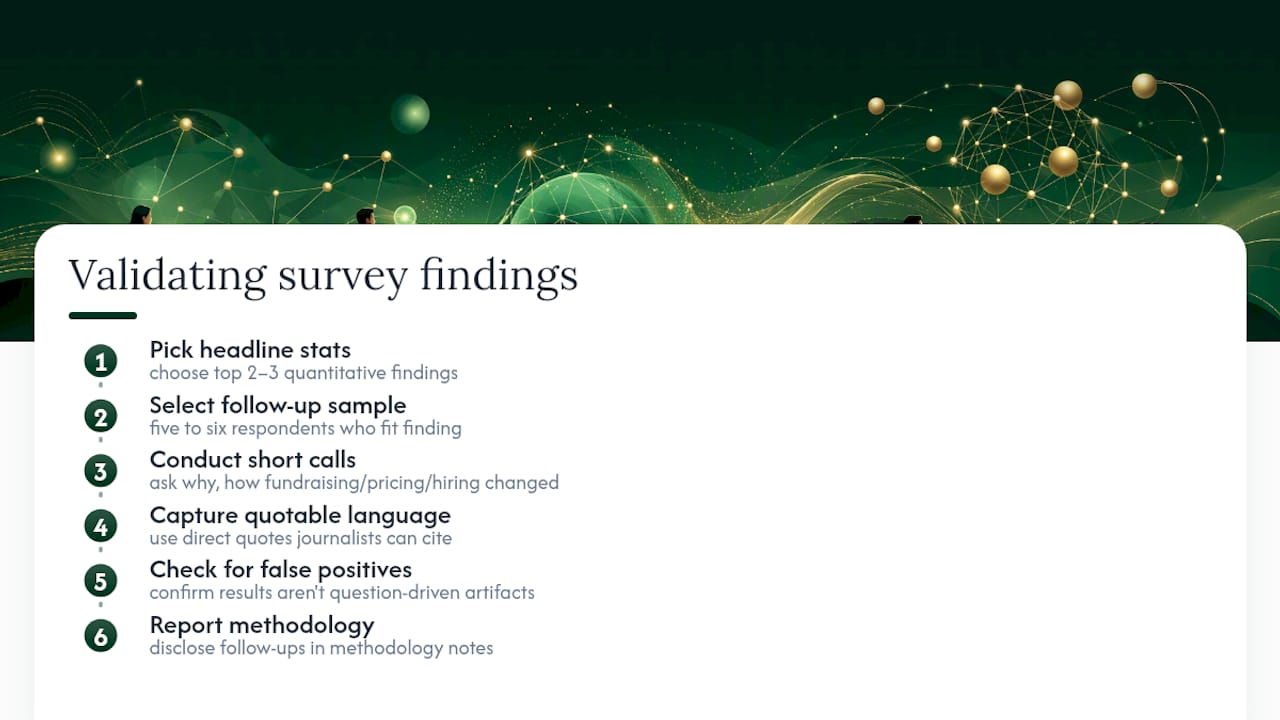
A striking percentage from a quantitative survey gets stronger, not weaker, when you attach a real voice to it. After you’ve identified your top two or three headline stats, go back to five or six respondents who fit that finding and ask for a short follow-up conversation.
The goal isn’t to re-litigate the survey. It’s to get language you can quote directly: why did they cut hiring, what specifically changed about their fundraising process, what triggered the pricing shift. That quote often becomes the most-cited line in the resulting article, more than the number itself.
This follow-up step also catches false positives. If a stat seems surprising, a quick round of calls will tell you fast whether it reflects something real or whether your question wording accidentally created an odd result. A founder survey that skips this step risks publishing a number that falls apart the moment a skeptical reporter asks a follow-up question of their own.
Keep the follow-up sample small and be transparent about it in your methodology notes: “quantitative data supplemented by follow-up interviews with five respondents” is a normal, credible line in any press packet. It shows you stress-tested your own findings instead of just publishing whatever the raw numbers produced.
Ethical Considerations and Participant Privacy in Founder Surveys
Founder data is often more sensitive than typical consumer research. Revenue figures, layoff counts, and personal stress levels can identify a specific company even without a name attached, especially in a small or niche vertical.
Always aggregate results before publishing. Never report a stat granular enough that a reader could reverse-engineer which specific founder or company it came from, particularly in a small n=50 to 150 sample where the pool of possible respondents is already narrow.
Be explicit with respondents about how their answers will be used. Tell them upfront whether individual quotes might be attributed by name (with separate consent) or whether all data will be reported only in aggregate. Founders who agreed to an anonymous survey and later see their specific numbers implied in a press release will not participate again, and word travels fast in tight founder networks.
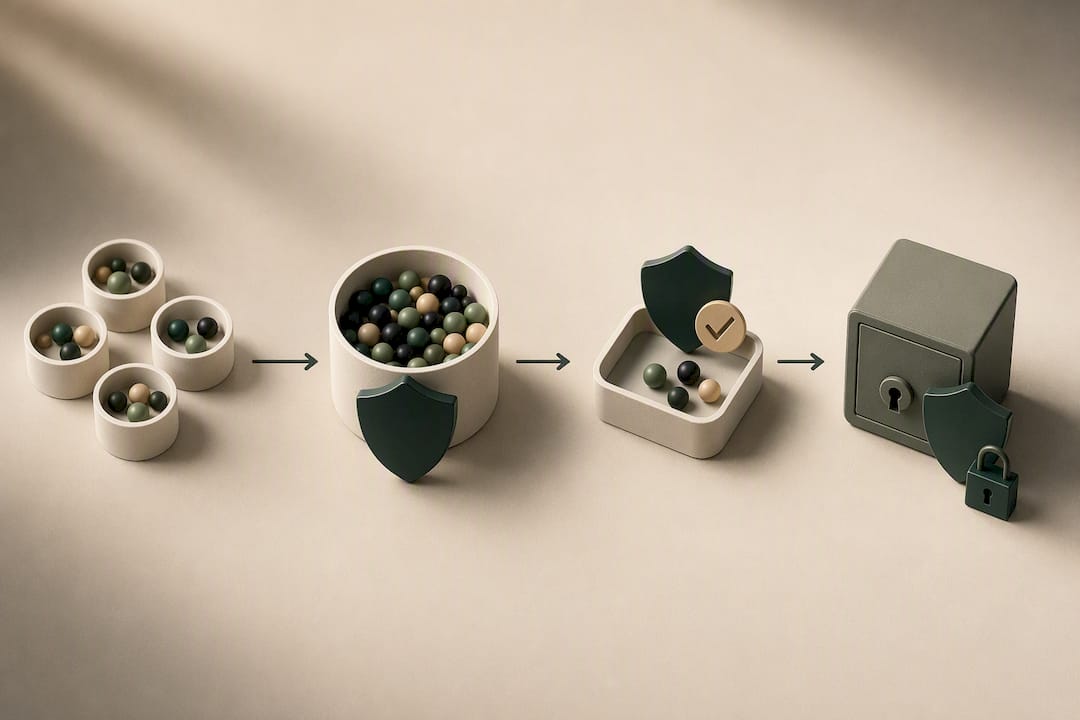
Store raw data securely and limit who on your team can see individually identifiable responses. If you’re working with a panel provider or co-funding partner, clarify data ownership and usage rights before the survey launches, not after you have results you want to publish.
When to Run Founder Surveys Yourself vs Bring in a Specialist
A small customer list and a fast-moving news hook are fine to run yourself. Once you need guaranteed placement strategy, multi-outlet pitching, or a sample large enough for tier-1 coverage, that’s when a specialist earns its cost. A firm like Storylinepros builds the question set, fielding plan, and pitch simultaneously, which is hard to replicate solo.
— Nik
Turning Founder Survey Data Into Actual Media Placements
Some firms exist for the gap between “we have interesting survey data” and “a reporter actually wrote about it.” That gap is where most founder-led research quietly dies, buried in a Google Doc nobody outside the company ever sees.

The deliverables are specific: a question set built around one headline claim, a fielding plan matched to your sample size and budget, a methodology writeup a skeptical editor won’t reject, and active pitching to outlets matched by beat. Some firms work on a success-based model tied to delivered placements, not a flat retainer you pay regardless of outcome, which differs from most traditional PR arrangements. If you’ve got founder survey data sitting unused, or you’re planning your first one and want it built to earn coverage from the start, review the case studies and request a pilot review through Storylinepros.
Sources
Guide to Custom PR Surveys — Drive Research on ideal survey length. PR Polling for Media Campaigns — Wakefield Research on narrative-first design. Bootstrapped Founder PR Playbook — PressVerified on sample sizing. Exclusive Data in Press Releases — PressFrolic on quality checks. Marketing Insights Blog — TBE Agency on campaign ideation.