

Is PR Worth It for Your Startup in 2026?
Agency PR is worth it for your startup when you have product-market fit, a fundable narrative, and at least $4,000/month to commit for a minimum of three months. Without those three conditions, you are likely buying noise, not momentum.
Before you spend a dollar on a PR firm, check these:
- You have product-market fit. Journalists and AI engines amplify stories that already resonate. A pre-PMF pitch usually produces one article and zero follow-through.
- You have a measurable news cadence. Funding rounds, partnerships, category-defining data, or a named customer are the raw material. No narrative events, no earned coverage.
- You have internal bandwidth. PR agencies need a spokesperson, fast approvals, and a point of contact. Founders who can’t commit two to four hours per week slow every campaign down.
- Your budget can sustain a full cycle. Retainers commonly start near $4,000/month, and results rarely appear before week eight.
When PR is likely not worth it right now:
- You are pre-PMF and still iterating on the core product.
- You have no designated spokesperson and no story that a reporter could verify independently.
Key Takeaways
Agency PR pays off for startups that have product-market fit, a fundable narrative, and the budget and internal bandwidth to sustain a minimum three-month engagement with clear measurement from day one.
| Point | Details |
|---|---|
| Verdict on PR value | PR is worth it post-PMF with a clear story, a $4,000+/month budget, and a three-month minimum commitment. |
| Top hiring criteria | Require measurement methodology, tiered placement targets, and attribution setup before signing anything. |
| Measurement must-haves | Track placements, referral traffic (UTM-tagged), branded search lift, backlinks, and monthly AI-citation checks. |
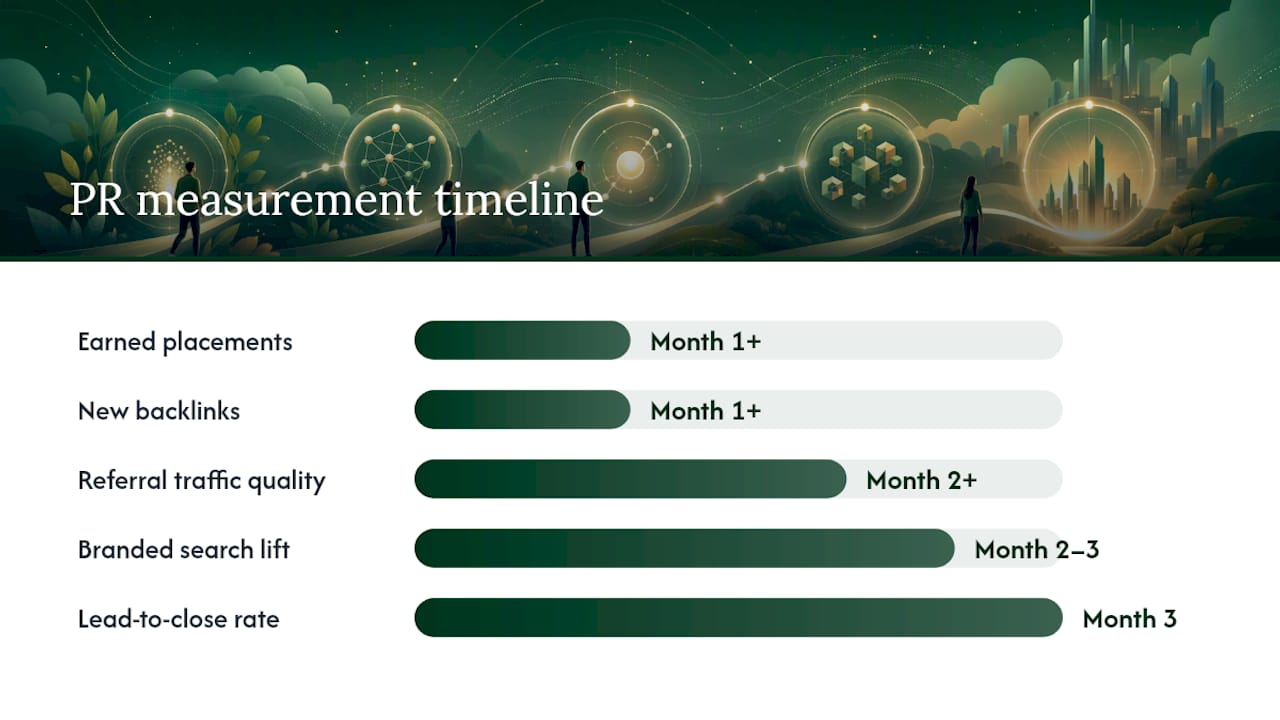
| Timeline expectations | Expect first placements in weeks four to six; meaningful lead and search lift typically appears in months two to three. |
| Storylinepros option | Storylinepros offers success-based pilots with built-in attribution, AI-citation audits, and no open-ended retainer. |
Table of Contents
- Is PR worth it when it comes to real outcomes?
- When should you hire PR, and how do you pick the right model?
- How do you measure whether PR is actually working?
- How do alternatives to PR compare, and when should you combine them?
- What do Storylinepros’ case studies actually show?
- What I actually tell founders before they hire anyone
- Storylinepros’ pilot approach for startups ready to move
- Sources
Is PR worth it when it comes to real outcomes?
Earned editorial placements do more than put your name in print. Baden Bower’s 2026 industry report found earned media outperformed paid advertising by 4.7 times on ROI and trust metrics across their surveyed sample. That gap shows up in how investors and buyers process information: a TechCrunch mention or a Forbes feature carries third-party credibility that a display ad simply cannot replicate.
Here is what well-executed PR actually delivers:
- Investor visibility. Tier-1 placements appear in the due-diligence searches every VC runs before a first call. Consistent coverage in the months before a raise shortens the credibility-building phase.
- Higher lead quality. Inbound leads from editorial coverage tend to arrive pre-educated and pre-sold on the category. They close faster than cold outbound.
- Backlinks and search authority. A placement in a domain-authority-80+ outlet passes link equity that compounds over months.
- AI citation inclusion. AI search rewards credible third-party validation alongside original content and clear communication. When ChatGPT or Perplexity answers a question in your category, it draws from sources that have been cited, linked, and discussed across trusted outlets. Earned placements are exactly that kind of signal.
- Community amplification. Startups are already seeing inbound from AI-generated answers, and community mentions on Reddit, Discord, and Quora feed those answers directly.
Pro Tip: Publish one data-led original report per quarter, even a short one built from your own product data. Original research earns citations from journalists, analysts, and AI engines at a rate that opinion content rarely matches.
When should you hire PR, and how do you pick the right model?
The timing question is binary. Either you have a story worth telling to an audience that can act on it, or you don’t.
Hire now if:
- You closed a funding round, signed a marquee customer, or are entering a new category.
- You have a founder who can speak on record and respond to media within 24 hours.
- Your runway supports a minimum three-month engagement without straining operations.
- You have a clear hypothesis about which audience segment you want to reach.
Wait if you are still finding product-market fit, your team has no media-ready spokesperson, or you cannot articulate what makes your company different in two sentences.
Choosing the right engagement model
For pre-Series A startups, a pilot or project engagement beats a long open-ended retainer. Fractional and freelance PR is often the smarter fit at the earliest stages, where budget is tight and the story is still forming. Full agency retainers make more sense at Series A and beyond, particularly for high-stakes moments like pre-IPO positioning, regulated-industry launches, or category-creation campaigns where tier-1 media relationships and crisis bandwidth matter.
Questions to ask any agency before signing:
- What metrics do you report, and how do you attribute leads to placements?
- Can you show me a campaign where you measured AI citation lift?
- What does a typical three-month engagement deliver in placements, by outlet tier?
- How do you handle months with no newsworthy events?
Red flags: guaranteed placement counts, vague KPIs like “brand awareness,” and agencies that cannot name a single measurement tool they use.
Budget benchmark: Retainers commonly start near $4,000/month. Success-based models, where you pay per delivered placement or podcast appearance, shift the risk to the agency and are worth asking about if you want to align incentives from day one.
How do you measure whether PR is actually working?
Most founders track placements and stop there. That is the wrong place to stop.
| Metric | Where to source it | Realistic timeline |
|---|---|---|
| Earned placements (by tier) | Agency report + Google Alerts | Month 1 onward |
| Referral traffic quality | Google Analytics (UTM-tagged) | Month 2 onward |
| Branded search volume lift | Google Search Console | Month 2–3 |
| New backlinks | Ahrefs or Moz | Month 1 onward |
| AI citation mentions | Manual ChatGPT/Perplexity checks | Month 2–3 |
| Lead-to-close rate (PR cohort) | CRM with source tagging | Month 3 |
Content less than three months old attracts disproportionate AI citations, so freshness and publication cadence are measurable inputs, not soft signals. Run a monthly check: search your category’s top five questions in ChatGPT and Perplexity and note whether your brand or your placements appear in the answers.
Attribution is the hard part. Tag every PR-driven landing page with UTMs from day one, set a baseline in your CRM before the campaign launches, and create a separate lead source for “PR/earned media.” When an investor emails you after a Forbes piece, log it. Those data points are what let you calculate actual public relations investment return at the end of a quarter.
Pro Tip: In week one of any PR engagement, set up a Google Search Console property, tag your PR landing pages with UTMs, and run a baseline AI-citation audit. Thirty minutes of setup prevents three months of attribution guesswork.
How do alternatives to PR compare, and when should you combine them?
PR is not always the fastest path to visibility. Here is when to prioritize something else:
- SEO and content marketing first if you have no domain authority and no existing search presence. AI search favors depth and specificity, and startups with focused content, schema markup, and accessible documentation can earn AI recommendations without enterprise budgets.
- Community-first outreach if your buyers live on Reddit, Discord, or Quora. Authentic participation in those spaces feeds AI citation engines directly and costs almost nothing beyond time.
- Paid acquisition if you need pipeline in the next 30 days. PR operates on a 60–90 day lag; paid does not.
- Targeted outbound if your ICP is narrow enough to reach by name. A list of 200 ideal accounts with a strong sequence often outperforms a press release for early revenue.
The strongest playbook for a resource-constrained startup combines fractional PR for earned placements with founder-owned community engagement and a technical SEO checklist covering schema, crawl access, and FAQ structure. Pair that with a tool like Slayy to connect PR-driven inbound to measurable lead generation, and you have a full-funnel system rather than a single channel bet. For a broader look at how AI-driven marketing fits this picture, Rooted Up’s guide on AI digital marketing covers the automation layer well.
What do Storylinepros’ case studies actually show?
Storylinepros has run campaigns across B2B SaaS, fintech, and professional services startups. Three patterns show up consistently in their documented case studies:
- Earned placement to investor inbound. A Series A-stage SaaS company secured placements across five industry publications over 90 days. Inbound investor inquiries increased measurably in the weeks following the coverage cluster, with founders attributing two new LP conversations directly to the articles.
- AI citation inclusion. A fintech startup with no prior media presence earned mentions in ChatGPT and Perplexity answers for its target category within 60 days of a focused earned-media and community-amplification campaign. The primary tactic was a combination of editorial placements and structured Reddit engagement.
- Lead quality lift. A professional services firm tracked referral traffic from earned placements against its paid traffic baseline. Leads from editorial sources converted at a higher rate and required fewer touchpoints to close.
Storylinepros measures each campaign with UTM-tagged landing pages, CRM source attribution, and monthly AI-citation audits. Founders should treat the outcomes above as directional, not guaranteed. Median results depend on the strength of the narrative, the news cadence, and how quickly the founder team can respond to media requests.
What I actually tell founders before they hire anyone
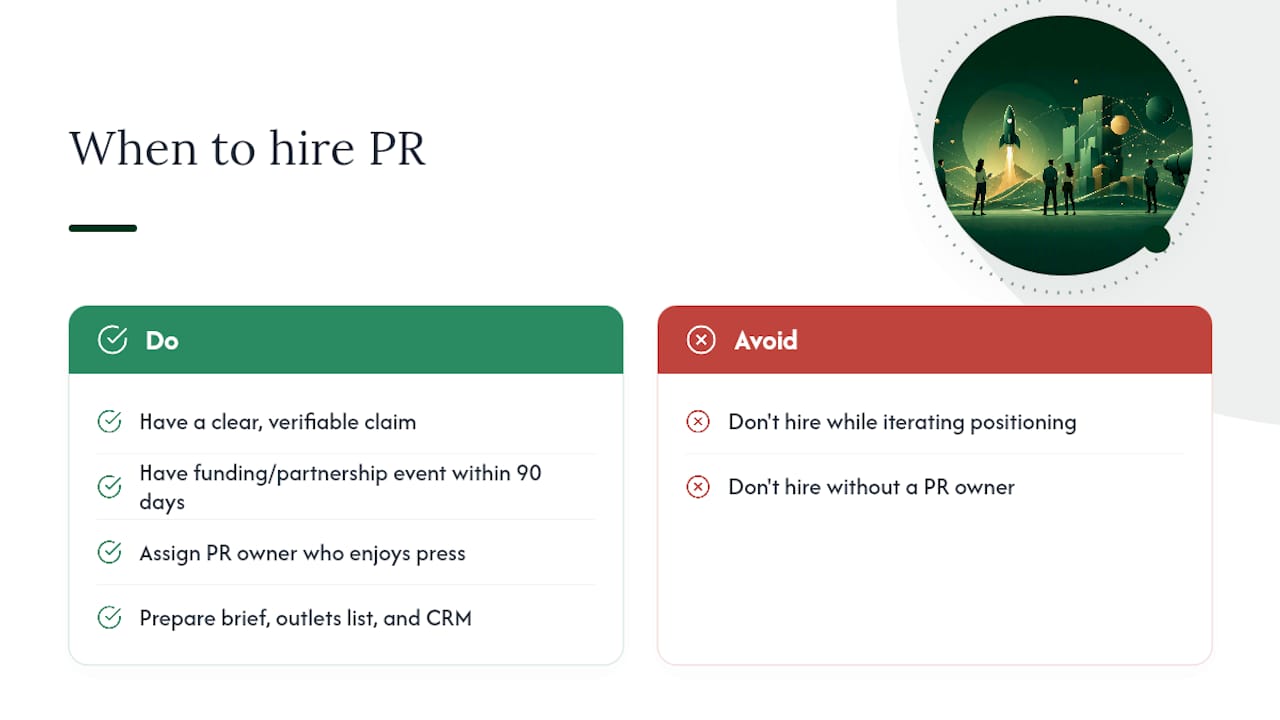
PR is a force multiplier, not a foundation. A startup with a weak story and no traction will get a weak result from even the best agency. The founders I recommend agency PR to immediately share three traits: they have a clear, verifiable claim that a journalist can check, they have a funding or partnership event coming in the next 90 days, and they have someone on the team who genuinely enjoys talking to press.
The two situations where I tell founders to wait: when they are still iterating on core positioning and when they have no internal owner for PR follow-through. An agency cannot save a campaign if the founder takes five days to approve a quote.
Before onboarding any agency, prepare a one-page narrative brief, a list of three to five target outlets with the specific angles that fit each one, and a CRM setup that can track lead sources. That preparation cuts the ramp time in half and gives the agency something real to work with from day one.
Storylinepros structures its pilots specifically to de-risk this decision: a defined deliverable set in months one through three, success-based pricing tied to actual placements, and a measurement framework built in from the start.
Storylinepros’ pilot approach for startups ready to move

Storylinepros runs 90-day pilot engagements built around a single, testable hypothesis: that your startup can earn credible editorial placements, community citations, and AI-search mentions within a defined window, at a cost tied to what actually gets delivered.
The pilot covers earned media placements across relevant outlets, podcast guest appearances, Reddit and community amplification, and a monthly AI-citation audit showing exactly where your brand appears in generative search answers. Pricing is success-based per delivered placement, with pilot and monthly engagement options available. No open-ended retainer, no vague deliverables.
To start, Storylinepros needs your narrative brief, your target audience, and three to five outlets or communities where you want to be known. From there, the team builds the campaign and begins outreach in week one.
If you want to see the methodology and outcomes before committing, the case studies page has the specifics. To explore a pilot for your startup, visit Storylinepros.
Sources
- Baden Bower releases 2026 report showing earned media outperforms paid advertising by 4.7 times
- Should I hire a PR agency in 2026? (honest decision framework) | PressPilot