

LLM Citations: Build, Earn, and Verify Them in 2026
An LLM citation is a structured reference an AI model includes to justify a specific claim, and the fastest path to reliable ones is a retrieval-augmented generation (RAG) pipeline that records canonical metadata, applies CIT-tag formatting, and runs a verification pass before any citation surfaces to a user. Without that pipeline, you are gambling on a model’s parametric memory, which GhostCite’s large-scale audit found produces hallucinated citations at high rates across models.
Three actions your team can run in a day to lift citation quality:
- Store canonical metadata now. For every document chunk in your index, record title, canonical URL, doc ID, author, last_updated, and a snippet hash. Missing any one field breaks the citation renderer downstream.
- Add a URL existence check to your post-generation step. A dead link is a ghost citation. A simple HTTP HEAD request before surfacing any reference catches the most common failure mode.
- Audit one high-traffic query for citation accuracy. Pull the top five answers your system returns, verify each cited source manually, and use that baseline precision score as your SLA starting point.
The single highest trust risk in any citation pipeline is the ghost citation: a reference that looks real but points to a nonexistent, misattributed, or fabricated source. The validation section below covers detection metrics and tools in detail.
Key Takeaways
Reliable LLM citations require a RAG pipeline with complete canonical metadata, a multi-check verification layer, and upstream content authority that makes your documents worth retrieving in the first place.
Table of Contents
- What are LLM citations and why do they matter for trust and SEO?
- How does a RAG pipeline produce structured citations?
- How do you implement citation generation step by step?
- How do you turn CIT tags into citations users can actually read?
- How do you detect and prevent hallucinated citations?
- Which tools and components should you evaluate for a citation pipeline?
- What tactics help brands get cited by LLMs?
- What prompt patterns work best for generating citations?
- How do you cite AI-generated text in APA, MLA, and Chicago style?
- How do you integrate LLM citations into an existing CMS or workflow?
- What are the legal and ethical risks of LLM citations?
- How do you monitor and maintain citation quality over time?
- What do real implementations look like?
- How do LLM citations affect user trust and SEO rankings?
- When should you prioritize citations over other trust signals?
- Storylinepros helps you earn, build, and track LLM citations
- Sources
What are LLM citations and why do they matter for trust and SEO?
A mention is when an LLM names a brand or concept in passing. A citation is when it attaches a specific, retrievable source to a specific claim. The difference matters enormously for credibility: a mention is marketing noise; a citation is verifiable evidence.
Research involving roughly 197 participants found that adding citations to LLM answers increases self-reported trust, but users who actually check those citations often end up less trusting when the sources are inaccurate. That dynamic creates a verification-first ROI case for any team shipping citation features. Accurate citations compound trust; inaccurate ones destroy it faster than no citations at all.
The SEO angle is less obvious but increasingly consequential. AI-powered answer engines like Perplexity surface cited sources as clickable references, which means a cited document earns an impression and potential traffic even when the user never types a follow-up query. For content teams, this is a new distribution channel that operates entirely outside traditional click-through rate models. Getting cited by an LLM can drive qualified referral traffic from users who are already mid-decision, not just browsing.
How does a RAG pipeline produce structured citations?
The architecture that reliably produces structured LLM citations follows a six-stage flow: user query → retriever → candidate documents → reranker → answer composer → citation renderer. Each stage has a specific job, and citation quality degrades when any stage is skipped or poorly configured.
The retriever pulls candidate chunks from a vector database (Pinecone, Weaviate, or Milvus are the most common choices). The reranker scores those chunks for relevance and filters out low-confidence matches before they reach the answer composer. The composer generates the response with inline CIT tags that reference chunk IDs. The renderer maps those IDs back to stored metadata and formats the final citation for the UI.
Every chunk in your index needs a complete metadata record. Best-practice guidance recommends storing a full canonical URL and a last_updated field for time-sensitive content, and using inline citations for one-off references while switching to a numbered reference list when the same source appears repeatedly.
| Metadata Field | Purpose | Notes |
|---|---|---|
| title | Display label for the citation | Use the document’s canonical H1, not the page title tag |
| canonical_url | Persistent deep link | Must resolve; include anchor fragment when available |
| doc_id | Internal chunk identifier | Used to map CIT tags back to metadata |
| author | Attribution string | Organization name when no individual author exists |
| last_updated | Freshness signal | ISO format; critical for legal and regulatory content |
| page_anchor | Paragraph-level deep link | Enables “jump to source” UX |
| snippet_hash | Content fingerprint | Detects source drift after indexing |
| license_flag | Rights and reuse status | Blocks citation of paywalled or restricted content |
Integration with your CMS requires two hooks: a metadata write-back when content is published or updated (to keep last_updated and snippet_hash current), and an analytics event when a citation is surfaced (to track citation impressions separately from page views).
Pro Tip: Set a cron job to re-hash stored snippets weekly against live URLs. When a hash changes, flag the chunk for re-indexing before the stale snippet reaches a user.
How do you implement citation generation step by step?
The implementation breaks into six ordered steps. Skipping step five (post-generation verification) is the most common engineering shortcut and the one that produces ghost citations at scale.
- Chunk your documents. Target 300–500 tokens per chunk with a 10–15% overlap. Shorter chunks improve retrieval precision; longer ones preserve more context for the composer. Always chunk at semantic boundaries (paragraph breaks, section headings), never mid-sentence.
- Store canonical metadata. Write all eight fields from the table above at index time. Use a schema-validated ingestion pipeline so missing fields fail loudly rather than silently.
- Index and vectorize. Embed chunks using a consistent model. If you switch embedding models later, re-embed the entire corpus; partial re-indexing creates retrieval inconsistencies.
- Tune the retriever. Set a minimum similarity threshold (typically 0.75–0.80 cosine similarity) below which chunks are excluded from the candidate set. This alone cuts a significant share of irrelevant citations before the composer sees them.
- Compose with CIT tags. Prompt the model to wrap every factual claim with a tag referencing the chunk ID:
<CIT id="chunk_042">The regulation took effect in January 2024.</CIT>. The tag must appear immediately after the claim it supports, not at the end of a paragraph. - Verify before surfacing. Before rendering, run a URL existence check, a snippet-match check (compare the stored snippet hash against the live document), and a license-flag check. Fail any citation that does not pass all three.
A minimal structured-output prompt looks like this conceptually: instruct the model to return a JSON object with two keys, answer (the response text with inline CIT tags) and citations (an array of objects, each containing chunk_id, title, canonical_url, and snippet). Parsing the CIT tags from the answer string is then a matter of a simple regex:
/<CIT\s+id="([^"]+)">(.*?)<\/CIT>/gs
The g flag handles multiple tags; the s flag lets the dot match newlines in multi-line claims. One common pitfall: models occasionally generate malformed tags with extra attributes or mismatched quotes. Build your parser to skip malformed tags and log them rather than crashing.
Pro Tip: Format canonical URLs with explicit anchor fragments (#section-id) at index time. That single change lets your UI show a “jump to paragraph” link instead of dropping users at the top of a long document, which measurably improves source verification rates.
How do you turn CIT tags into citations users can actually read?
Mapping a CIT tag to a displayable citation follows four steps: resolve the chunk ID to its metadata record, retrieve the canonical URL and anchor, pull the stored snippet for preview, and check the license flag before rendering.
UI patterns that preserve trust:
- Inline footnote superscript. A numbered superscript next to the claim, linking to a reference list at the bottom of the response. Works well for long-form answers with multiple sources.
- Expandable source card. A collapsed card beneath the claim that expands to show the source title, snippet preview, author, and last_updated date. Perplexity uses a variant of this pattern.
- Numbered reference list. A dedicated section below the answer listing all cited sources with title, URL, and access date. Preferred for academic or legal contexts where readers expect to verify every claim.
- Failure fallback. When a citation fails verification, replace the CIT tag with a plain-text statement of the claim and log the failure. Never surface a broken or unverified link to a user.
Accessibility matters here. Screen readers need descriptive anchor text, not “source [1].” Write anchor text as the document title or a short description of the claim. On hover or focus, show the full source card including the prompt metadata and model version, which satisfies disclosure requirements for AI-generated content.
UX anti-patterns that actively reduce trust: linking to a site’s homepage instead of the specific page, showing a snippet that does not match the claim, displaying a last_updated date that is years old without flagging it, and omitting the author or organization entirely.
How do you detect and prevent hallucinated citations?
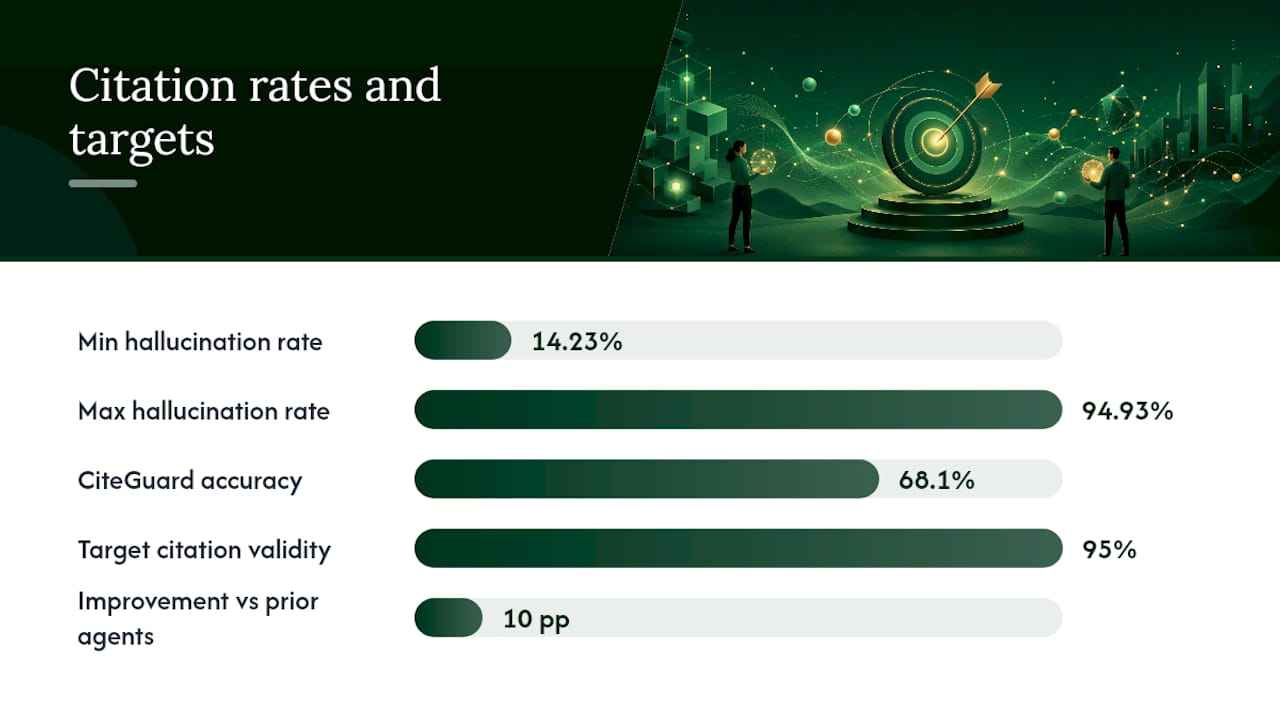
GhostCite’s benchmark of 13 LLMs found hallucination rates spanning 14.23% to 94.93%, with an archival analysis of 56,381 papers flagging 739 invalid citations in published literature. Those numbers mean engineering teams should assume non-trivial fabrication risk by default, not treat it as an edge case.
Four metrics to track in CI:
- Citation validity (precision). The share of surfaced citations that pass all three verification checks (URL live, snippet matches, license clear). Target 95% or above as your SLA.
- Oracle coverage@k. Of the k most relevant documents for a query, what fraction did the retriever actually surface? Low coverage means the retriever is missing good sources, which pushes the composer toward fabrication.
- Attribution alignment. Does the cited snippet actually support the claim it is attached to? This requires either a semantic similarity check or human review. Automated checks using a cross-encoder model work well at scale.
- Ghost citation rate. The share of citations that reference a URL that does not exist or a document that does not contain the cited claim. This is your primary safety metric.
CiteGuard, a retrieval-aware agent that adds multi-step actions (ask_for_more_context, search_text_snippet), improves citation attribution accuracy by about 10 percentage points over prior agents and approaches human performance at roughly 68.1% on the CiteME benchmark when paired with strong retrieval. That gap between automated and human performance is where your human-in-the-loop threshold should sit: route any citation with a confidence score below your threshold to a human reviewer before it surfaces.
Practical checks to run in your verification layer:
- HTTP HEAD request to confirm URL existence
- DOI or ISBN lookup for academic sources
- Cosine similarity between the stored snippet and the live document text (flag if below 0.85)
- License flag check to block paywalled or restricted content
- Cross-reference against a known-bad URL blocklist
A sudden drop usually signals a source site going offline, a URL structure change, or a model update that shifted generation behavior.*
Which tools and components should you evaluate for a citation pipeline?
The ecosystem breaks into four component types. You need one from each category; mixing and matching is normal.
LLM families:
- Anthropic’s Claude (Citations API) offers native citation formatting and is the most direct path to structured CIT-tag output without heavy prompt engineering.
- OpenAI’s GPT-4o family handles structured JSON output reliably and integrates well with function-calling patterns for citation formatting.
- Retrieval-specialized models fine-tuned on citation tasks can outperform general-purpose models on attribution alignment, though they require more infrastructure.
Vector databases:
- Pinecone is fully managed, low-latency, and the fastest to get running for teams without dedicated infrastructure engineers.
- Weaviate adds native hybrid search (vector + keyword) and built-in metadata filtering, which helps when your corpus mixes structured and unstructured content.
- Milvus is open-source and scales to billions of vectors, making it the right choice for large corpora where licensing costs matter.
Citation and verification frameworks:
- CiteGuard-style multi-step agents that combine retrieval with snippet verification represent the current state of the art for attribution accuracy.
- Perplexity’s architecture demonstrates how retrieval-first answer generation can surface citations as first-class UI elements rather than afterthoughts.
When choosing components, rank your priorities: accuracy first for legal or medical content, latency first for consumer-facing chat, cost first for high-volume internal tools. Pinecone and Claude together give you the fastest time-to-production; Milvus and a fine-tuned retrieval model give you the most control over cost at scale.
What tactics help brands get cited by LLMs?
Getting cited by an LLM is partly an engineering problem and partly a publishing problem. The engineering side is about making your content retrievable; the publishing side is about making it authoritative enough to survive a reranker’s quality filter.
Editorial steps:
- Publish original research or proprietary data with explicit methodology sections. LLMs favor sources that make verifiable claims with traceable evidence.
- Write single-topic documents rather than sprawling guides. A 1,200-word report on one narrow question retrieves better than a 6,000-word overview of a broad field.
- Add persistent anchors to every major section (H2 and H3 headings). This enables paragraph-level deep linking, which is what citation renderers need to show a “jump to source” link.
- Include explicit metadata in your HTML: author, publication date, last modified date, and canonical URL in the
<head>. Schema.org Article markup makes these fields machine-readable.
Technical steps:
- Submit a dataset sitemap to Google Search Console and Bing Webmaster Tools. This signals that your content is structured and citable.
- Expose machine-readable licensing via a
licensemeta tag or arobots.txtdirective. Content with clear licensing is less likely to be filtered by a citation pipeline’s license-flag check. - Ensure full-text accessibility for crawlers. Paywalled or JavaScript-rendered content that crawlers cannot read will not be indexed and therefore cannot be cited.
PR and visibility steps:
- Syndicate authoritative summaries to high-trust domains. A summary of your research published on a domain with high authority increases the probability that retrievers surface your content.
- Track which of your pages appear in AI-generated answers using tools that monitor LLM search impressions. Adjust your content calendar based on what is already being cited.
Pro Tip: Prioritize publishing small, high-precision documents on a single topic over comprehensive guides. A focused document on one question retrieves more reliably and carries lower fabrication risk than a long-form piece that covers ten related questions.
For teams building AI writing governance into their editorial process, aligning citation standards with content production workflows from the start saves significant rework later.
What prompt patterns work best for generating citations?
Two approaches dominate: single-pass and two-pass generation. Each has a distinct trade-off profile.
Single-pass asks the model to generate the answer and attach CIT tags in one inference call. It is fast and cheap, but the model must rely entirely on the retrieved context window. If a relevant chunk is missing from the retriever’s output, the model may fabricate a citation rather than acknowledge the gap.
Two-pass separates claim generation from citation attachment. The first pass generates the answer with claim placeholders. The second pass searches for and verifies a source for each placeholder before attaching a citation. This approach is slower and more expensive but produces materially better attribution alignment.
| Dimension | Single-pass | Two-pass |
|---|---|---|
| Latency | Low (one inference call) | Higher (two calls plus retrieval) |
| Attribution reliability | Moderate | High |
| Engineering complexity | Low | Medium to high |
| Cost per query | Lower | Higher |
| Best use case | Internal tools, low-stakes content | Customer-facing, legal, medical content |
Conceptual single-pass prompt template: “Using only the provided context chunks, answer the following question. Wrap every factual claim with <CIT id='[chunk_id]'>claim</CIT>. If no chunk supports a claim, state that explicitly rather than citing a source.”
Conceptual two-pass prompt template (pass two): “For each claim below, search the provided index for the most relevant supporting document. Return a JSON array where each object contains claim_id, chunk_id, canonical_url, and match_confidence. Only include citations with match_confidence above 0.80.”
Key parsing considerations:
- Strip and log malformed CIT tags rather than crashing the renderer
- Deduplicate citations that reference the same chunk ID multiple times in one response
- Normalize canonical URLs (strip tracking parameters, enforce HTTPS) before storing or displaying
How do you cite AI-generated text in APA, MLA, and Chicago style?
Academic and legal citation standards for AI-generated content have converged on a shared set of required elements: the tool name and version, the prompt or query, the generation date, and a shareable link when the platform supports one. NYU’s citation guidance recommends recording all four elements and cautions that AI-generated text is often unretrievable unless a stable chat link exists.
MLA’s guidance treats the prompt as the title element, names the AI tool and version in the container field, and recommends including a shareable chat link rather than treating the AI as the author.
| Style | Format | Example |
|---|---|---|
| APA | Author/Company. (Year). Title or description of prompt [AI-generated text]. Tool Name. URL | OpenAI. Summary of RAG pipeline architectures [AI-generated text]. ChatGPT (GPT-4o). https://chat.openai.com/share/… |
| MLA | “Prompt text or description.” Tool Name, version, Company, Day Month Year, URL. | “Explain retrieval-augmented generation.” Claude, claude-3-5-sonnet, Anthropic, claude.ai/share/… |
| Chicago | Company. “Prompt text.” Generated by Tool Name (version). Month Day, Year. URL. | Anthropic. “Summarize citation hallucination research.” Generated by Claude (claude-3-opus). claude.ai/share/… |
For legal citation contexts, the Bluebook format applies when citing cases or regulations that an LLM surfaced. The University of Notre Dame’s Bluebook sample citations show the required elements: reporter volume, reporter abbreviation, first page, pinpoint page, court abbreviation, and year. When an LLM cites a legal document, verify the reporter, volume, and page number independently before including it in any legal filing or published work.
Disclosure checklist for teams publishing AI-assisted content:
- Record the exact prompt used
- Note the tool name and model version
- Log the date the output was generated
- Save a shareable chat link if the platform supports it
- Disclose in the document whether AI-generated text appears inline or in an appendix
- Treat any secondary source an LLM lists as unverified until independently confirmed
How do you integrate LLM citations into an existing CMS or workflow?
The integration point that most teams underestimate is the metadata write-back loop. When a content editor publishes or updates a document, the CMS needs to push the updated canonical URL, last_updated timestamp, and a fresh snippet hash back to the vector index. Without that loop, your citation pipeline will surface stale or broken references as content evolves.
A practical integration pattern for teams using headless CMS platforms: add a webhook on the publish event that triggers a re-indexing job for the affected document. The job re-chunks the document, re-embeds the chunks, updates metadata records, and re-hashes snippets. This keeps the index current without requiring a full corpus re-index.
For editorial workflows, the most useful addition is a citation audit step in the content review checklist. Before any piece goes live, a reviewer confirms that every external source the document cites resolves, matches the claim it supports, and carries a clear license. This mirrors the verification logic in the pipeline itself and catches errors before they propagate into the index.
Analytics integration is the other gap. Track citation impressions as a distinct event type, separate from page views and clicks. When a citation surfaces in an LLM answer, log the chunk ID, the query that triggered it, and the verification outcome. Over time, this data tells you which documents are being cited most often, which are failing verification, and where retrieval gaps are pushing the model toward fabrication.
What are the legal and ethical risks of LLM citations?
Copyright is the most immediate legal risk. When a citation pipeline retrieves and surfaces a verbatim snippet from a copyrighted document, the snippet display may constitute reproduction under U.S. copyright law, depending on length and context. The fair use analysis under 17 U.S.C. § 107 considers purpose, nature of the work, amount reproduced, and market effect. Short factual snippets used for attribution generally fare better than long verbatim passages, but no automated system can make that determination reliably. Legal review of your snippet display policy is not optional for production systems.
Privacy is a second risk that surfaces when the corpus includes documents containing personal information. If a retrieved chunk includes a name, email address, or other personally identifiable information, surfacing it in a citation creates potential liability under applicable U.S. state privacy laws. The license-flag field in your metadata schema should include a PII-detected flag, and chunks flagged as containing PII should be excluded from citation rendering by default.
Attribution integrity is an ethical obligation as much as a legal one. Citing a source for a claim it does not actually make is misleading regardless of whether it is technically legal. The ghost citation problem documented in the GhostCite audit is not just a technical failure; it erodes the epistemic value of citations as a trust signal. Teams shipping citation features carry a responsibility to verify attribution alignment, not just URL existence.
Finally, model outputs that cite real authors for positions those authors do not hold can constitute defamation in extreme cases. Any citation pipeline that attributes a specific claim to a named individual should include a human review gate for high-stakes content.
How do you monitor and maintain citation quality over time?
Citation quality degrades for three reasons: source content changes after indexing, model behavior shifts after an update, and corpus coverage gaps widen as new content is published but not indexed. A monitoring strategy needs to address all three.
For source drift, the snippet-hash check described in the implementation section is your primary detector. Run it on a scheduled basis, not just at query time. A weekly batch job that re-hashes all stored snippets against live URLs and flags mismatches gives you advance warning before stale citations reach users.
For model behavior shifts, track citation validity precision as a time-series metric. A sudden drop after a model version update is a strong signal that the new version handles CIT-tag formatting differently or retrieves context differently. Pin your model version in production and test new versions against your citation quality benchmarks before promoting them.
For corpus coverage gaps, monitor the queries that trigger low oracle coverage@k scores. These are the queries where the retriever is not finding good sources, which is where fabrication risk is highest. Use those queries to prioritize new content creation or indexing of additional sources.
Retraining or fine-tuning decisions should be driven by attribution alignment scores, not just citation validity. A pipeline can achieve high URL-existence precision while still attaching citations to claims they do not support. Attribution alignment is the harder metric to move, and it is the one that actually determines whether your citations are trustworthy.
What do real implementations look like?
Perplexity’s public architecture is the most widely studied example of LLM citations in production. The system retrieves live web content at query time, surfaces citations as numbered inline references, and displays expandable source cards with title, URL, and snippet. The key engineering decision is retrieval-first: the answer is generated from retrieved content, not from parametric memory, which structurally limits hallucination risk.

Legal research platforms have implemented citation pipelines that verify case citations against official legal databases before surfacing them. The verification step checks reporter, volume, page number, and court against a structured legal database, then flags any citation where the retrieved case text does not contain the quoted language. This two-pass approach is slower but appropriate for a domain where a fabricated citation in a legal brief carries serious professional consequences.
Academic publishing tools have integrated citation verification into manuscript submission workflows. When an author submits a paper, an automated check resolves every DOI in the reference list, retrieves the abstract, and flags references where the cited claim does not appear in the abstract or full text. This catches both honest errors and AI-generated ghost citations before peer review.
The common thread across these implementations: verification is not a post-launch feature. Teams that shipped citation features without verification built the debt in immediately and paid it in user trust erosion.
How do LLM citations affect user trust and SEO rankings?
The trust effect is documented and directional. Adding citations increases self-reported trust. But the study of roughly 197 participants found that a significant portion of users checked citations, and those who verified inaccurate citations reported lower trust. The implication for product teams: citation accuracy is not a nice-to-have quality metric. It is the variable that determines whether citations help or hurt your trust scores.
On the SEO side, the mechanism is still emerging, but the directional evidence is clear. AI answer engines that surface citations drive referral traffic to cited sources. Pages that appear as citations in AI-generated answers gain a new impression channel that operates independently of traditional organic search rankings. For content teams, this means citation-worthiness is becoming a distinct optimization target alongside traditional keyword ranking.
Structured metadata and schema markup appear to improve the probability of being cited, because they make content easier for retrievers to parse and rank. Pages with explicit author, date, and canonical URL signals in their HTML are more likely to pass a citation pipeline’s metadata completeness check. This is a direct parallel to how structured data improves traditional search snippet eligibility.
When should you prioritize citations over other trust signals?
The honest answer is that most teams should not start with a full citation pipeline. Start with verification rules for your highest-risk content categories: legal, medical, financial, or any content where a wrong answer carries real consequences.
The over-reliance on LLM-as-a-Judge is the pitfall teams most consistently miss. Using the same model to both generate and evaluate citations creates a circular validation loop. The model that fabricated a citation is not well-positioned to detect that it fabricated it. CiteGuard’s architecture is instructive here: the evaluation step uses retrieval and snippet matching, not model self-assessment.
Product managers setting SLAs should define three handoff thresholds: a green zone where citations surface automatically, a yellow zone where citations surface with a disclosure flag, and a red zone where citations are withheld and the claim is stated without attribution. Engineering owns the green/yellow boundary; legal and editorial own the yellow/red boundary. That division of responsibility prevents both over-caution (withholding useful citations) and under-caution (surfacing unverified claims).
The metric to watch in the first 90 days is not citation volume. It is attribution alignment: the share of surfaced citations where the cited snippet genuinely supports the attached claim. Citation volume is easy to inflate by lowering verification thresholds. Attribution alignment is what users actually experience.
Storylinepros helps you earn, build, and track LLM citations
Most startups do not have a citation problem. They have a visibility problem that a citation pipeline cannot fix on its own. If your content is not being retrieved in the first place, the most sophisticated RAG architecture in the world will not cite you.

Storylinepros builds the upstream visibility layer that makes citation pipelines work: earned placements on high-trust domains, syndicated authoritative summaries, and structured content assets designed to pass retrieval quality filters. The approach is success-based, meaning you pay for delivered placements and measurable citation impressions, not a monthly retainer for effort. A typical engagement runs from a focused pilot (four to six placements to establish baseline citation data) through a build phase that scales what works. See what that looks like in practice at the Storylinepros case studies page, or go directly to Storylinepros to start a conversation about your current AI search visibility.
Sources
Primary sources worth reading beyond this article:
- GhostCite: A Large-Scale Analysis of Citation Validity in the Age of Large Language Models
- CiteGuard: Retrieval-aware agent for citation attribution (ACL 2026)
- How to cite LLM best practices · llmbestpractices
- Citing & evaluating AI-generated text - NYU citation guide
- Citing generative AI - MLA Style Center