

Should You Try Pay-for-Performance PR?
Pay-for-performance PR is a smart fit if you’re a growth-stage company with a defined conversion event and enough patience to vet vendors hard before signing. It’s the wrong fit if your brand still needs foundational narrative work, since agencies can’t sell a story that isn’t built yet.
Pay-for-performance PR (also called pay-per-placement, pay-for-results, or performance PR) ties agency payment to a verified outcome, usually a live editorial placement or a predefined KPI, rather than a flat monthly retainer. The model has spread fast because marketers want the same accountability from PR that they already demand from paid media, and the shift toward performance PR as a data-driven strategy borrowing from digital marketing metrics backs that up. Storylinepros bills against delivered placements, podcast bookings, and syndicated coverage rather than hours worked.
- Best for: product launches, lead-gen campaigns, AI search visibility pushes
- Skip it if: you need brand positioning built from scratch first
- Payment trigger: verified placement or a specific KPI, not effort or time
Quick data point: Unclear success definitions are a real problem in this space. Industry reporting shows that 36% of brands that adopted performance PR without clear definitions ended up dissatisfied with the results.
Table of Contents
- What Is Pay-for-Performance PR, Exactly?
- What Do Payment Structures and Pricing Actually Look Like?
- When Does This Model Actually Pay Off?
- What Red Flags Signal a Bad Performance PR Deal?
- Vetting Agencies and Structuring the Contract
- How Storylinepros Applies This Model in Practice
- How Long Does a Performance PR Campaign Actually Take?
- What Legal and Ethical Rules Apply to This Model?
- Where to Verify These Claims
- The Gap Between the Pitch and the Practice
- A Path to Measurable, Result-Driven Visibility
- Frequently Asked Questions
- Sources
What Is Pay-for-Performance PR, Exactly?
Performance PR pays an agency only when it delivers a defined, verifiable outcome. That’s the whole model, and it’s a sharper departure from tradition than it sounds. Retainer PR pays for effort, activity, and access. Performance PR pays for proof.
You’ll see the concept under a few different names in vendor pitches: pay-per-placement, pay-for-results, or simply performance-based PR. They all describe the same mechanic. MarketGuest’s breakdown of the model frames it as linking budget directly to results instead of hours logged, which is the core distinction procurement teams should hold onto.
What actually counts as a “result” varies by contract, but the strongest agreements define it narrowly:
- Editorial placements in outlets that meet a specified domain authority threshold, verified by URL and byline.
- Referral traffic attributable to a placement, tracked through UTM parameters or server logs.
- Podcast appearances on shows with a minimum audience size or download count.
- Share-of-voice gains measured against named competitors over a defined window.
One distinction matters more than any other in this list: earned editorial coverage is not the same as paid or sponsored content. A journalist choosing to cover your story because it’s newsworthy carries credibility and SEO value that a “sponsored post” label never will. Any agency that blurs that line, counting advertorials or paid guest posts as “placements,” is misrepresenting the model entirely.
What Do Payment Structures and Pricing Actually Look Like?
Pricing in this space isn’t standardized the way, say, PPC bidding is, but four structures show up repeatedly across vendor proposals.
- Per-placement flat fees, often tiered by the publication’s domain authority (a DA 30 blog costs less than a DA 70 national outlet).
- Tiered pricing packages, where a bundle of guaranteed placement types is priced as a unit.
- Revenue-share hybrids, where the agency takes a cut of attributable pipeline or sales, common in ecommerce and SaaS.
- Retainer-plus-success-fee hybrids, where a smaller base retainer covers strategy and outreach while a bonus kicks in per verified placement.
Rates vary widely by industry and publication tier, and any agency quoting a single universal number is oversimplifying. What matters more than the exact dollar figure is the KPI framework attached to it. Before signing, ask a vendor to define, in writing:
- The minimum domain authority or publication tier that qualifies as billable
- Share-of-voice or mention-volume targets over a set period
- Referral traffic uplift, tied to actual analytics access, not agency-reported estimates
- Lead or conversion metrics, only if the agency genuinely controls that funnel stage
- Reporting cadence, ideally weekly or biweekly rather than a single end-of-quarter summary
A useful gut check from practitioner discussions on Gartner’s peer community: KPIs should reflect what the agency actually controls, like published placements or qualified media leads, not downstream outcomes like closed revenue unless a revenue-share arrangement is explicitly negotiated.
When Does This Model Actually Pay Off?
Performance PR earns its keep when incentives line up cleanly between what you’re paying for and what you actually need. The agency only gets paid when you get a result, which removes most of the upfront risk that makes retainer contracts feel like a leap of faith.
It tends to work best for AI search visibility pushes:
- Product launches with a hard date and a specific announcement to place
- Lead-generation campaigns where referral traffic and conversions are trackable
- Link-building efforts aimed at AI and search visibility, where editorial links from high-authority domains deliver materially more SEO value than mass guest posting
Pro Tip: Run a 90-day pilot before committing to a longer engagement. It’s short enough to limit downside and long enough to see whether an agency’s placement pipeline is real or theoretical.
Where performance PR falls short is foundational brand work. If your company hasn’t nailed down its core narrative, positioning, or differentiators, no agency can talk a national outlet into covering a story that doesn’t exist yet. That kind of groundwork is better suited to a retainer or hybrid arrangement, where you’re paying for strategic development, not just placement delivery.
What Red Flags Signal a Bad Performance PR Deal?
Not every agency selling “performance PR” is actually running one. Some red flags show up before you even sign.
- Vague success definitions. If a proposal doesn’t specify exactly what counts as a billable placement, walk away.
- Guaranteed top-tier placements. No agency can promise coverage in a specific national outlet. Anyone who does is either lying or planning to pay for it.
- Paid placements counted as earned. Sponsored content, advertorials, and pay-to-play “contributor” articles are not the same as editorial coverage, and counting them as such inflates results artificially.
- No raw reporting access. If you can’t see the actual URLs, bylines, and analytics behind a claimed result, you’re taking the agency’s word for it.
- No refund or dispute policy. Contracts should specify what happens if a placement gets pulled, unpublished, or fails verification after payment.
Beyond contract language, watch for operational shortcuts: link schemes, mass-syndicated low-quality content, or tactics that trade short-term placement counts for long-term editorial credibility.
Vetting Agencies and Structuring the Contract
Before you sign anything, request three things: raw placement reports from a past campaign, direct links to the bylines and URLs claimed as results, and dashboard access rather than a static PDF summary. Canvas PR’s guidance on performance-based models recommends exactly this level of transparency as the baseline, not an upgrade.
A solid contract should spell out, in plain language:
- Success definitions. What counts as a billable result, and what explicitly does not (paid placements, syndicated reprints, low-authority sites).
- Authority thresholds. The minimum domain authority, audience size, or reach a placement must hit to qualify.
- Verification process. How results get confirmed, whether that’s live URL checks, analytics screenshots, or third-party tools like Muck Rack or Cision.
- Payment schedule. When invoices trigger relative to placement confirmation, and whether there’s a holdback period to account for retractions.
- Refund terms. What happens if a placement is later removed or fails to meet the agreed threshold.
- IP and republishing rights. Who owns the content, and whether the agency can reuse it in its own portfolio or case studies.
That window catches retractions and lets you confirm the coverage actually stuck.*
On negotiation specifically: start with a pilot agreement rather than a 12-month commitment, insist on an explicit exclusion for paid or sponsored placements, and reserve audit rights so you can spot-check reported results against your own analytics whenever you want.
How Storylinepros Applies This Model in Practice
Storylinepros bills against delivered outcomes, meaning earned media placements, podcast bookings, and syndicated coverage that’s been verified before an invoice goes out. That structure only works if the verification is airtight, which is why the model leans on a proprietary technical layer to track placements and attribution rather than relying on self-reported summaries.
- Editorial-first sourcing: placements come from genuine media and community engagement, not paid insertions counted as earned coverage
- Transparent dashboards: clients see placement data and attribution as campaigns run, not in a single retrospective report
- Contract language aligned to outcomes: payment triggers match verified deliverables, echoing the same success-definition discipline outlined earlier in this guide
Startups working with Storylinepros have used this approach to build citation-worthy visibility across trusted outlets, the kind of coverage that positions them as credible references in both traditional and AI-driven search results.
Full campaign detail lives in Storylinepros’s case studies, which lay out the placement volume and visibility gains behind specific engagements.
How Long Does a Performance PR Campaign Actually Take?
Most performance PR engagements don’t produce billable results in week one, and any vendor promising otherwise is setting you up for disappointment. The realistic arc runs in three phases.
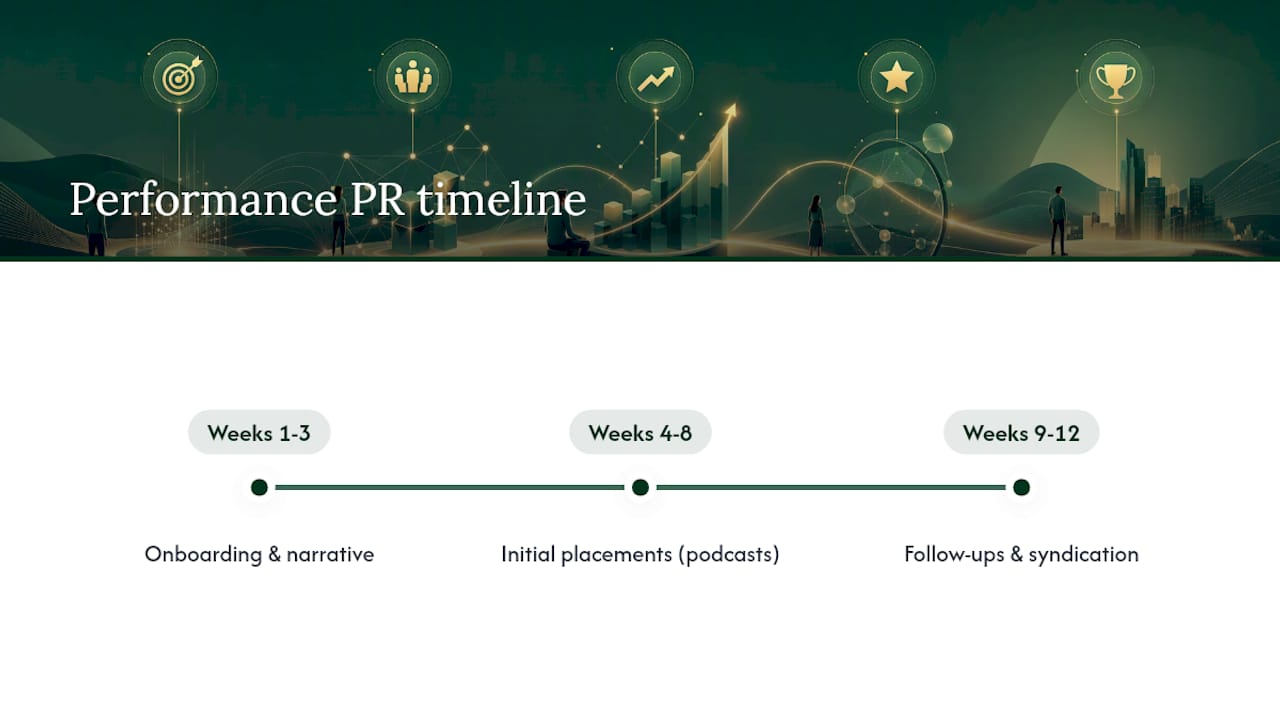
Weeks 1 to 3 cover onboarding: narrative development, target publication lists, and pitch drafting. Nothing billable happens here, but skipping it is exactly how campaigns end up with weak placements later.
Weeks 4 to 8 is when the first wave of placements typically lands, assuming the story and targeting are solid. Podcast bookings often move faster than written placements since scheduling is more flexible than an editor’s calendar.
Weeks 9 to 12 is where momentum usually builds, since journalists who’ve covered you once are more likely to consider a follow-up angle, and syndication from early placements starts compounding.
Payment milestones should track this arc rather than a fixed calendar date. A contract that expects results in week two is either misunderstanding the sales cycle of earned media or padding placement counts with something other than genuine editorial coverage. If you’re running a pilot, 90 days is a realistic window to judge whether an agency’s pipeline is real, long enough to see at least one full cycle of pitching, placement, and reporting.
What Legal and Ethical Rules Apply to This Model?
Performance PR sits closer to advertising law than most marketers assume, mainly because payment structures can blur the line between earned coverage and paid promotion if contracts aren’t careful.
The core rule: if money changed hands for a specific placement, and that placement doesn’t disclose the relationship, you’re in FTC endorsement guideline territory, not just a PR gray area. This matters most with sponsored content, paid guest posts, and influencer or podcast placements where compensation exists. Editorial coverage secured through genuine pitching, where the outlet chose to cover you because the story earned it, doesn’t carry the same disclosure burden, but it also can’t be manufactured through payment without becoming exactly the kind of placement that needs disclosure.
Well-run programs also require upfront agreement on how syndicated content gets counted versus true first-run editorial coverage. Treating a syndicated reprint the same as an original placement in your KPI reporting misrepresents your results internally, even if no external law is broken. The same discipline applies to excluding any paid or promotional placement from your “earned” count entirely. Agencies operating in good faith build this distinction into their contracts before a campaign starts, not after a client asks hard questions about a report.
Performance PR works because it ties agency payment to a verified outcome instead of hours worked, but only when both sides agree in writing on what counts as a result before the campaign begins.
| Point | Details |
|---|---|
| Payment trigger | Compensation should follow a verified placement, KPI, or referral metric, never billable hours. |
| Definitions prevent disputes | Write success definitions, authority thresholds, and exclusions into the contract before work starts. |
| Watch for red flags | Vague terms, guaranteed top-tier coverage, and paid placements counted as earned all signal a bad deal. |
| Match the model to the goal | Product launches and lead-gen campaigns fit well; foundational brand building usually needs a retainer or hybrid. |
| Storylinepros ties billing to delivery | Storylinepros invoices against verified placements, podcast bookings, and syndicated coverage with dashboard-level transparency. |
Where to Verify These Claims
- PRSA: industry standards and best-practice guidance for benchmarking earned media
- Muck Rack and Cision: media databases useful for confirming journalist bylines and outlet reach
- Inc.: reporting on performance PR’s growth and adoption across agencies
- MarketGuest: primer on structuring pay-for-performance budgets and contracts
- Storylinepros: case studies documenting measurable placement outcomes
The Gap Between the Pitch and the Practice
Most coverage of pay-for-performance PR treats it like a solved problem: pay for outcomes, skip the risk, done. That’s naive. The research is clear that a meaningful share of implementations fail because nobody defined “success” tightly enough before money started moving. The model isn’t the risk. Vague contracts are.
What gets underrated is how much of this comes down to boring contract mechanics rather than agency talent. A skilled PR team with a loose success definition will still generate disputes. A mediocre team with airtight KPIs, authority thresholds, and verification requirements will at least generate honest ones. Marketing managers evaluating this model should spend less time asking “can this agency get us press” and more time asking “can this agency show me raw placement data from three past campaigns.” One of the practitioner threads on Gartner’s peer community makes this exact point: KPIs need to reflect what an agency actually controls.
Prioritize the contract before the pitch. The story matters, but the paperwork is what protects you when the story doesn’t land the way anyone hoped.
A Path to Measurable, Result-Driven Visibility
If you’ve read this far, you already know what separates a real performance PR partner from a vendor padding a placement count. Storylinepros was built around that distinction: billing tied to delivered placements, podcast bookings, and syndicated coverage, verified through a proprietary technical layer instead of self-reported summaries.

What makes this different from a traditional retainer agency isn’t just the payment structure, it’s what the model is optimized for. Storylinepros focuses specifically on visibility in AI-driven search, positioning startups as citable, credible references across outlets that both journalists and AI models trust. That’s a narrower, more measurable target than “brand awareness,” and it’s the kind of target procurement teams can actually track against finance-ready KPIs.
Founders evaluating a pilot can start by reviewing Storylinepros’s case studies for placement volume and visibility outcomes. Then reach out through the Storylinepros site to scope a campaign against your own launch timeline or lead-gen targets.
Frequently Asked Questions
Is pay-for-performance PR the same as pay-per-click advertising? No. PPC pays for clicks or impressions on paid ad placements. Pay-for-performance PR pays for verified earned media coverage, podcast appearances, or specific KPIs like referral traffic, not paid ad space.
What’s a reasonable KPI to negotiate with a performance PR agency? Stick to outcomes the agency directly controls: verified placements above a set domain authority, podcast bookings, or share-of-voice gains. Avoid tying payment to closed sales unless you’ve explicitly agreed to a revenue-share structure.
How is this different from a traditional PR retainer? A retainer pays for time and effort regardless of outcome. Performance PR pays only when a defined result is delivered and verified, which shifts financial risk toward the agency instead of the client.
Can pay-for-performance PR hurt my SEO if done poorly? Yes, if an agency uses link schemes or low-quality syndicated content to inflate placement counts. Always require editorial-only placements and verify domain authority and legitimacy before counting anything toward your KPIs.
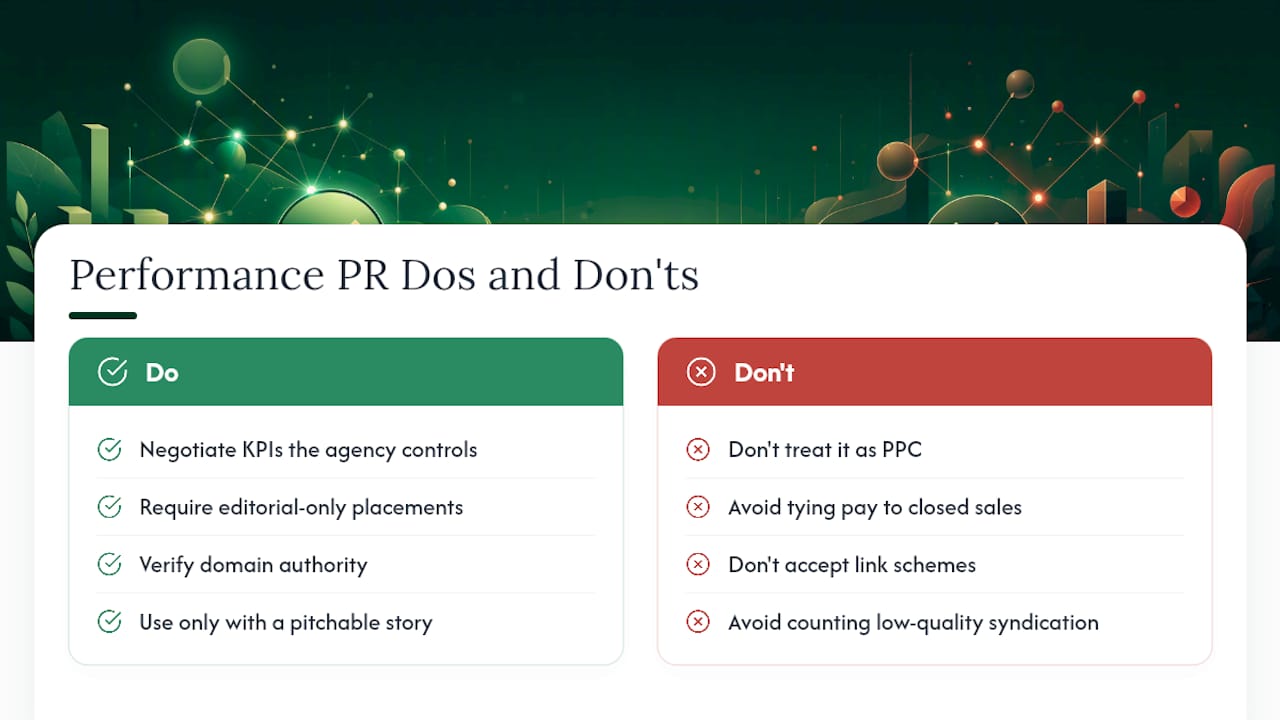
Should early-stage startups without a defined brand story try this model? Generally not right away. Performance PR assumes you already have a pitchable narrative. Companies still figuring out core positioning usually get more value from foundational strategy work first, then layering in performance PR once the story is ready to place.
Sources
- This Fast-Growing PR Trend Is Taking a Page From Digital Marketing — Inc.
- Pay for Performance PR: A Smarter Way to Link Budgets to Real Results - MarketGuest
- Pay-for-Performance PR: Aligning Agency Incentives with Your Brand’s Success — Prism PR Agency
- What Is Performance-Based PR? — Canvas PR