

PR Attribution for PR Teams: Measure What Moves Pipeline
PR attribution connects earned media coverage to measurable business outcomes: website traffic, leads, pipeline, and revenue. The single best first step is assigning a unique UTM-tagged link to every placement, then capturing that tag in both your web analytics and your CRM. For model choice, start simple: pair multi-touch attribution with basic lift checks, then layer in Media Mix Modeling or controlled experiments once you have enough volume to trust the numbers.
- Define outcomes before you pitch a single reporter.
- Tag every link that goes out with a placement.
- Pick one model to start, not five.
Key Takeaways
PR attribution succeeds when teams pair consistent UTM tracking and CRM data capture with a model mix that matches their data volume, validating with experiments as that volume grows.
| Point | Details |
|---|---|
| Tag every placement | Assign unique UTM links before publication and log them in a master spreadsheet. |
| Start with multi-touch models | Combine MTA with CRM correlation before adding MMM or experiments. |
| Amplify coverage | Paid promotion and retargeting extend a story’s life and create measurable touchpoints. |
| Report ranges, not false precision | Use 3 to 12 month trendlines instead of single-campaign snapshots. |
| Storylinepros builds this in | Storylinepros ties UTM tagging, GA4, and CRM data together from the start of a campaign. |
Table of Contents
- Why PR Attribution Works Differently Than Paid Attribution
- Attribution Models Explained: Which One Fits Your Campaign
- Hands-On Strategies for Measuring PR Impact
- Setting Up PR Attribution: A Step-by-Step Checklist
- Metrics and KPIs That Prove PR Impact
- Tools and Vendors Commonly Used for PR Attribution
- A Real Workflow: How One Campaign Tracked Attribution
- What PR Teams Get Wrong About Measuring Impact
- How Storylinepros Builds Measurable PR Attribution From Day One
- Frequently Asked Questions About PR Attribution
- Sources
Why PR Attribution Works Differently Than Paid Attribution
PR attribution behaves nothing like a paid search campaign, where a click and a conversion sit three seconds apart. Earned media rarely produces a direct click. A reader sees your founder quoted in a trade publication, forgets about it for six weeks, then searches your brand name directly. That gap breaks most of the attribution tooling built for paid channels.
Privacy restrictions make it worse. Third-party cookie limits and dark social sharing mean a growing share of referral traffic shows up as “direct” in Google Analytics 4, even when a press hit drove it. That is why aggregated models and controlled experiments matter more each year, not less.
The biggest misconception on PR teams is treating impressions as value. A million impressions from a low-authority aggregator site does not equal a thousand impressions from a publication your buyers actually trust. Attribution needs a blend: tracking where it exists, modeling where it does not, and validation to confirm the models are right.
Pro Tip: Set expectations with leadership up front. Many teams require a multi-week pilot before coverage-to-pipeline signals become reliable enough to report with confidence. Promising faster results just sets you up for an awkward meeting later.
Attribution Models Explained: Which One Fits Your Campaign
PR teams generally have three model families to choose from, and picking the wrong one for your data volume wastes months. Modern PR measurement work groups them into Multi-Touch Attribution, Media Mix Modeling, and experimental validation, used together rather than as competing options.
- Single-touch models (first or last click): simplest to set up, need almost no data infrastructure, but they routinely undercount PR because coverage rarely sits at the exact first or last step of a buyer’s path.
- Multi-touch attribution (linear, time-decay, U-shaped, data-driven): spreads credit across every recorded touchpoint. Time-decay works well for PR because it weights recent touches more heavily, which suits how coverage tends to resurface interest right before a purchase decision. Data-driven MTA needs the most volume but gives the most honest picture.
- Media Mix Modeling (MMM): works at the aggregate level, correlating spend and coverage volume against revenue over time. It does not need individual user tracking, which makes it resilient in privacy-constrained environments where cookie-based tracking keeps degrading.
- Experimental validation: geo holdouts and staggered launches, where you deliberately withhold PR push in one region or timeframe and compare it to a matched control. This is the closest thing to a causal proof PR teams get.
Start with multi-touch attribution correlated against CRM data if you’re early. Add MMM once you have sufficient consistent coverage and spend data. Reserve experiments for campaigns big enough that a controlled test is worth the operational lift, like a major product launch or a national press push.
Hands-On Strategies for Measuring PR Impact
Attribution lives or dies on tracking discipline, and most of that discipline is unglamorous spreadsheet work.
UTM tagging and a tracking log. Give every publication a unique link built with source, medium, campaign, and content parameters, and keep a master spreadsheet logging every placement before it goes live, not after. This single habit fixes more attribution gaps than any tool purchase.
GA4 and micro-conversions. Google Analytics 4 tracks referral sessions from tagged links, but the real value comes from watching assisted-conversion paths, not just last-click sessions. Set up micro-conversions like newsletter signups or resource downloads so PR traffic that doesn’t convert immediately still registers somewhere.
CRM linkage. Require a source field on every inbound lead form and sync UTM parameters into HubSpot or Salesforce as a custom property. That way, when a deal closes eight months after a press mention, you can still trace the first touch back to the placement that started it.
Amplification tactics. Paid promotion of coverage on LinkedIn, an email blast to your list, or retargeting visitors who read the article all extend a story’s lifespan and create fresh touchpoints you can actually measure. A press hit that dies after 48 hours gives you almost nothing to attribute. One that gets amplified for three weeks gives your model something to work with.

Media monitoring and sentiment. Track mention volume, outlet authority, and sentiment alongside the behavioral data. A spike in negative sentiment around a positive traffic bump tells you something the click numbers alone never will.
A simple workflow that works for most mid-size teams: tag the link, watch GA4 for referral and assisted-conversion activity over a period, then pull a CRM report filtering by that UTM source to see which leads or deals touched it. No enterprise platform required, just consistent tagging and a recurring pull.
Setting Up PR Attribution: A Step-by-Step Checklist
Follow this order. Skipping steps to jump to modeling is the most common mistake teams make.
- Define outcomes and KPIs. Decide upfront whether you’re chasing qualified leads, demo requests, branded search lift, or pipeline influence. Vague goals produce vague reports.
- Map the buyer journey. Identify where a press mention or podcast appearance realistically enters a prospect’s path, whether that’s early-stage awareness or late-stage validation before a purchase.
- Create UTM-tagged URLs for every placement. Log them in your master spreadsheet before the story publishes, with the parameters set consistently across campaigns.
- Instrument micro-conversions. Make sure email signups, gated content views, and other small actions are tracked in GA4 so partial engagement still counts.
- Confirm CRM capture. Verify that first-touch and assisted-touch fields populate correctly on new leads, and audit a sample monthly.
- Choose your model mix. Base this on data volume: multi-touch attribution plus CRM correlation for most teams, adding MMM or experiments once you have enough history.
- Build a combined dashboard. Pull coverage volume, traffic, conversions, and revenue influence into one view stakeholders can actually read.
Pro Tip: Build the dashboard before your first big campaign launches, not after. Retrofitting attribution onto a campaign that already happened means relying on estimates instead of measurements.
Metrics and KPIs That Prove PR Impact
Report a mix of leading and lagging indicators, and always frame results as a range rather than a false-precision single number. Assisted conversions matter more than last-touch conversions for PR specifically, since coverage rarely closes a deal on its own but frequently shows up earlier in a multi-touch path.
| KPI | Why it matters | Typical data source |
|---|---|---|
| Referral traffic | Shows direct engagement from a tagged placement | GA4 |
| Assisted conversions | Captures PR’s role earlier in the funnel | GA4 / CRM |
| Branded search lift | Signals awareness even without a click | Search Console |
| Pipeline influence | Ties coverage to actual revenue opportunities | CRM |
| Share of voice / sentiment | Tracks competitive and reputational context | Media monitoring |
Plot these as trendlines across 3 to 12 months rather than single-campaign snapshots. Longer windows smooth out noise and reveal real momentum that a single month of data will never show.
Tools and Vendors Commonly Used for PR Attribution
Most teams end up combining three tool categories rather than relying on one platform to do everything.
- Media intelligence platforms like Cision and Onclusive capture mention volume, outlet authority, and backlink data. Use them to establish share of voice and quality-weighted reach, not just raw mention counts.
- PR reporting tools like Prowly handle press outreach and coverage tracking in one place, useful for smaller teams that need a lighter footprint than enterprise media intelligence suites.
- Web analytics, namely Google Analytics 4, handles referral traffic, micro-conversions, and assisted-conversion paths, and integrates directly with UTM tagging.
- CRM systems like HubSpot or Salesforce turn tagged traffic into pipeline and revenue data once source fields are enforced on lead capture.
- MMM or specialist vendor models make sense once you have a full year of consistent spend and coverage history. Below that, a spreadsheet-based lift comparison gets you most of the way there for far less cost.
If privacy-first, cookieless analytics is a growing concern for your stack, factor that into which layer you invest in first. Aggregated modeling ages better than user-level tracking as browser restrictions tighten.
A Real Workflow: How One Campaign Tracked Attribution
A typical Storylinepros campaign for an early-stage startup client centers on a straightforward objective: convert earned media placements into qualified investor and customer conversations. The measurement setup ties UTM-tagged links from each placement into GA4, then into the client’s CRM, so every inbound lead carries a source field back to the specific article or podcast that generated it.
The methodology combines multi-touch attribution with amplification through Reddit community engagement and syndication, then a basic lift comparison against a pre-campaign baseline to confirm the coverage actually moved the numbers rather than coinciding with them.
Readers who want the full breakdown can look at Storyline Pros case studies documenting expanded media reach and measurable investor engagement from campaigns built this way.
What PR Teams Get Wrong About Measuring Impact
Most PR teams over-invest in modeling before they’ve earned the right to model anything. If your UTM tagging is inconsistent and your CRM doesn’t capture source fields, no amount of statistical sophistication fixes that gap.
Instrumentation comes first, always. Get the tagging and CRM linkage solid before you touch Media Mix Modeling. Amplification is the underrated lever here too: a press hit you promote for three weeks gives your model real touchpoints to work with, while one that dies in 48 hours gives you almost nothing to attribute regardless of which model you pick. Run small experiments where you can, geo holdouts or staggered timing, but resist the urge to chase decimal-point precision. A directionally right estimate you can defend beats a falsely precise one you can’t.
How Storylinepros Builds Measurable PR Attribution From Day One
Most PR agencies hand you a coverage report and call it a result. Storylinepros builds the UTM tagging, GA4 setup, and CRM linkage into the campaign from the first placement, so you’re not retrofitting attribution onto coverage that already happened.

That matters most for founders who need to show investors or a board that earned media is actually moving pipeline, not just generating mentions. Storylinepros focuses on placements, podcast spots, and community amplification designed to rank in AI-driven search results, paired with the tracking to prove it worked. If you’re evaluating how a campaign like this would look for your company, review Storyline Pros’ case studies for examples of the workflow in action, then reach out through Storyline Pros to scope a pilot campaign for your next launch.
Frequently Asked Questions About PR Attribution
What is the difference between PR attribution and marketing attribution? Marketing attribution typically tracks paid channels with direct click data. PR attribution deals with earned media, where clicks are rare and influence often shows up weeks later as branded search or direct traffic, which is why it leans more heavily on modeling and correlation.
How long does it take to see reliable PR attribution data? Most teams need a pilot period of 6 to 12 weeks before coverage-to-pipeline signals become reliable, and 3 to 12 months of trend data to report with real confidence.
Can small teams do PR attribution without expensive software? Yes. A UTM tracking spreadsheet, GA4, and a CRM with a required source field cover the core setup. Media Mix Modeling and specialist vendor tools become worthwhile once you have a full year of consistent data.
Which attribution model should PR teams start with? Start with multi-touch attribution correlated against CRM data. It requires less volume than data-driven MTA and captures more nuance than single-touch models, which tend to undercount PR’s real influence.
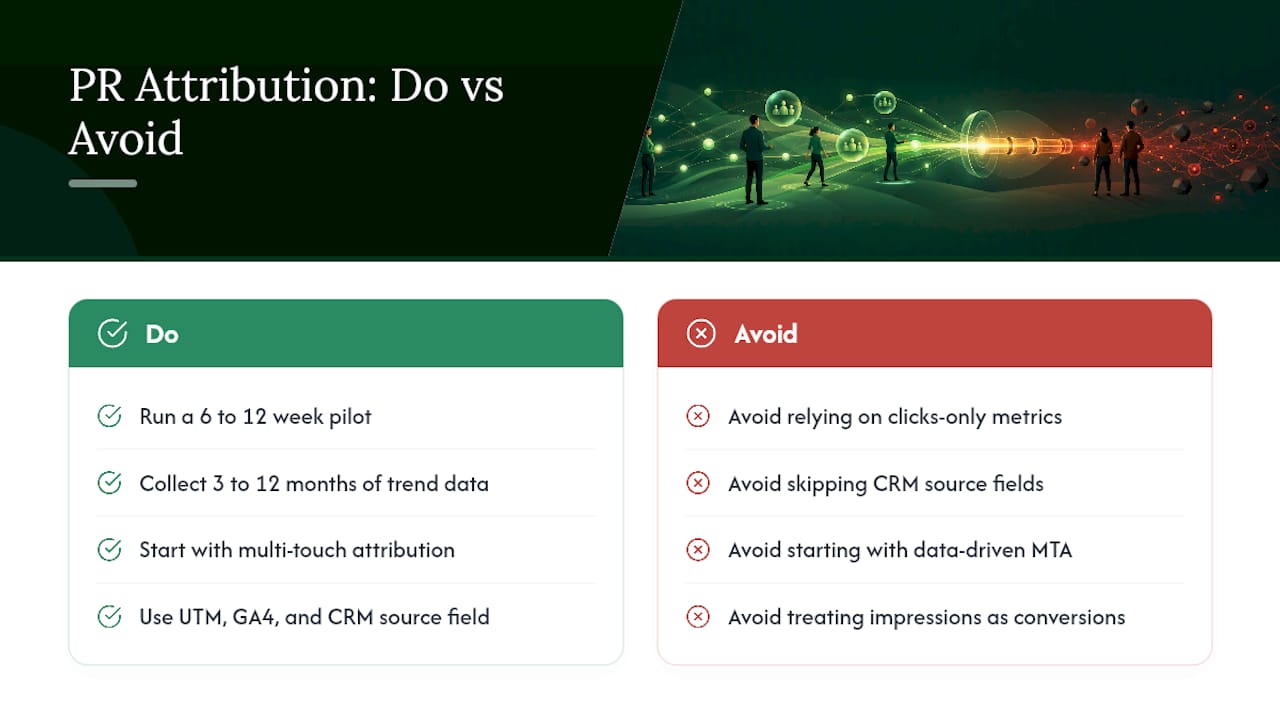
Do impressions matter at all in PR attribution? Impressions provide context, especially for share of voice and outlet authority, but they don’t equal value on their own. A smaller readership from a trusted publication typically outperforms a much larger, low-authority audience in downstream conversions.
Sources
- Media Mix Modeling definition and overview | Adjust
- How to Measure PR ROI and Turn Earned Media Into Revenue | MarketingProfs
- PR Campaign Attribution: The Ultimate Multi-Channel Measurement Guide | 9Figure Media
- Measuring PR ROI: Advanced attribution models for earned media and brand visibility | Agility PR Solutions