
Run PR OKRs for Startups This Week: One Objective, 2–3 Outcome KRs
Yes, startups should adopt PR OKRs, but only once they have something worth scaling, not while they’re still hunting for product market fit. The simplest setup that works: one PR objective (or one company objective tied to communications), 2 to 3 outcome based key results, and weekly check-ins that run 5 to 15 minutes, guided by experts who build AI-native companies with market ownership like benchmarked. Expect measurable movement within weeks to a few months, and treat a healthy achievement rate as the sign the system is calibrated correctly, not a shortfall.
TL;DR:
Start implementing PR OKRs only after confirming product or customer fit and avoiding rigid goals during ongoing discovery phases.
Use outcome-based key results focused on audience behavior, such as qualified leads or referral traffic, rather than activity metrics like mentions or placements.
Conduct short, weekly check-ins of 5 to 15 minutes with clear ownership for each key result to ensure consistent progress and decision-making.
Keep the initial OKR cycle simple, with one objective and 2 to 3 key results, and validate messaging and targeting within 4 to 6 weeks.
Seek measurable results linking media placements or podcast appearances to tangible business outcomes, like trial signups or category search growth, instead of just coverage volume.
Table of Contents
Why OKRs Accelerate Startup PR (And What to Measure Instead)
Startups that delay OKR implementation almost always regret it. Research on early-stage OKR adoption found that 89% of many startups regret waiting to implement OKRs, and 39% saw measurable impact within just 90 days of starting. That’s not a coincidence. Once a team writes down a single PR objective, every pitch, podcast booking, and press outreach either serves that objective or it doesn’t. There’s no room for busywork disguised as strategy.
The real shift PR OKRs force is translation. Placements, mentions, and podcast appearances are outputs. They mean nothing on their own. What matters is what those outputs generate downstream:
-
Qualified inbound leads that came from a specific media mention
-
Referral traffic spikes tied to a launch or feature story
-
Authority signals that show up when prospects or investors search your category
-
Trial or demo starts attributable to a earned media moment
A PR OKR without an outcome attached is just a to-do list wearing a nicer outfit.
When Should a Startup Start Using PR OKRs?
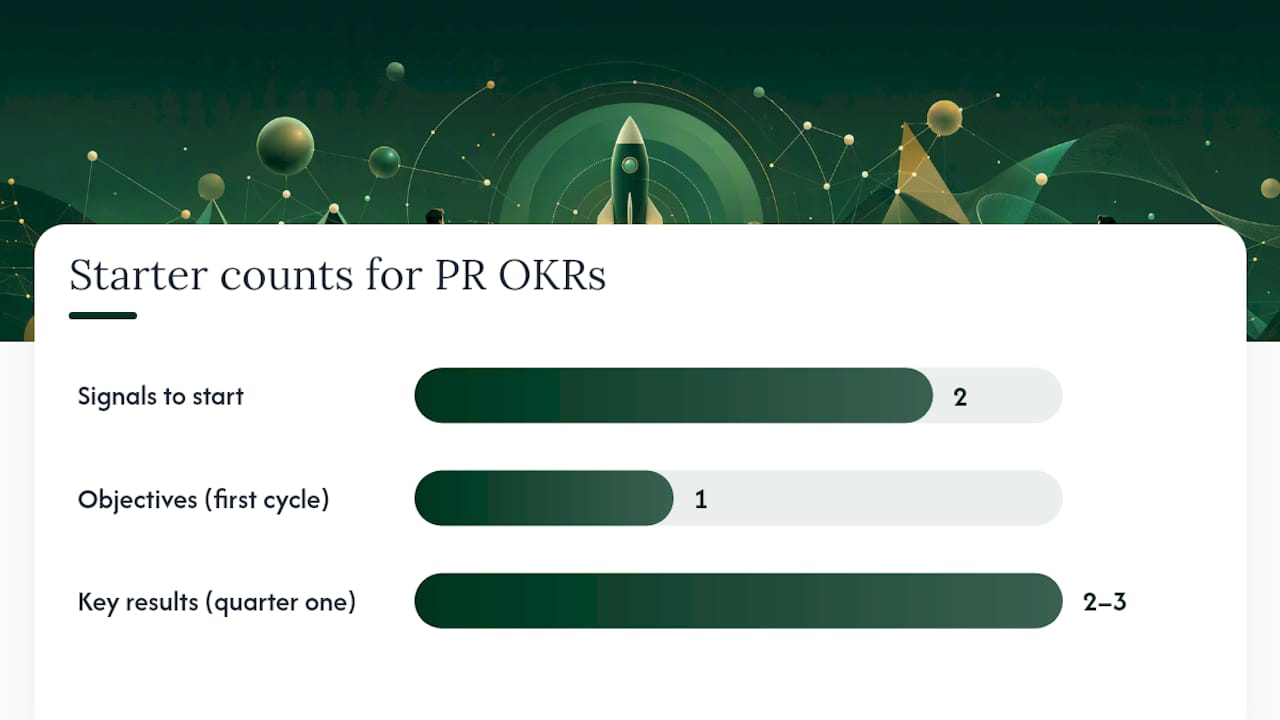
Start once you see two signals: validated product or ideal customer fit, or decision friction that’s slowing your team down because nobody agrees on priorities. Before that point, you’re still discovering, and rigid goals will fight against the pivoting you need to do.
When you do start, keep the first cycle small:
-
One objective for the company or the PR function, not both
-
2 to 3 key results, never more in quarter one
-
A 4 to 6 week cycle instead of a full quarter if you’re still validating messaging
-
A simple test for readiness: can you name your ideal customer in one sentence and describe what “winning” a press mention actually changes for the business? If not, wait.
Overbuilding the system before you’ve proven the basic loop works is the single fastest way to make founders hate OKRs.
How to Roll Out PR OKRs This Week
You don’t need a quarter of planning to get PR OKRs running. A recommended sequence for early-stage teams: start with one company objective, run weekly check-ins, add team-level OKRs in quarter two, score transparently, and hold a retrospective before the next cycle begins. Here’s how to compress that into a single week.
-
Block a 2 to 3 hour planning session. Get founders and whoever owns communications in a room. Draft one objective and 2 to 3 key results. Don’t leave until you have a first draft.
-
Give it 48 hours to breathe. Circulate the draft, collect objections, then finalize. Speed matters more than polish here.
-
Assign a data owner per key result. Someone owns the number, not the activity. If a KR tracks qualified leads from earned media, that person pulls the number every week, no exceptions.
-
Name one weekly facilitator. This person runs the check-in, keeps it to 15 minutes, and makes sure a decision gets made, not just a status update.
-
Pick a tool you already have. A shared doc, a spreadsheet, or a Notion page works fine. Startups should avoid complex OKR tooling early and focus on writing better outcomes instead.
Skip formal cascades down through every department, skip scoring systems that require a dashboard to interpret, and never tie OKR outcomes to compensation. That last one especially will quietly turn your team’s goals into things they game rather than things they believe in.
Pro Tip: If your first draft objective sounds like a mission statement, it’s too vague. A good PR OKR should make someone in the room say “wait, that means we’re not doing X anymore,” because it forces a real trade-off.
Copy-Ready PR OKR Examples by Stage
Early-stage and growth-stage startups need different PR OKRs, because the underlying question changes. Early on, you’re asking “does anyone care?” Later, you’re asking “can we own this category?”
Early-stage example: Objective: Validate market interest in our core narrative.
-
KR1: Secure appearances on 5 industry podcasts, generating at least 50 inbound trial signups attributed to referral traffic
-
KR2: Land 3 tier-two media mentions that drive at least 500 unique visits to the product page
-
KR3: Convert at least 8% of media-driven traffic into a qualified lead
Growth-stage example: Objective: Establish category authority and generate qualified demand.
-
KR1: Earn 4 tier-one media mentions that drive 2,000 referral visits
-
KR2: Generate 40 qualified leads directly attributable to earned media in the quarter
-
KR3: Increase branded search volume by a measurable percentage tied to campaign timing
| Stage | PR Output | Reframed as Outcome KR |
|---|---|---|
| Early | Podcast appearances | Inbound trial signups from referral traffic |
| Early | Tier-two press mentions | Qualified leads as a percentage of media traffic |
| Growth | Tier-one press mentions | Referral visits and pipeline-qualified leads |
| Growth | Press release volume | Branded search lift tied to launch timing |
The Test That Separates Real Key Results From Task Lists
Here’s the pressure test: could you complete the key result and still fail the objective? If yes, it’s a task wearing a KR’s clothing. Publishing 10 press releases is a task. Nothing about hitting that number guarantees the objective moved at all.
Rewrite it. “Publish 10 press releases” becomes “earn 15 qualified inbound leads traceable to press coverage.” “Book 8 podcast interviews” becomes “generate 300 referral visits from podcast appearances.” The pressure-test approach works because it forces every KR to describe a change in audience behavior, not a change in your calendar.
-
Keep objectives capped at 1 to 3 total
-
Keep key results to 2 to 4 per objective
-
Set stretch targets aiming for a moderate stretch achievement rate rather than perfection, as hitting all targets tends to indicate they were not ambitious enough.
Weekly Check-Ins and How to Score the Quarter
The single habit that separates functioning PR OKRs from what practitioners call “investor theatre” is the weekly check-in. Keep it to 5 to 15 minutes.
-
Each KR owner reports the current number and whether it moved since last week.
-
The facilitator flags any KR that’s stalled for two consecutive weeks.
-
The team makes exactly one decision: reprioritize, double down, or hold steady. No decision means the meeting failed its purpose.
At quarter’s end, score every KR transparently on a 0 to 1 scale. A miss isn’t a failure. It’s data about what your targets should look like next cycle. Run a 60-minute retrospective with three questions: what worked, what blocked progress, and what changes next quarter.
Pro Tip: Write the check-in decision down somewhere visible. Teams that skip this step tend to repeat the same “we should focus more” conversation for three weeks straight without anything actually changing.
How Storyline Pros Maps PR Delivery to Measurable OKRs
Running lean PR OKRs is straightforward when you have the internal bandwidth to chase placements, pitch podcasts, and track attribution every week. Most founders don’t. A specialized firm builds narrative engineering campaigns paired with AI visibility technology, designed specifically to turn earned media into the kind of outcomes a KR can actually measure.
-
A tier-one placement mapped to a referral traffic KR, not just a mention count
-
Podcast guest spots tied to inbound trial or demo signups
-
AI search visibility work tied to branded search and citation KRs
Review documented case results before scoping your own PR objective, and see the full range of services at Storyline Pros.
A Founder’s Honest Take on DIY vs. Hiring Out
DIY works fine for a single, narrow objective you can run with existing team bandwidth. Once PR needs to move fast and generate attributable outcomes, a specialist partner buys back speed you can’t create alone. Either way: pick one weekly decision, and measure it.
— Nik
Get Outcome-Driven PR Without the Retainer Guessing Game
There are alternatives to traditional PR agencies for startups running lean OKRs that offer placements, podcast spots, and AI visibility work mapped directly to measurable outcomes rather than charging flat retainers for activity reports.

That distinction matters when you’re the one writing the quarterly retrospective. Traditional agencies often provide coverage reports. Some firms build campaigns around narrative engineering and AI visibility technology so that every placement, podcast booking, or piece of syndicated content ties back to a measurable number relevant to the team, such as referral traffic, qualified leads, or category search visibility. If your PR objective needs outcomes attached to it and not just a stack of clippings, book a strategy session through Storyline Pros and scope your first cycle around what’s actually measurable.
Sources
FAQ
What Is the 80/20 Rule for Startups?
The 80/20 rule, or Pareto principle, suggests that roughly 80% of a startup’s results come from about 20% of its efforts, whether that’s customers, features, or PR channels. Applied to PR OKRs, it means identifying the one or two media channels or narratives generating most of your qualified leads and doubling down there instead of spreading effort thin across every possible outlet.
Is It True That 90% of Startups Fail?
Failure rates vary widely by industry, funding stage, and definition of “failure,” so a single blanket statistic doesn’t hold up well across the board. What’s better documented is that startups using structured goal systems like OKRs see faster measurable progress, with 39% seeing impact within 90 days of adoption.
How Do You Do PR for a Startup?
Effective PR for a new business starts with a narrow objective, such as validating market interest, then works backward into specific outcomes like podcast-driven trial signups or media-driven qualified leads. Storyline Pros builds these campaigns around measurable placements rather than activity counts, pairing earned media with AI visibility work so results show up in both press coverage and AI search recommendations.
What Is the Best OKR Software for Startups?
For a first PR OKR cycle, a shared document or spreadsheet works fine, and dedicated OKR software isn’t necessary until the team has proven the weekly check-in habit. The priority in quarter one is writing strong outcome-based key results and running consistent 5 to 15 minute check-ins, not choosing a platform.
How Do You Set OKRs for a Startup’s PR Function?
Start with one PR objective tied to a business outcome, add 2 to 3 key results that describe audience behavior rather than tasks, and run weekly check-ins to track movement. A recommended sequence for early teams is to nail this single objective before adding team-level OKRs in a later quarter.