

2–3 Startup Awards a Quarter: Strategy to Fuel Press & AI for Founders
Awards are worth pursuing when you treat them as credibility infrastructure, not trophy collecting: a deliberate calendar of two or three stage-matched programs a quarter, each one feeding a specific activation plan. Founders juggling ten priorities should be cautious about entering everything that lands in their inbox. The next move is simple: pick two to three target awards that match your current traction, then write the activation plan before you write the entry.
TL;DR:
- Most awards provide third-party validation that can boost press coverage, investor interest, and recruiting, but they do not generate direct funding or revenue.
- Focus on awards that have transparent judging criteria, meaningful reach, and tangible post-award benefits like backlinks and press features to maximize value.
- Build a systematic awards process with an evidence library, internal deadlines, and regular review to avoid wasted effort and improve submission quality over time.
- Tailor each entry around one clear claim supported by metrics, quotes, and visuals, and avoid applying to too many awards or relying on generic submissions.
- Use finalist or shortlisting as ongoing credibility, gather judge feedback to improve future applications, and measure ROI by tracking coverage, investor meetings, and backlinks post-application.
Table of Contents
- What Awards Actually Do for a Startup (And What They Don’t)
- How to Choose Awards and Build an Awards Calendar
- Preparing a Winning Nomination
- Building an Awards Program You Can Run Without Burning Out
- Post-Award Activation and Measuring ROI
- Sequencing Awards by Funding Stage
- How to Gather Endorsements and Testimonials to Strengthen Your Application
- Common Pitfalls and Mistakes to Avoid When Applying for Startup Awards
- Strategies for Leveraging Nominations Even If You Don’t Win
- The Storyline Pros Take on Awards as Visibility Infrastructure
- Sources
- FAQ
What Awards Actually Do for a Startup (And What They Don’t)
An award works as third-party validation. A judging panel that doesn’t work for you saying your product or growth is real carries more weight than your own pitch deck, and that signal travels: press pickups, warmer investor replies, easier recruiting conversations with candidates who Google you before the interview. Awards can compress fundraising timelines and reduce investor friction by cutting the cognitive load an investor spends verifying you’re legitimate. That’s the mechanism. It’s not a check. No award has ever wired money into a startup’s bank account, and treating recognition as a fundraising strategy on its own is a mistake.
What a single well-chosen award actually produces is a stack of reusable assets:
- A press mention you can link from your homepage and pitch deck
- A judge-reviewed narrative you can repurpose for future submissions
- A badge or logo for your website and email signature
- A LinkedIn and social moment that gives your team something real to share
- A data point for your next investor update
How to Choose Awards and Build an Awards Calendar
Not every award deserves your time. Run each one through a quick rubric before you commit hours to an entry:
- Independence and transparency. Does the program publish its judging criteria and its judges’ names? If the “who’s judging” page doesn’t exist, that’s a red flag.
- Judging rigor. Are entries scored against evidence, or is this a popularity contest decided by whoever pays for the biggest sponsorship tier?
- Reach. Does the outlet or organization have an audience your investors or customers actually read?
- Post-award value. Do winners get a backlink, a press release, a feature story, or just a certificate PDF?
- Category fit. Is there a category that matches your actual traction, or are you stretching a story to fit a category that doesn’t apply?
Pay-to-play schemes are easy to spot once you know what to look for: a “guaranteed win” pitch, a five-figure “recognition package” bundled with the trophy, or an organizer who can’t name a single independent judge. Editorial awards and audited lists tend to be harder to game, which is exactly why they carry more weight with investors and search engines alike.
On timing: operational playbooks recommend one to two entries per month rather than a scramble every December and January when half the internet’s awards deadlines cluster. Build your calendar in January for the full year, and set internal deadlines two weeks before the real ones.
Pro Tip: Keep a shared doc listing every award’s deadline, entry fee, and required word counts. Founders lose more good opportunities to missed deadlines than to rejected entries.
Preparing a Winning Nomination
Judges read dozens, sometimes hundreds, of submissions. Evidence beats adjectives every time — a judge skimming your entry wants a number, a customer quote, or a chart, not a paragraph of self-praise.
Start by picking one focused claim: fastest growth in your category, highest retention, biggest cost savings for customers. Then build the proof around it.
- A metrics table showing before/after or year-over-year change
- Two or three direct customer quotes tied to measurable outcomes
- A visual (screenshot, chart, product shot) that makes the claim concrete
- Links to any press coverage or third-party data that corroborates your numbers
Write for a skeptical reader who has seen a hundred “revolutionary” startups this year. Clarity and context win over enthusiasm. Forbes’ guidance on award submissions makes the same point: tailor your language to someone reading fast, and lead with the outcome, not the backstory.
Pro Tip: Build one evidence packet per quarter, then adapt it for each award’s specific prompts instead of starting from a blank page every time. Judges’ feedback from a near-miss can sharpen your next entry.
Building an Awards Program You Can Run Without Burning Out
Treating awards as a one-off scramble every time a deadline appears is how founders burn a weekend on a rushed entry and still lose. The fix is operational: build a system once, then run it.
- Maintain an evergreen evidence library: metrics, quotes, screenshots, and boilerplate bios, updated quarterly.
- Assign one named owner, even if it’s you for now, so submissions don’t fall through the cracks between other priorities.
- Budget realistically. A modular evidence library brings crafted-entry time down to roughly 8 to 10 hours instead of the 20-plus hours a from-scratch entry demands.
- Set an annual entry-fee budget, since fees range widely and add up fast across a full calendar.
- Close the loop: track which entries convert to coverage and which don’t, and retire programs that never pay off.
Templates aren’t a shortcut that cheapens the work. They’re what let you enter five relevant awards a year instead of one, because the second and third entries take a fraction of the time the first one did.
Post-Award Activation and Measuring ROI
Winning is the easy part. Most founders let the momentum die within a week because they never planned what comes after the trophy.
- Day 0: Push the shortlist or win announcement to your list, social channels, and any press contacts already in your pipeline.
- Week 1: Repackage the win into a short case study or blog post, with the metrics and quotes from your evidence packet front and center.
- Ceremony night: Post live, tag the organizers, and tag any judges or sponsors who engage. This is often when organic reach peaks.
- Quarter +1: Fold the award into your next investor update, your sales deck, and your website’s trust section.
Prioritize channels in order: trade press outreach tied to your category, investor updates, sales enablement material for your team, and backlink outreach to sites that cover your industry.
A simple ROI framework beats guesswork: multiply the expected benefit (press value, investor interest, hiring credibility) by your realistic probability of winning or placing, then subtract the real cost, hours plus entry fees. Measuring by the resulting coverage and citation stack rather than trophy count keeps you honest about what’s actually working.
Track four things after every award cycle: media mentions, inbound investor meetings, hires that mention the award in their applications, and backlinks earned. If none of those move after three cycles, the program isn’t earning its spot on your calendar.
Sequencing Awards by Funding Stage
Not every award matters at every stage, and applying too early to a program built for scaled companies wastes an entry and can even hurt your narrative.
- Pre-seed: Target founder-profile awards and early-traction categories. “30 under 30”-style lists and local entrepreneur recognitions fit here, since you likely don’t have audited revenue yet.
- Seed: Shift toward traction and customer-impact categories. This is where retention numbers, case studies, and growth percentages start to carry real weight.
- Series A and beyond: Audited and revenue-based awards, plus buyer-evaluated industry programs, become worth the effort because your numbers can now survive verification.
A rough 12-month sequencing rule: enter two accessible, credible awards in your first two quarters to build the evidence library, then use quarters three and four to apply to one or two higher-bar programs once you have the metrics to back the claim. Skip anything that requires three years of audited financials if you’re eighteen months old. That mismatch reads as desperation to a judge, not ambition.
How to Gather Endorsements and Testimonials to Strengthen Your Application
Most award applications ask for customer proof, and most founders scramble for it the week the entry is due. Fix that by building the habit earlier.
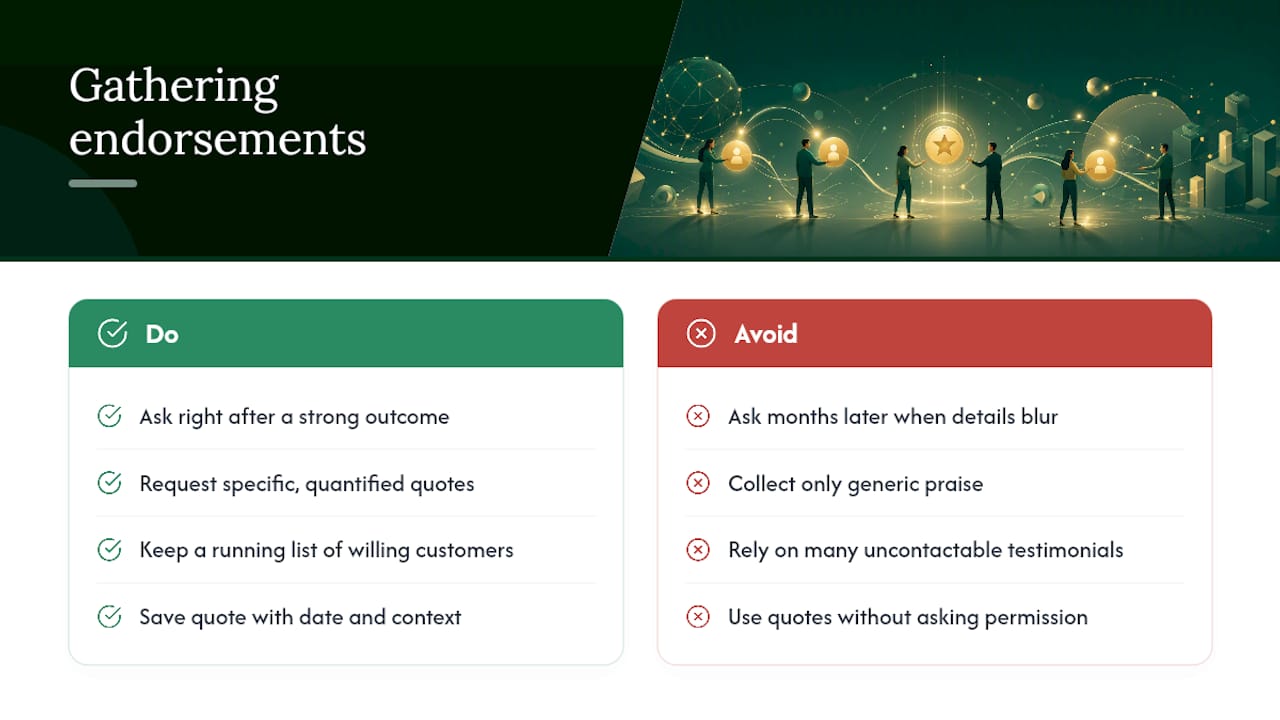
Ask happy customers for a specific, quantified quote right after a strong outcome, not months later when the details have blurred. “This tool cut our onboarding time in half” is usable. “We love this product” is not, no matter how sincere it sounds. Time the ask to a natural high point: right after a renewal, a positive support interaction, or a case study call.
Keep a running list of customers willing to be quoted, screenshotted, or called by a journalist or judge if needed. Not every award requires a live reference, but some judging panels do call customers directly, and having two or three who’ll pick up the phone and say something specific is worth more than a dozen generic testimonials sitting in a spreadsheet.
Investors and advisors count too. A short line from a board member or a well-known angel about your execution can round out a founder-focused category entry, especially at the pre-seed and seed stages where you may not have deep customer data yet. Ask for permission to use any quote in an awards context specifically. Some people are fine with a LinkedIn recommendation but not comfortable being quoted in a press-facing submission, and it’s worth knowing the difference before you submit.
Store every quote, with the date and context, in the evidence library alongside your metrics. A testimonial without context ages badly. One tied to a specific number and date stays usable for years.
Common Pitfalls and Mistakes to Avoid When Applying for Startup Awards
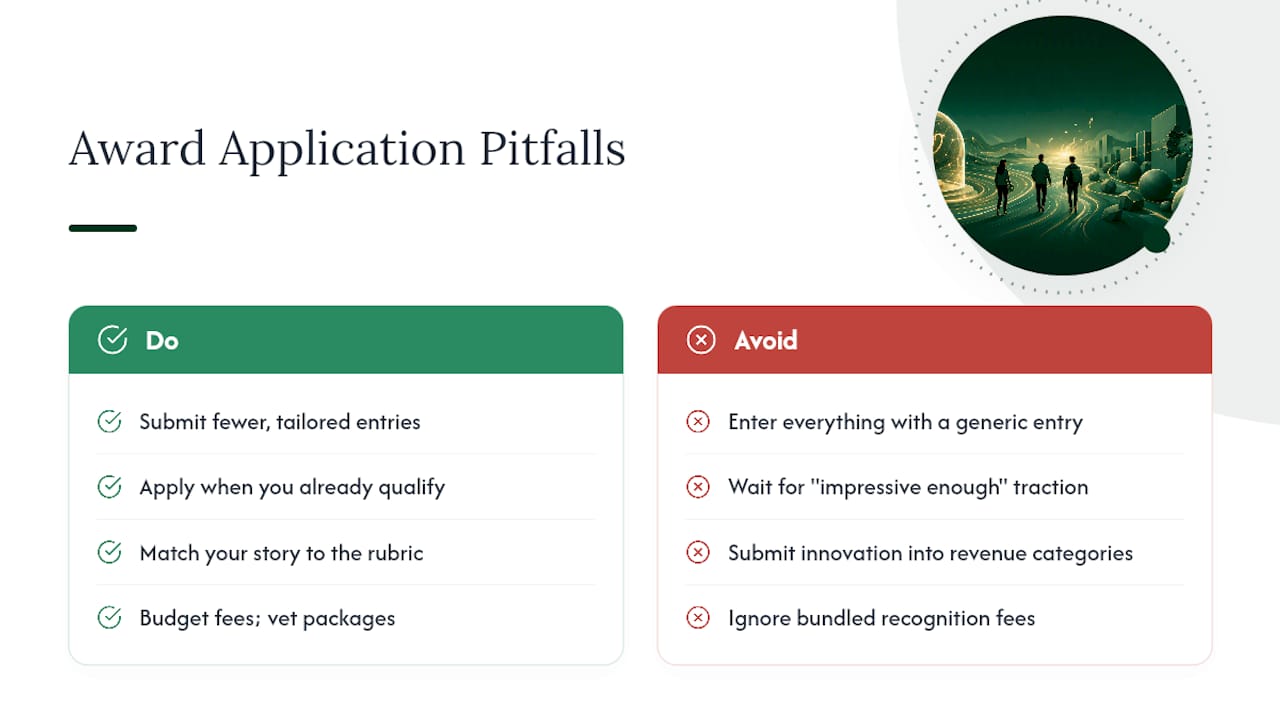
The most expensive mistake is entering everything. Founders who apply to fifteen awards a year with a generic, unedited entry usually win fewer than founders who apply to five with a tailored one. Judges can tell when a submission was copy-pasted from a different category.
A second common error: waiting until the traction is “impressive enough.” There’s no such threshold. Early-stage categories exist precisely because judges expect early-stage numbers. Waiting a year to apply to a founder-profile award you already qualified for just means a competitor claims that recognition first.
Missing the narrative-to-category match is another frequent failure. An entry built around “innovation” submitted to a category scored on “revenue growth” wastes strong material on the wrong judging rubric. Read the category description twice before you start writing.
Fee blindness catches founders off guard too. Some programs bundle a “recognition package” with the entry fee that inflates cost well beyond what the credibility is worth. Budget for entry fees the same way you’d budget for any other marketing spend, and walk away from anything that feels more like a sales funnel than a judging process.
Finally, founders often skip the post-win plan entirely, assuming the award will “speak for itself.” It won’t, unless someone repackages it into a press mention, a sales asset, and an investor update within the first week.
Strategies for Leveraging Nominations Even If You Don’t Win
A shortlist or finalist placement is still usable, and treating it as a loss wastes real material. Most award programs let finalists use “Finalist” or “Shortlisted” language and badges, which still functions as third-party validation even without the top spot.
Announce the nomination the same way you’d announce a win, just calibrated: a shorter social post, a line in your next investor update, a mention in your sales deck’s credibility section. “Named finalist for [category] alongside [recognizable peer companies]” carries weight, especially if the shortlist includes companies your prospects already know.
Ask for judge feedback if the program offers it. Judges’ comments are one of the few unbiased external reviews a startup gets, and applying that feedback to your next entry, or to your actual product positioning, often matters more than the trophy would have.
Reapply the following year with the gaps addressed. A judge’s note about weak evidence in your customer-impact section is a roadmap, not a rejection. Programs that run annually often see repeat entrants win once they’ve closed the specific gap that held them back the first time.
Don’t let a non-win stop you from entering the next relevant award on your calendar. One rejection says nothing about how a different panel, with different judges and a different rubric, will read the same evidence.
The Storyline Pros Take on Awards as Visibility Infrastructure
Awards matter to us because they generate exactly what AI search systems and investors both reward: verifiable, third-party mentions tied to a specific claim. An AI model summarizing “best startups in [category]” pulls from citable, structured mentions, and a well-covered award placement is precisely that kind of citation. Most founders treat the trophy as the finish line. We treat it as raw material for a broader visibility campaign, feeding the same earned-media and AI-citation infrastructure that turns one mention into a dozen.
If you want help turning a shortlist or win into a real distribution plan, Storyline Pros builds that layer for high-growth startups aiming to become the answer AI search engines actually recommend.
Sources
For calendar planning and cost-per-mention logic, see PressVerified’s awards calendar. For fundraising mechanics, First Unicorn Startup’s analysis is worth a read. For legitimacy checks on industry lists, InstantPress’s guide covers verification standards, and Stevie Awards’ blog explains judge expectations directly.
- How Startup Awards Actually Help Fundraising — And When They’re a Waste of Time | First Unicorn Startup
- How business awards can earn recognition that truly matters — Stevie Awards blog
FAQ
Is a startup awards strategy actually worth the time investment?
Yes, when you select two to three stage-matched programs a quarter and pair each entry with a real activation plan. Random, high-volume applications waste far more time than a focused calendar.
How many startup awards should a founder apply to per year?
Most operational playbooks recommend one to two entries per month rather than clustering everything into December and January, which keeps quality high without overwhelming a small team.
How do I know if an award is a pay-to-play scheme?
Check whether the organizer publishes judging criteria and judges’ names. A program pushing a “guaranteed win” package or bundling a pricey “recognition package” with the entry fee is a warning sign.
What should I do if I’m a finalist but don’t win?
Use the finalist or shortlist status the same way you’d use a win, just calibrated in tone, and request judge feedback if it’s offered so you can strengthen your next application.
How do I measure the ROI of an award application?
Multiply the expected benefit, press value, investor interest, and hiring credibility, by your realistic win probability, then subtract the real cost in hours and fees. Track media mentions, investor meetings, hires, and backlinks afterward to see what it actually delivered.