

Founders: Make a GEO Ready Startup Funding Announcement AI Will Cite
A startup funding announcement earns its place in AI search results when it’s built to be extracted, not just read. The first 75–100 words need to carry five facts: the amount raised, the round stage, the lead investor, what the money buys, and one real traction number.
TL;DR:
- Funding announcements should clearly state the amount raised, round stage, lead investor, use of capital, and a verifiable traction metric within the first 75–100 words.
- Distributing the announcement effectively requires publishing on your own site first, briefing embargoed reporters, and then activating owned channels like LinkedIn and company blogs.
- Adding structured data with schema markup and ensuring entity name consistency across all profiles significantly improves AI engines’ ability to cite your release correctly.
- Legal compliance means never disclose investor names, amounts, or valuation details without explicit approval and avoiding premature or inflated announcements if funding shortfalls occur.
- Tailor your messaging for seed versus later rounds, emphasizing founder vision early for seed and concrete metrics for Series A and beyond to match industry expectations.
Table of Contents
- What Makes a Startup Funding Announcement Work for Reporters and AI
- When Should You Send a Funding Announcement Under Embargo?
- How Should You Distribute a Funding Announcement for Maximum Reach?
- Does Structured Data Actually Help AI Engines Cite Your Announcement?
- The 90-Minute Playbook for Getting Everything Ready Before Embargo
- How Do You Know If Your Announcement Actually Got Cited?
- Legal and Regulatory Compliance Considerations in Startup Funding Announcements
- Best Practices for Handling Sensitive Information and Investor Confidentiality
- How Should the Announcement Change Between a Seed Round and a Series A or Later?
- What Do You Do If the Funding Round Fell Short of Your Target?
- Common Pitfalls in Startup Funding Announcements and How to Avoid Them
- How Storylinepros Builds Announcements That Get Cited
- Get Your Funding Announcement Built to Earn Media and AI Citations
- What to Do in the Next 72 Hours
- Sources
What Makes a Startup Funding Announcement Work for Reporters and AI
A funding announcement lives or dies in its first paragraph. Reporters skim it in seconds; AI engines often lift that paragraph wholesale as a summary, which means generative engines rely heavily on the first 75 to 100 words to decide what a release is about and whether to cite it at all.
Start with the headline. Keep it under 90 characters and pack in the company name, the funding round, and the round stage: “Acme Robotics Raises Series A Led by Northlight Ventures.” Skip adjectives like “revolutionary” or “game-changing.” A machine doesn’t parse enthusiasm; it parses nouns and numbers.
The sub-headline does secondary work. Use it to name the lead investor if the headline didn’t, or to surface a metric the headline couldn’t fit: “Funding will accelerate expansion into multiple new markets after strong year-over-year growth.”
Then comes the lede itself, built around who, what, when, and why, plus one number a reporter could verify. Reporters and AI engines both scan for five specific facts first: amount, round label, lead investor, post-money valuation if you’re disclosing it, and what the capital funds.
Order the paragraphs that follow like this:
- The lede paragraph with the five core facts.
- A proof paragraph with the founder quote and a growth metric.
- A problem/solution paragraph in one or two sentences, no origin story.
- A use-of-funds paragraph naming two or three concrete initiatives.
- A boilerplate paragraph with company description and press contact.
Avoid these common lede mistakes:
- Leading with the founding story instead of the round.
- Using “significant funding” instead of an actual dollar figure.
- Burying the lead investor’s name in paragraph three.
- Writing a headline that reads like a mission statement.
When Should You Send a Funding Announcement Under Embargo?
A 48 to 72 hour embargo window gives reporters enough lead time to write a real story instead of a rewrite of your release. Brief two to four target reporters directly during that window, under embargo, rather than blasting the release to a long list before it’s public.
Tuesday through Thursday mornings, Eastern time, tend to pull the strongest pickup, since Mondays get buried under weekend catch-up and Fridays lose readers to the week’s wind-down. Check TechCrunch, Axios Pro Rata, and major sector newsletters for competing raises before you lock a date.
Set a hard deadline for investor quote approval, ideally 24 hours before the embargo lifts. If the lead investor can’t sign off in time, ship the release without the quote rather than miss the news cycle, then publish a corrected version later that links back to the original.
Pro Tip: Build your embargo list around reporters who’ve covered your sector or your lead investor before. A cold pitch to a generalist desk almost always underperforms a warm pitch to someone who already knows the space.

How Should You Distribute a Funding Announcement for Maximum Reach?
Distribution works in layers, and the order matters more than most founders assume.
- Publish first on your own newsroom page and make that URL canonical. Every wire copy, syndicated post, or partner mention should canonicalize back to it.
- Brief your embargoed reporters directly, timed to publish the moment the embargo lifts.
- Activate owned channels the same morning: founder LinkedIn post, company blog, investor shares.
- Consider a wire service only if broad reach matters more than exclusivity, and confirm the wire will canonicalize to your newsroom rather than becoming the source of record itself.
For owned amplification, have your founder post to LinkedIn personally, since founder posts routinely outperform the company account on engagement. Pre-write two or three social snippets for your team and investors so they can share within minutes, not hours.
Targeted outreach beats a broad wire blast for a seed round with a niche story; a wire makes more sense for a Series B or C with wide market relevance. Whichever you choose, keep the company name, investor names, and round terminology identical across every version so AI engines don’t fragment your entity across slightly different mentions.
Does Structured Data Actually Help AI Engines Cite Your Announcement?
Yes, and it’s one of the few technical levers a founder can control directly. Adding PressRelease schema markup to your newsroom page gives generative engines an explicit signal about what the content is, when it published, and who’s behind it.
A minimal JSON-LD block should include:
headline: matching your on-page headline exactly.datePublished: the exact publish timestamp.authorandpublisher: your company as a legal entity, consistently named.about: the funding event, withsameAslinks to the lead investor’s official page or Crunchbase profile.
Canonical newsroom URLs that wire copies link back to meaningfully improve the odds an AI engine attributes the citation to your domain instead of a syndicated copy.
Entity consistency matters as much as the schema itself. Use the identical legal company name, spelled the same way, across the release, your newsroom, your LinkedIn page, and your Crunchbase listing. Inconsistent entity signals across web profiles measurably reduce citation probability, because the engine can’t confirm it’s looking at the same company twice.
| Formatting cue | Why it helps AI extraction |
|---|---|
| Labeled quotes (“Jane Doe, CEO, said:”) | Clarifies attribution for summarization |
| Short paragraphs (2–4 sentences) | Easier for models to lift cleanly |
| Explicit numeric metrics | Avoids ambiguous paraphrasing |
| Consistent entity names | Prevents fragmented citations |
The 90-Minute Playbook for Getting Everything Ready Before Embargo
Most last-minute release errors come from skipping steps under deadline pressure, not from bad writing. A 90-minute playbook broken into five 15-minute blocks keeps the process tight and repeatable.
- Lock the five core facts and draft the headline plus lede (15 minutes).
- Collect and finalize both quotes, founder and lead investor (15 minutes).
- Build the one-pager: hook, financials, product demo link, press contact (15 minutes).
- Assemble the media kit: logo files, founder headshots, product screenshots (15 minutes).
- Confirm the outreach list, embargo terms, and publish schedule (15 minutes).
Your one-pager needs a clear structure: a one-line hook at the top, the five core facts in a short block, a link to a product demo or screenshot, and a direct press contact with a phone number, not just a general inbox.
Set approval deadlines for every stakeholder at least a day before embargo, including legal review if your cap table has any disclosure sensitivities.
How Do You Know If Your Announcement Actually Got Cited?
Two weeks after publishing, run a set of target prompts across ChatGPT, Perplexity, and Claude, asking about your company, your round, or your sector, and check whether your canonical newsroom page shows up in the response.
Track pickup quality alongside citation presence:
- Do outlet articles link back to your canonical URL, or just mention the round?
- Do founder and investor quotes appear verbatim, or are they paraphrased incorrectly?
- Are the amount and round stage consistent across every outlet that covered it?
If your canonical page isn’t showing up, the fix usually isn’t a new release. Update your existing structured data, republish the corrected canonical version, and pursue a corroborating mention on a partner site or podcast to reinforce the entity signal.
Citation Share, the measured rate at which your canonical source appears in AI-generated answers about your company, is the metric that matters most here. A release that gets covered by five outlets but cited by zero AI engines hasn’t done its job for long-term visibility.
Legal and Regulatory Compliance Considerations in Startup Funding Announcements
A funding announcement is a public statement, and securities law treats it that way. In the United States, Regulation D governs private placements, and general solicitation rules under Rule 506© restrict how openly you can promote a raise if you’re using that exemption, particularly around accredited investor claims.
Never state investor names or amounts you haven’t received explicit written approval to publish. Term sheets and side letters often carry confidentiality clauses that outlast the round itself, and an eager press release can breach them without anyone noticing until a lawyer flags it weeks later.
Valuation disclosure deserves particular care. Announcing a post-money valuation publicly can trigger disclosure expectations in future rounds or create a benchmark that complicates a later down round narrative. Many companies choose to announce the amount raised and the round stage while leaving valuation undisclosed, and that’s a legitimate, common choice, not a red flag to reporters.
If your company operates internationally, check whether the jurisdiction of your investors imposes its own disclosure rules. The rules governing a UK or EU based investor’s public statements can differ from US securities law.
Route every draft through counsel before embargo, not after. A 24 hour legal review window built into your prelaunch schedule costs far less than an amended release explaining a compliance misstep.
Best Practices for Handling Sensitive Information and Investor Confidentiality
Not every detail belongs in a press release, and the discipline to leave things out is as important as the discipline to include the right five facts. Cap table structure, individual check sizes within a round, and side agreements with specific investors should stay out of any public document.
Before drafting begins, circulate a short document to every investor participating in the round asking explicitly what they’re comfortable having named. Some investors, particularly institutional lead investors, want their name front and center as social proof. Others, especially smaller angels or strategic investors with competing portfolio companies, may prefer to stay unnamed or be described only as “existing investors.”
Get quote approval in writing, not over a phone call. A quote that seemed fine verbally can read differently once it’s permanently attached to your company’s public record and picked up by AI engines that don’t distinguish between an approved final quote and an early draft.
Treat any pre-announcement data, including revenue figures or customer counts shared during due diligence, as confidential until you’ve explicitly cleared it for the release. It’s common for a number discussed casually in a board meeting to end up in a draft release before anyone confirms it’s fit for public consumption.
Pro Tip: Keep a single source-of-truth document listing exactly what’s approved for public disclosure, and require every version of the release to be checked against it before it goes out.
How Should the Announcement Change Between a Seed Round and a Series A or Later?
A seed round announcement and a Series A announcement are different documents, not just different numbers plugged into the same template.
Seed announcements often lead with the problem and the founder’s conviction, because there’s rarely a large traction metric to lean on yet. A seed lede might read: “Acme Robotics raised $2 million in seed funding led by First Round Capital to build the first warehouse automation platform designed specifically for mid-size logistics operators.” The use-of-funds paragraph carries more weight here since there’s no growth curve to point to.
Series A and beyond announcements should lead harder with metrics. By this stage you likely have revenue growth, customer counts, or retention numbers worth naming, and the five-fact lead should include at least one of them explicitly. A vague seed-stage phrase like “early customer interest” won’t cut it at Series A; reporters and AI engines alike expect a number.
Later rounds, Series B and beyond, often shift the story from “does this work” to “how big can this get.” Expansion plans, new market entry, and headcount growth become more central than the original problem statement, since by this point the market has usually already validated the premise.
Lead investor selection also shifts in prominence. A seed round might name an angel or a small fund; by Series A and later, the lead investor’s reputation often does real work as third-party validation, which is exactly why the investor quote functions as social proof that AI engines treat as third-party corroboration.
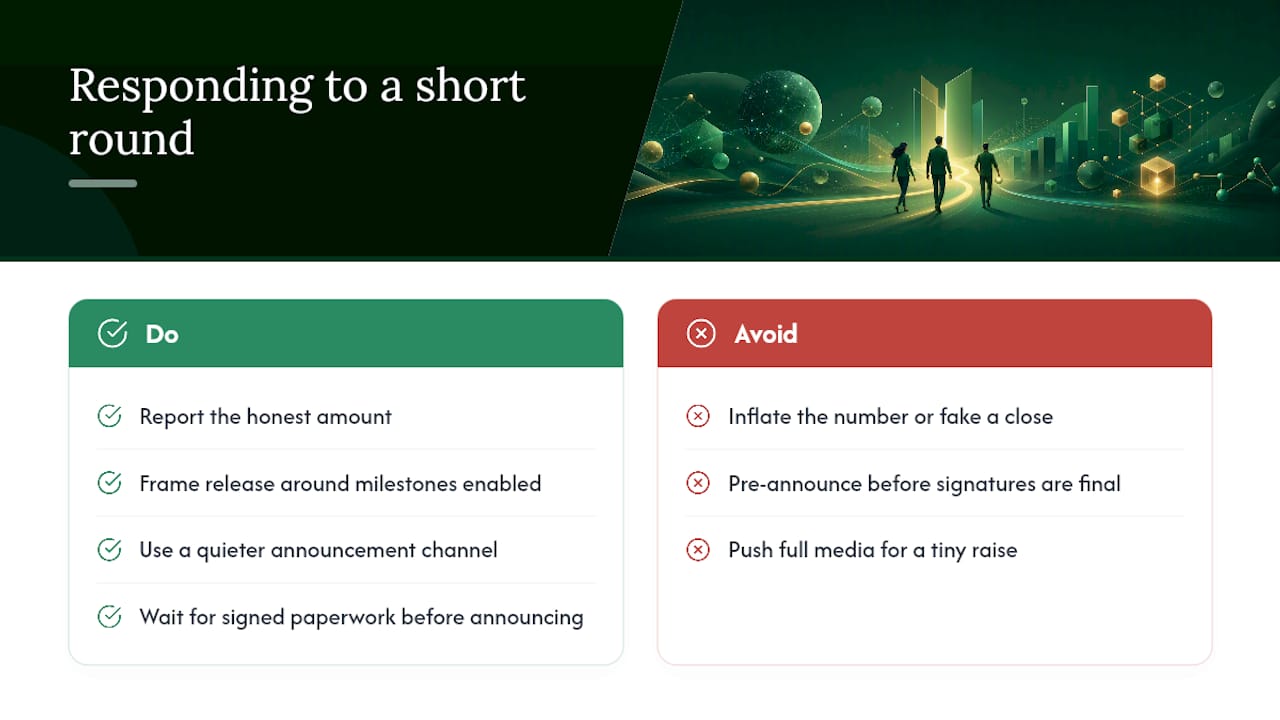
What Do You Do If the Funding Round Fell Short of Your Target?
Not every round closes at the number a founder originally set out to raise, and how you handle that gap in public matters more than most founders expect.
The instinct to inflate the number or announce a “final close” that quietly omits a lower total than planned almost always backfires. Reporters compare notes, investors talk to each other, and a discrepancy between what you announced and what later shows up in your cap table or a future round’s materials damages credibility far more than an honest smaller number would have.
If the round closed below target, consider framing around what the capital actually enables rather than the gap itself. A $4 million raise against an original $6 million target is still real capital that funds real milestones. Center the release on those milestones instead of comparing the outcome to an unannounced internal goal nobody outside the company knew about.
Silence is also a legitimate option. Not every round needs a press release. If the amount raised is genuinely too small to generate credible coverage, a quieter approach, a LinkedIn post from the founder rather than a full media push, can avoid inviting scrutiny of the shortfall without technically hiding anything.
If a round falls apart entirely after initial signals of interest, avoid pre-announcing before signatures are final. The most common self-inflicted crisis in this category is a founder who tells press or posts publicly about a round “closing soon,” only to have the lead investor pull out. Wait for signed paperwork before any public statement, always.
Common Pitfalls in Startup Funding Announcements and How to Avoid Them
The most frequent mistake is burying the five core facts under a founder narrative. A release that opens with three paragraphs about the company’s origin story before mentioning the amount raised loses both reporters and AI engines, both of which scan the opening lines for extractable facts.
Vague superlatives are the second most common problem. Phrases like “significant funding” or “explosive growth” tell a reader nothing verifiable. Concrete numbers and specific quotes materially improve both editorial pickup and AI citation chances compared to generic enthusiasm.
Generic investor quotes rank close behind. A quote that just says “we’re excited to back this team” wastes the strongest piece of third-party corroboration in the entire release. Push your lead investor for a sentence that explains the actual reason they invested, tied to a market trend or a specific traction point.
Inconsistent entity naming across the release, the newsroom, and social channels quietly undermines AI citation even when the content itself is strong. If your company name appears one way in the release and slightly differently on LinkedIn, you’ve fragmented the signal an engine needs to confirm it’s the same entity.
Finally, treating the release as a one-time event rather than a linked asset limits its long-term value. A release that stands alone, with no connected explainer or founder Q&A, has less staying power as a citation source than one built as part of a small, cross-linked content cluster.
How Storylinepros Builds Announcements That Get Cited
Most PR agencies optimize for a single day of coverage. Storylinepros optimizes for the citation that outlives it. The approach starts from the same GEO principles covered above, structured facts, entity consistency, schema, and clustered content, then applies a proprietary tracking layer that measures actual Citation Share across major AI engines rather than guessing based on media logo counts.
That data-driven model is also why Storylinepros works on a success-based structure instead of a flat retainer: outcomes are measurable, so clients pay for delivered placements rather than agency hours. A pilot campaign typically starts with an entity audit and a single flagship announcement, with a documented citation check before scaling further.
— Nik
Get Your Funding Announcement Built to Earn Media and AI Citations
Everything above works better with someone who runs this playbook full time. Storylinepros is the alternative to a retainer PR firm for founders who need a funding announcement that actually shows up when someone asks an AI engine about their space, not just a press release that disappears after one news cycle.

Storylinepros builds each announcement around the same structured, entity-clear approach covered in this guide, then tracks whether it actually gets cited across ChatGPT, Perplexity, and Claude instead of stopping at a media hits report. Engagements run as pilots, single-project campaigns, or ongoing monthly work, priced against delivered placements rather than billed hours, so the incentive stays aligned with getting your round in front of investors and customers who search before they ever talk to your team.
If you’re preparing a raise and want the release built right the first time, start with Storylinepros and review the documented client outcomes before your embargo clock starts running.
What to Do in the Next 72 Hours
Draft your headline and 75 to 100 word lead first, before anything else, using the five-fact structure covered above.
- Lock your canonical newsroom URL and confirm your one-pager is ready for outreach.
- Get written investor quote approval, with a fallback plan if it doesn’t land in time.
- Finalize your embargo list of two to four target reporters.
- Schedule your Citation Share check for two weeks after publish.
| Task | Deadline | Owner |
|---|---|---|
| Headline and lead draft | Day 1 | Founder |
| Investor quote approval | 24 hours before embargo | Lead investor |
| Canonical newsroom live | Before outreach begins | Founder/agency |
| Citation Share audit | 2 weeks post-launch | Agency |
Sources
- AI Press Release Optimization: Optimize Press Releases for GEO
- How to announce a startup funding round: the headline formula, the five facts reporters look for, quotes that work, and when to send under embargo.
- GEO for Funding Announcements: Turn a Raise Into AI Citations
- A Founder’s 90-Minute Playbook for Funding Announcements That Both Newsrooms and AI Engines Cite · Prfect Blog