
Guide
How Storyline Pros works
Storyline Pros runs a clear loop for high-growth tech companies that need both newsroom coverage and a seat in AI answers. Understand the milestone. Map the claims. Measure the gap. Place the story where buyers and models already look. Measure again.
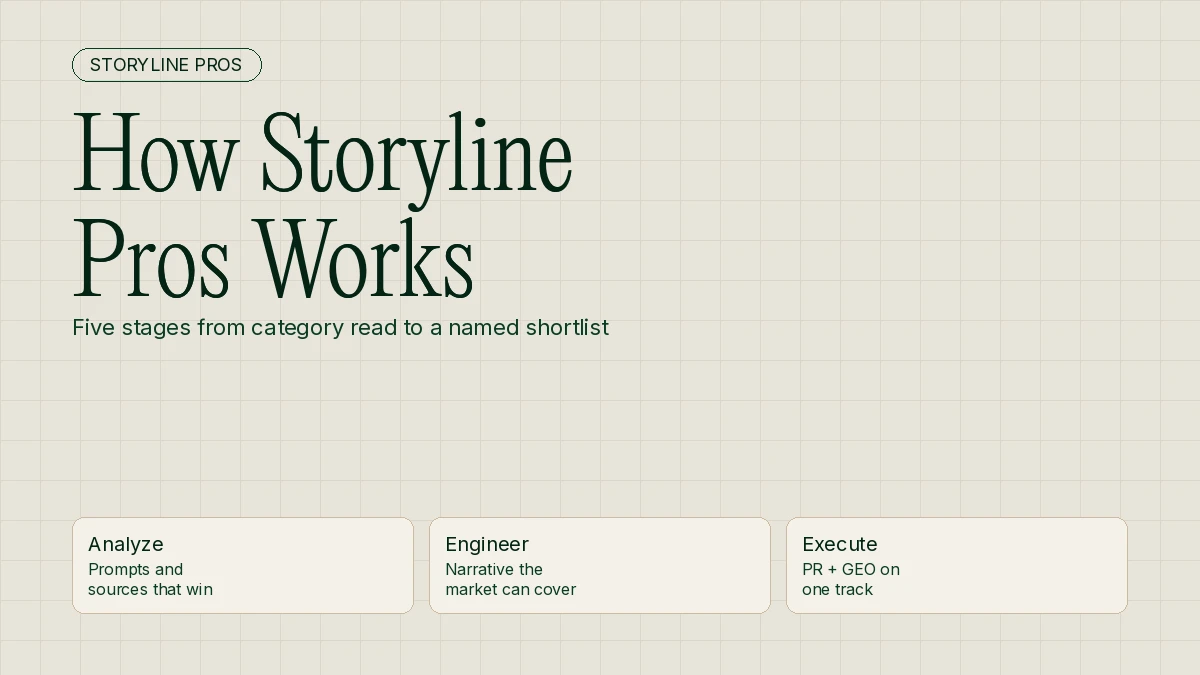
This Guide is the operating sequence. Soft commercial detail stays on the strategy session. Dollar amounts for packages are never published here.
Storyline Pros is a narrative engineering and AI visibility firm. Founders and process live on About. Journalists start at Media.
Why the sequence matters
Many teams reverse the order. They pitch first, then invent claims that match whatever landed. Or they rewrite the homepage, then wonder why ChatGPT still shortlists someone with denser third-party proof.
The five-stage spine exists so every placement has a job before it ships, and so measurement judges the same prompts before and after. Activity without that spine can look busy. It rarely moves the answers that start meetings.
The five-stage process
Every engagement that fits follows the same spine. Scope and channel weight change with the milestone. The order does not.
Stage 1. Strategy session and category fit
Book a 30-minute strategy session. We look at category, product maturity, and the milestone (launch, raise, category push, or similar). We ask whether the technology can survive scrutiny and whether a public record can actually be built.
If the answer is no, we say so. We take a limited number of companies each quarter. Fit questions also live on FAQ. For a firm definition before you book, read What is Storyline Pros?.
The session is not a free media plan. It is a fit gate. Bring the prompts buyers already ask, the milestone on the calendar, and honesty about what you can prove.
Stage 2. Narrative Map
We draft the claims you should own, tied to buyer questions people already ask AI. Priority prompts. Proof each claim needs. Channels that can carry that proof. Claims you will not make.
The Narrative Map becomes the brief for every placement. A feature that establishes category leadership. A podcast transcript that explains the mechanism. A listicle that puts you in a shortlist query. A community thread that corrects a false comparison. Without the map, teams spray announcements and hope. With the map, ChatGPT and peer systems have a coherent story to retrieve.
More on the practice: What is a narrative engineering firm and Narrative engineering for startups.
Stage 3. GEOview baseline
Before heavy pitching, GEOview AI Visibility Technology snapshots how ChatGPT, Perplexity, Claude, and Google AI already describe your category. Prompt-level visibility. Share of answer. Competitor positions.
GEOview is technology for audit and tracking. It is not an engine you switch on. We do not invent a citation percent. That baseline is what later work is judged against. If you already appear on the prompts that matter, the program looks different from a cold start.
Stage 4. Dual-track execution
Execution runs on two tracks at once. Both draw from the same Narrative Map.
Track A is media and third-party proof. Earned media, news syndication, podcasts, community amplification, listicles and reports. Journalists, producers, editors, and community spaces remain central to the public record. Cynthia's media relations work sits in that tradition. We still embargo when asked, still fact-check, still decline weak exclusives. How press works with us: Media.
Track B is GEO and on-site clarity. Schema, entity pages, FAQs, llms.txt, and other assets that help models parse your own domain. On-page work matters. It does not mint the third-party citations that put you in a shortlist when the buyer never visits first.
Together the tracks feed a six-channel ecosystem: earned media, news syndication, podcasts, community, listicles and reports, plus GEOview-informed on-site assets. Not every engagement runs every channel at full weight. Scope follows the milestone and the gaps the baseline showed. Channel detail: Services. ChatGPT-first path: Get cited by ChatGPT. Broader founder playbook: How to get recommended by AI.
Stage 5. Completed placements, make-good, and re-measurement
Fees attach to work that landed. If a scoped placement misses its window, you choose the make-good: keep pitching at no extra cost, take a credit, or pause billing on that item until it completes. You are not funding quiet retainers.
After placements ship, GEOview re-reads the same prompts. Monthly packages keep the narrative moving. Focused pilots prove the motion first. We adjust channels when answers move, or when they do not. Progress is what the answer prints.
Dual-track execution in practice
Teams often ask whether they should hire PR first and add GEO later, or buy on-page GEO and hope press follows. Dual-track means neither waits for the other.
Media placements create the URLs and transcripts models already know how to weigh. On-site GEO makes your own claims machine-readable. GEOview ties both to named prompts. If Track A ships without Track B, models may see coverage but struggle to reconcile your site. If Track B ships without Track A, you have a polished brochure while the shortlist still names competitors with denser third-party proof.
The weekly rhythm is simple. Map jobs. Pitch and produce against those jobs. Log completed placements. Re-check priority prompts. Report delivery against the floor you scoped. That is the operating loop, not a content calendar dressed as AI strategy.
Founder access matters on both tracks. Track A needs spokespeople who can survive an editor's follow-up questions. Track B needs someone who can approve claim language on entity pages and FAQs without watering the Narrative Map into marketing mush. We stay clear on who pitches what so journalists are not double-touched when you also have an in-house team.
What GEOview measurement looks like
Three views matter most.
Prompt-level visibility. Does this buyer question name you.
Share of answer. How often you appear across the prompts that matter.
Competitor positions. Who else already sits in those shortlists.
We set those views at baseline, ship work, then re-read. Models refresh from the public record at different speeds. Some categories shift after strong third-party coverage. Others need a denser footprint. We measure. We do not publish a fixed calendar for when a model will change an answer. Product page: GEOview. Related framing for startups owning the GEO noun: GEO for startups.
Re-measurement uses the same prompt list whenever possible. Adding new prompts mid-flight is fine when the milestone changes. Changing the list every week so the report looks better is not how we work.
What you will not see
Logo walls of unapproved clients. Guaranteed model outputs. Vendor name-drops as the product. A standalone team page (founders live on About). Public package dollar amounts.
We also will not sell you a retainer that bills whether or not placements land. We do not promise ChatGPT will print a specific name. FAQ states the same limit.
Who this process is for
High-growth tech with a real product and a story still missing from the sources models cite. Emerging-tech founders in AI, biotech, fintech, cleantech, and adjacent B2B are the usual fit. Minimum stage, exclusivity, and international fit sit on FAQ.
If you only need a single announcement executed by a team that already owns AI visibility elsewhere, a focused PR partner can be right. If buyers already ask AI before they visit you, and you are missing from those answers, press alone usually under-delivers. Compare the jobs on Narrative engineering vs PR. Buyer checklist for the hire: Hire an agency for AI answers. Honest noun for "AI SEO" RFPs: AI SEO agency.
Soft CTA
Ready to walk the loop on your category? Book a strategy session.
Prefer to read first: AI visibility agency playbook, Resources, FAQ, Media, GEOview.