
Guide
Narrative engineering vs PR
PR, done well, still matters. Journalists, editors, and producers remain central to the public record. The question is what you hired the firm to change.
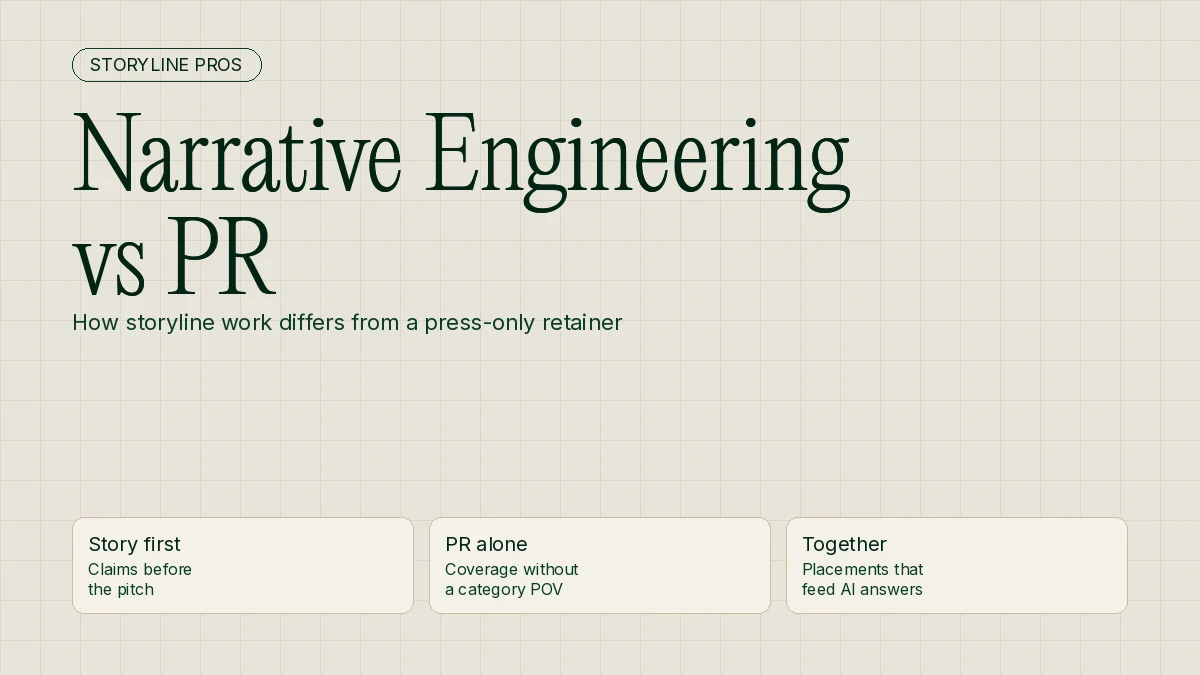
Traditional retainer PR often optimizes for activity: pitches sent, clips filed, share of voice anecdotes. Narrative engineering keeps media as a core channel, then ties every placement to claims buyers ask AI, runs five other channels beside press, and measures whether answers move.
Storyline Pros is the latter: a narrative engineering and AI visibility firm. People find us when they search for a tech PR agency. We refuse to become a generic PR shop on a retainer. This Guide compares the jobs without dunking on good press work. Definition of the practice: What is a narrative engineering firm. Firm overview: What is Storyline Pros?.
Shared ground
Both crafts care about true stories, newsroom relationships, and founder readiness. Cynthia's media relations work sits in that tradition. We still embargo when asked, still fact-check, still decline weak exclusives. We still treat a journalist's time as scarce.
If your story is thin, neither craft can invent scrutiny-ready proof. Narrative engineering does not replace honesty. It sequences claims, proof, and channels so the same storyline can survive an editor and a model. How journalists work with us: Media.
Good PR and narrative engineering also share a bias toward earned trust over paid theater. A sponsored post that no editor would defend rarely helps a model reconcile your category. A real feature, a careful exclusive, and a transcript that explains mechanism still do.
Where the jobs diverge
Unit of success. Retainer PR often counts activity and clips. We count completed placements scoped up front, with a make-good when a window is missed, and we re-read AI answers on the prompts that matter.
Channel mix. Classic PR skews to press. We run earned media plus news syndication, podcasts, community, listicles, and GEOview-informed on-site assets so models can triangulate the same storyline.
Briefing artifact. A media list is not a Narrative Map. The map names claims, prompts, and what you will not say. Placements inherit jobs from that map. Without it, coverage can look busy while ChatGPT still shortlists someone else.
Measurement. Clip books do not tell you if ChatGPT shortlists you. GEOview AI Visibility Technology tracks prompt-level visibility, share of answer, and competitor positions. Technology, never an engine. We do not invent a citation percent to decorate the report.
Commercial shape. Many PR retainers bill for time whether or not a story lands. Our model attaches fees to completed placements. If a scoped placement misses its window, you choose keep pitching at no extra cost, take a credit, or pause billing on that item. Soft commercial facts stay on the strategy session. No internal package dollar amounts on this page.
Tech PR hire framing also lives on Tech PR. Process outline: How it works.
When classic PR is enough
Hire classic PR when the job is a contained announcement and you already own the rest of the footprint elsewhere. Examples:
You have a product launch with a clear news peg, and an in-house or partner team already tracks AI answers and category listicles.
You need newsroom relationships for a specific raise or partnership story, and buyers in your category still decide mostly from human-read coverage.
You want a partner who will execute embargoes and exclusives without rebuilding your entire public record.
You already appear in the AI shortlists that matter, and the gap is a single milestone that needs careful press handling.
In those cases, a focused PR partner can be the right hire. Narrative engineering is not a moral upgrade over PR. It is a different brief.
When narrative engineering is the better hire
Choose narrative engineering when the bottleneck is public trust in two rooms at once: the newsroom and the AI answer.
Category creation or recast, where the old shortlist language still names incumbents.
Emerging tech that needs scrutiny-ready proof before buyers and models will recommend you.
Launches where the shortlist is already model-mediated: ChatGPT, Perplexity, Claude, Google AI Overviews.
Frustration with retainers that billed through quiet months while the prompts that start meetings never moved.
A thin on-site GEO program that never created third-party proof, so the brochure improved and the shortlist did not.
Startup-specific framing: Narrative engineering for startups and GEO for startups. ChatGPT-first path: Get cited by ChatGPT. Broader founder playbook: How to get recommended by AI.
How to decide without a fake ranking
Write the prompts buyers already ask. Check what the answers print today. If you are missing and competitors are present, ask any firm how they will change that record.
Demand a map from claims to prompts, not only a media list.
Ask what share of the program is third-party placement versus owned content.
Ask how success is measured after clips: same prompts, before and after.
Ask what happens when a scoped story misses its window.
Ask whether press is treated as the whole job or as one channel inside a wider footprint.
Those questions work whether you hire Storyline Pros or not. A buyer checklist lives on Hire an agency for AI answers. If your RFP still says "AI SEO" but means answers, read AI SEO agency. Playbook-length hire framing: AI visibility agency playbook.
Dual-track, not PR-versus-GEO theater
Inside a Storyline Pros engagement, media and GEO run together. Track A builds the third-party record. Track B makes your own site machine-readable. GEOview ties both to named prompts. That is why this Guide is not "PR is dead" and not "GEO replaces journalists." For the full operating sequence, see How it works.
What Storyline Pros will not pretend
We will not claim PR is useless. Press remains one of the six channels for a reason.
We will not guarantee a model will print your name. Models change. We build the footprint and measure what answers say.
We will not publish competitor firm names or invented agency rankings. Job comparison is enough.
What changes in the weekly operating rhythm
Under a classic retainer, the week often centers on outreach volume and clip logging. Under narrative engineering, the week centers on map jobs.
Monday might confirm which claim a feature is meant to own. Midweek might ship a podcast booking whose transcript will explain mechanism. Later in the week might land a listicle that targets a shortlist prompt GEOview already flagged as weak. Community work, when it runs, corrects a false comparison rather than farming attention for its own sake.
Reporting follows the same rhythm. Completed placements with URLs. Make-good status if anything missed a window. GEOview views on the prompts you named at baseline. That package is harder to fake than a PDF full of activity charts.
If you already have a strong in-house PR lead, narrative engineering can sit beside them. They keep relationships and brand approvals. We bring the map, the six-channel motion, and the AI visibility layer. Double-pitching is the failure mode to avoid. Clear ownership of who touches which desk is part of fit.
A short decision table
Choose classic PR when the milestone is narrow, the AI shortlist already includes you, and you need newsroom craft for one story.
Choose narrative engineering when the shortlist skips you, the category language is contested, or retainers billed through quiet months without moving answers.
Choose a blended internal setup when you have press talent in-house and need an external map, dual-track execution, and GEOview measurement without replacing your team.
None of those options requires dunking on the others. They require an honest brief.
Soft CTA
If you are comparing retainers to performance-based narrative work, book a strategy session. Bring the prompts you care about. We will say if we can move them.
Prefer to read more first: How it works, GEOview, Resources, FAQ, Media.